2/3rd glacier collapsed, plunged 1.2km before 'liquid concrete' swamped Nepal
What's the story
The devastating flash flood that swept through the Nepal-Tibet border region on Wednesday, killing almost 500 people so far, was triggered by a dramatic glacier collapse. Reportedly, nearly two-thirds of a high-altitude glacier sheared away and plunged about 1.2 km into the Lhende Khola river catchment. The Lhende Khola river feeds into the Bhote Koshi and then the Trishuli River. This caused an ice avalanche that blocked the river temporarily before releasing a torrent downstream.
Images
Satellite images show glacier before and after collapse
The incident has been reconstructed using satellite imagery and scientific assessments.
Satellite images analyzed by ISRO's National Remote Sensing Centre confirmed the extent of the glacier collapse.
An August 24 Sentinel-2 image showed an intact glacier, while a Landsat-9 image taken on August 26 revealed a large scar where the glacier had broken away.
Bishal Nath Upreti, president of the Nepal Centre for Disaster Management, called Wednesday's floods "one of the largest disasters" in Nepalese history.
Seismic registration
Experts explain glacier fall
The scale of the glacier fall was crucial to the subsequent events.
Daniel Shugar, a geomorphologist at the University of Calgary, estimated that around 200 square meters of ice broke off and "collapsed about 1.2km vertically."
This drop converted gravitational energy into motion, allowing the mass to pick up rocks and sediment in its path.
Hatim Sharif, a hydrologist at the University of Texas at San Antonio, described such fast-moving mud-and-water flows as "like liquid concrete."
Initial misidentification
USGS initially reported earthquake near Kathmandu
Initially, the United States Geological Survey (USGS) had reported a 4.4-magnitude earthquake near Kathmandu.
However, "additional analysis of nearby seismic stations, long-period seismic waves, and satellite imagery led to the determination that the seismic event was instead a glacial collapse and debris flow," it said.
The mudslide swept into the Gyirong port in China-controlled Tibet, while settlements along the Bhote Koshi and Trishuli rivers in Nepal were destroyed by a 33-foot-high wall of water, debris, and mud that poured downstream.
Ongoing rescue efforts
Rescue operations underway
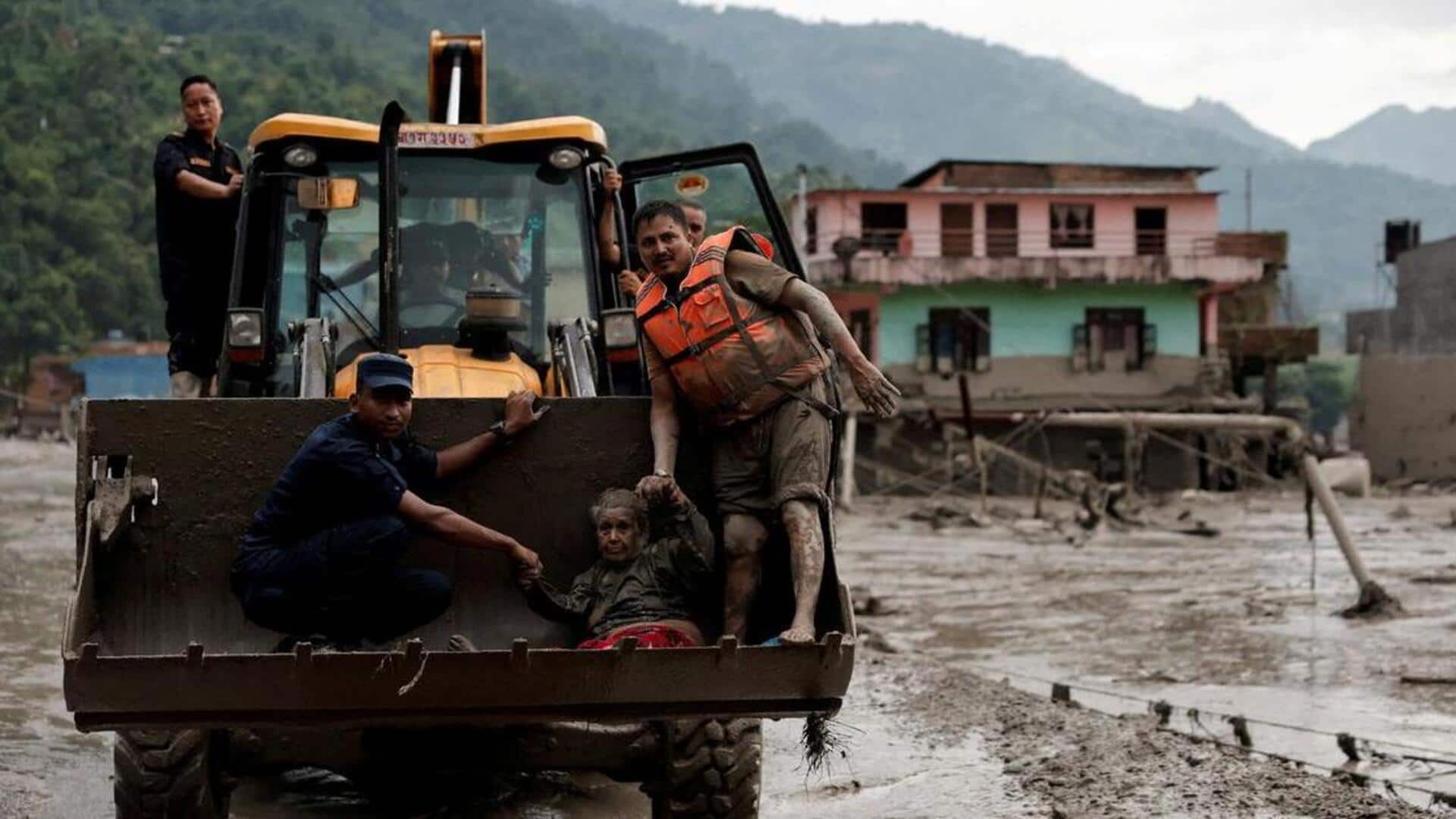
Rescue operations are currently underway with over 5,000 army and police personnel deployed. However, these efforts are being hampered by damaged infrastructure such as roads and bridges.
At least 469 people have died in Nepal so far and hundreds are missing.
In Tibet, three people have died and more than 550 are missing.
Meanwhile, China has paused a rescue operation, citing the high risk of renewed flooding in Tibet.