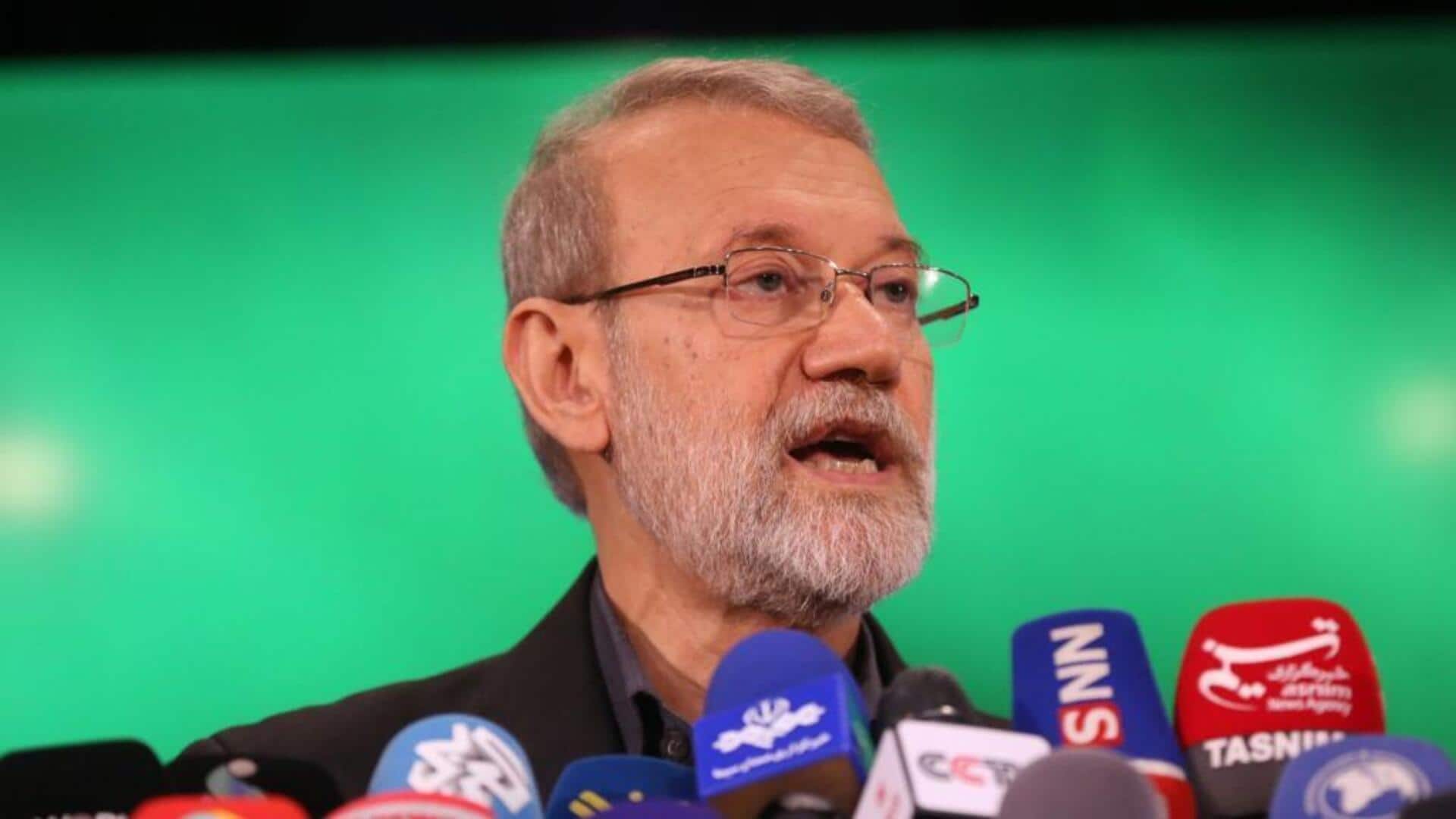
Iran confirms security chief Ali Larijani killed along with son
What's the story
Ali Larijani, a key figure in Iran's political landscape and head of the Supreme National Security Council, was killed in an airstrike near Tehran, Iran has confirmed. The attack took place at his daughter's home in Pardis, northeast of the capital. Along with him, his son Morteza Larijani, security deputy Alireza Bayat and several bodyguards were also killed.
Israeli confirmation
Israel confirms Larijani's death
Israel's Defense Minister Israel Katz had earlier confirmed Larijani's death, saying he was one of the senior figures "eliminated" in Israeli strikes.
Katz said these leaders had "joined Khamenei along with all those eliminated from the axis of evil in the depths of hell."
Israel also confirmed Gholamreza Soleimani's death, head of Iran's Basij paramilitary force.
Leadership pursuit
Israel vows to continue targeting Iran's top leadership
The Israeli military has vowed to continue targeting Iran's top leadership, including Mojtaba Khamenei, the new supreme leader.
"We don't know about Mojtaba Khamenei, we don't hear...see him," Military spokesman Brigadier General Effie Defrin said.
"But I can tell you one thing: We will track him down....neutralize him."
Despite the loss, Iran has also stood firm, with Foreign Affairs Abbas Araghchi saying the US and Israel had yet to realize that Iran's government does not rely on a single individual.
System
'System continued despite the massive national loss'
Araghchi cited the assassination of the country's supreme leader, Ayatollah Ali Khamenei, who was killed on the first day of US-Israeli bombings on February 28, stating that "the system continued" despite the massive national loss.
"We have not had anyone more important than the leader himself, and even the leader was martyred, yet the system continued its work and immediately provided a replacement," the foreign minister told Al Jazeera.
Political career
Larijani's career and significance in Iran
Born in 1958 into a clerical family, Larijani joined the Revolutionary Guards during the Iran-Iraq War.
He served as culture minister and headed Iran's state broadcaster.
Over time, he became known as an "ultimate insider" with deep ties across Iran's political and military establishment.
As chief nuclear negotiator from 2005 to 2007, he defended Iran's right to enrich uranium. He remained involved in strategic planning and advising leadership on talks with the US while maintaining ties with Russia and China.