Nepal meteorology department received information 16mins after flood crossed border
What's the story
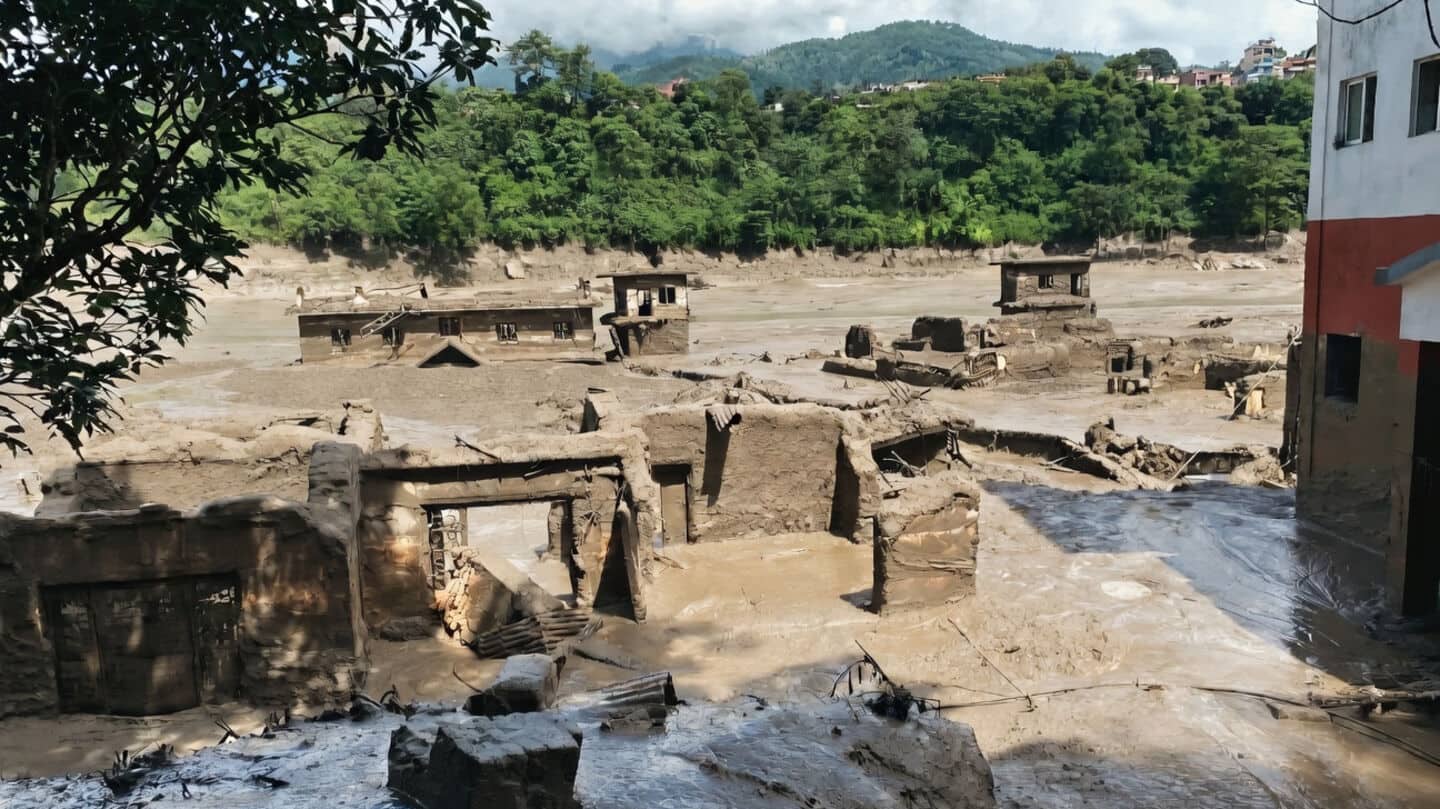
Nepal authorities had no idea when a huge surge of floodwaters erupted from China's Tibetan region into Nepal through the Rasuwagadhi border crossing on Wednesday morning, Nepal News reported. As of Friday, the flood has killed nearly 500 people, with hundreds still missing. The flood reached Syabrubesi village in the Rasuwa district in just 10 minutes and spread through the Trishuli River to downstream areas, sweeping away homes, schools, and infrastructure along the way.
Warning delay
Flood warning came too late
Nepal News reported that it was only 16 minutes after the flood crossed the border that the Department of Hydrology and Meteorology received information from the Rasuwa District Administration Office, routed through the National Disaster Risk Reduction and Management Authority (NDRRMA).
Early warning SMS were sent to riverbank communities soon after, but by then, the flood had already started its destructive journey across upper Rasuwa.
Sauharda Joshi, a hydrologist at the department, said timely information could have significantly reduced casualties.
Unmet agreement
'If we had been informed while the flood...'
After a similar incident last year following a transboundary glacial outburst flood that caused massive devastation in the Rasuwagadhi area, Nepal and China had agreed to share water hazard data in border areas.
However, no timely warning was received before Wednesday's flood.
"The flood crossed into Nepal around 8:40am and reached Syabrubesi within 10 minutes," Joshi said.
"If we had been informed while the flood was building up in Tibet, human casualties could have been significantly minimized."
Infrastructure damage
Infrastructure and educational institutions damaged
The flood caused extensive damage across vulnerable riverbanks, affecting educational institutions, hydropower projects, and other critical infrastructure.
Around 12 operational hydropower plants with a combined capacity of 431.1 MW were reportedly damaged.
The flood also swept away 22 bridges and five Bailey bridges across Rasuwa, Nuwakot, and Dhading.
While the exact trigger and comprehensive structural assessment are ongoing, river corridors along the Bhote Koshi, Trishuli, and Narayani rivers—spanning Rasuwa, Nuwakot, Dhading, Gorkha, Chitwan, and Nawalparasi districts—have been severely affected.
Cause investigation
Glacier collapse or glacial lake outburst flood suspected
According to experts, flash floods in high-altitude areas like Rasuwa are often triggered by severe rainfall, glacial lake outburst floods (GLOFs), or enormous ice avalanches.
Associate Professor DB Kattel from the Chinese Academy of Sciences suggested warming trends in Tibet could have triggered such events.
"Temperature analysis...over the past ten days shows...warming trend, which can trigger glacier collapses and secondary landslides," Kattel explained.
Meteorologist Sanjeev Adhikari agreed, saying, "Preliminary analysis suggests...the flood in Rasuwa cannot be attributed to rainfall alone."