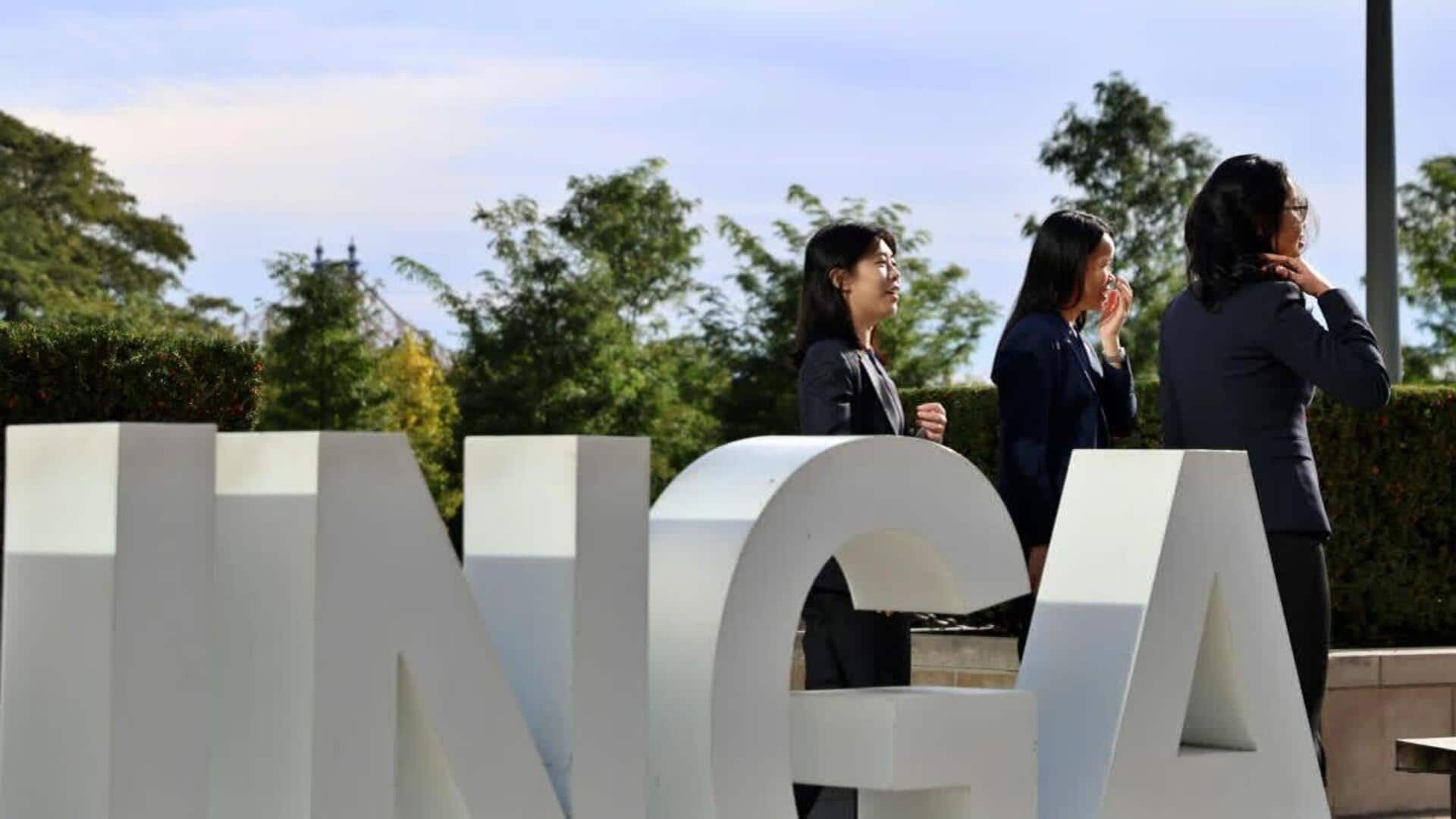
India rejects Pakistan's nuclear blackmail attempts at UNGA
What's the story
India has firmly rejected Pakistan's attempts at nuclear blackmail during a United Nations General Assembly meeting. The Indian delegation, led by Anmol Sher Singh Bedi, Senior Adviser (Disarmament) at the Permanent Mission of India to the Conference on Disarmament in Geneva, said that nuclear weapons should not be used as "routine instruments of statecraft." Bedi reiterated that Jammu and Kashmir is an integral part of India and accused Pakistan of provoking crises in the region.
Accusations
Accountability is crucial for peace, says Bedi
Bedi said that crises in the region follow a "recurring pattern" of provocation, denial, and appeals for restraint.
He warned that without accountability, peace only becomes a pause between crises.
"Where those in power are neither elected by people nor accountable to them, their decisions carry no risk and impose no cost for those who take them," he said.
Terrorism response
India will not submit to nuclear blackmail: Bedi
Bedi outlined three clear lines drawn by India: any terrorist attack will be met with a fitting response, India will not submit to nuclear blackmail, and no distinction will be made between sponsors and masterminds of terrorism.
He referred to India's "Operation Sindoor" in May last year as a measured response to the Pahalgam terror attack that killed 26 civilians.
Treaty tensions
Bedi speaks on Indus Waters Treaty
Bedi also spoke about the Indus Waters Treaty, which he said was based on good faith and goodwill.
After the Pahalgam attack, India had put the treaty on hold until Pakistan stops supporting cross-border terrorism.
On proliferation issues, Bedi referred to the AQ Khan network's history and its role in Security Council Resolution 1540.
He urged states to exercise vigilance for their own security against unchecked nuclear cooperation and advanced military capability transfers.