Pakistan raises concerns over Indus Treaty suspension at 'international conference'
What's the story
Pakistan recently hosted an "international conference" to discuss the Indus Waters Treaty (IWT), warning that its failure could destabilize global order. The IWT, signed in 1960 between India and Pakistan with World Bank mediation, governs the sharing of waters from the Indus River system. India suspended the treaty after a Pakistan-sponsored terror attack in Pahalgam in April 2025 killed 26 civilians. At the time, Prime Minister Narendra Modi stated that "blood and water cannot flow together."
Conference highlights
IWT key for regional peace, says Dar
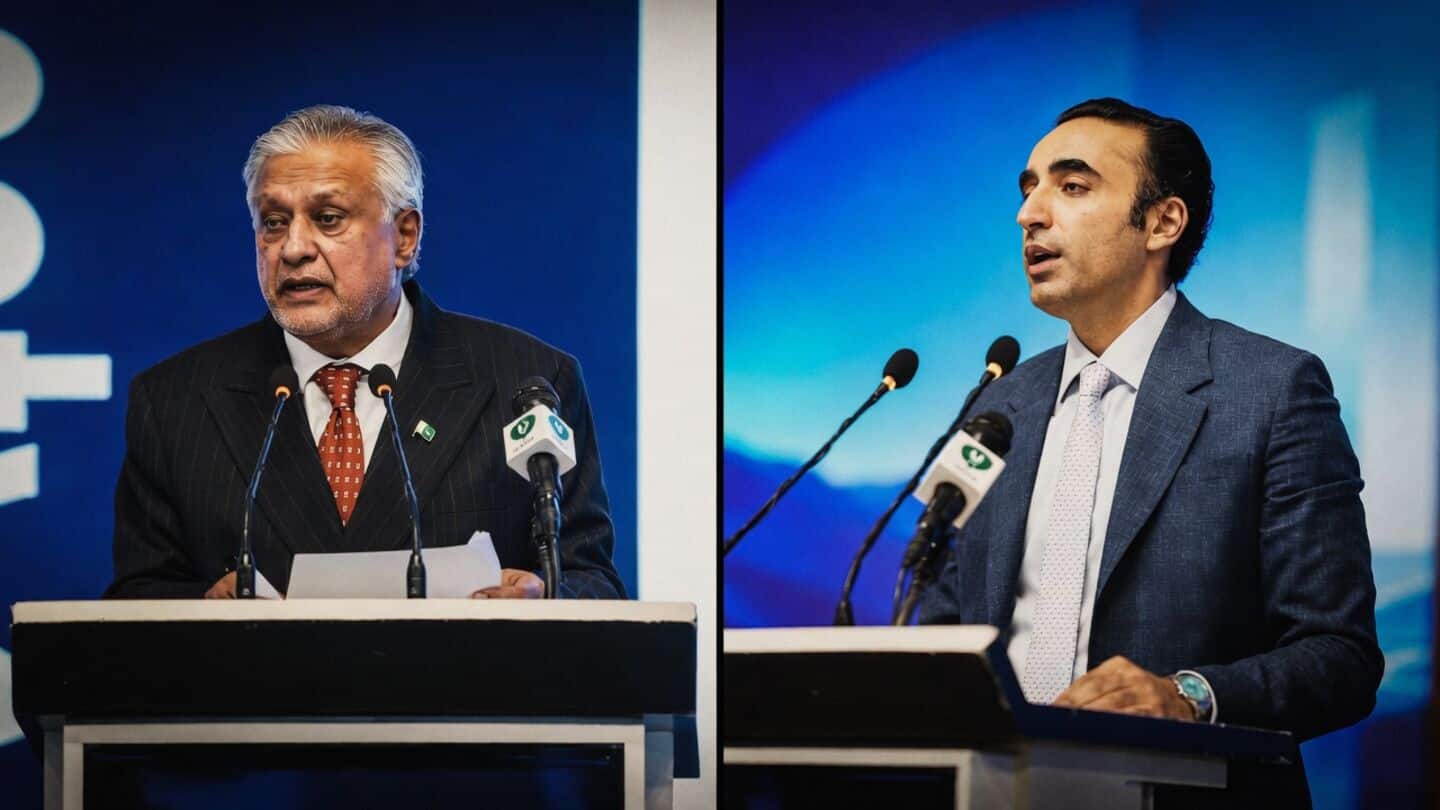
Addressing the conference, Pakistan's Deputy Prime Minister and Foreign Minister Ishaq Dar stressed the IWT is not "merely a water-sharing arrangement but a vital instrument of regional peace, stability, and cooperation."
He warned that depriving Pakistan of its rights under the treaty could have serious consequences for regional peace and security.
Pakistani Peoples Party chief Bilawal Bhutto Zardari also warned that any attempt to undermine Pakistan's water rights would receive a "national response."
Treaty
Indus 'is not a bargaining chip'
Bilawald called Indus Pakistan's "lifeline" and said access to its waters was central to the country's survival.
"If anyone believes that Pakistan will surrender...Sindh, they do not know Pakistan. We want peace...dialogue, but dialogue under law. We want coexistence, but not submission," he said.
He further argued that Indus "is not a bargaining chip" or "a weapon to be placed in India's hands," and any attempt to turn that lifeline into a "noose" must be treated as a threat.
Seminar address
If treaty doesn't hold, no world order will remain secure
Pakistan's Information Minister Attaullah Tarar called the conference "first-of-its-kind."
The event was titled "Indus Waters Treaty as an Enduring Legal and Institutional Framework."
According to Arab News, Pakistan brought together local and international experts on water and international law to strengthen its case "against India's suspension of the decades-old water-sharing agreement."
Pakistani senator Musadik Malik said at the conference that if this treaty doesn't hold, no world order that is on paper post World War II will remain secure.
Treaty credibility
Malik questions credibility of international treaties
Malik further questioned the credibility of international treaties if one "powerful country" could unilaterally suspend them.
"When a law needs to be tested, it must be done at the weakest point and not the strongest point. The Indus Waters Treaty is the strongest pact the world has ever seen," he said.
Targeting India, Malik said such attitudes in history had led to genocide.
Water weaponization
Weaponizing shared waters dangerous, says Dar
Dar also warned against weaponizing shared waters, calling for cooperation and respect for international law.
He said any attempt to deprive Pakistan of its rights under the treaty would have "profound consequences" for regional peace and security.
The IWT allocates six rivers of the Indus basin between India and Pakistan.
India has maintained that the treaty will remain in abeyance until Pakistan ends support for cross-border terrorism.