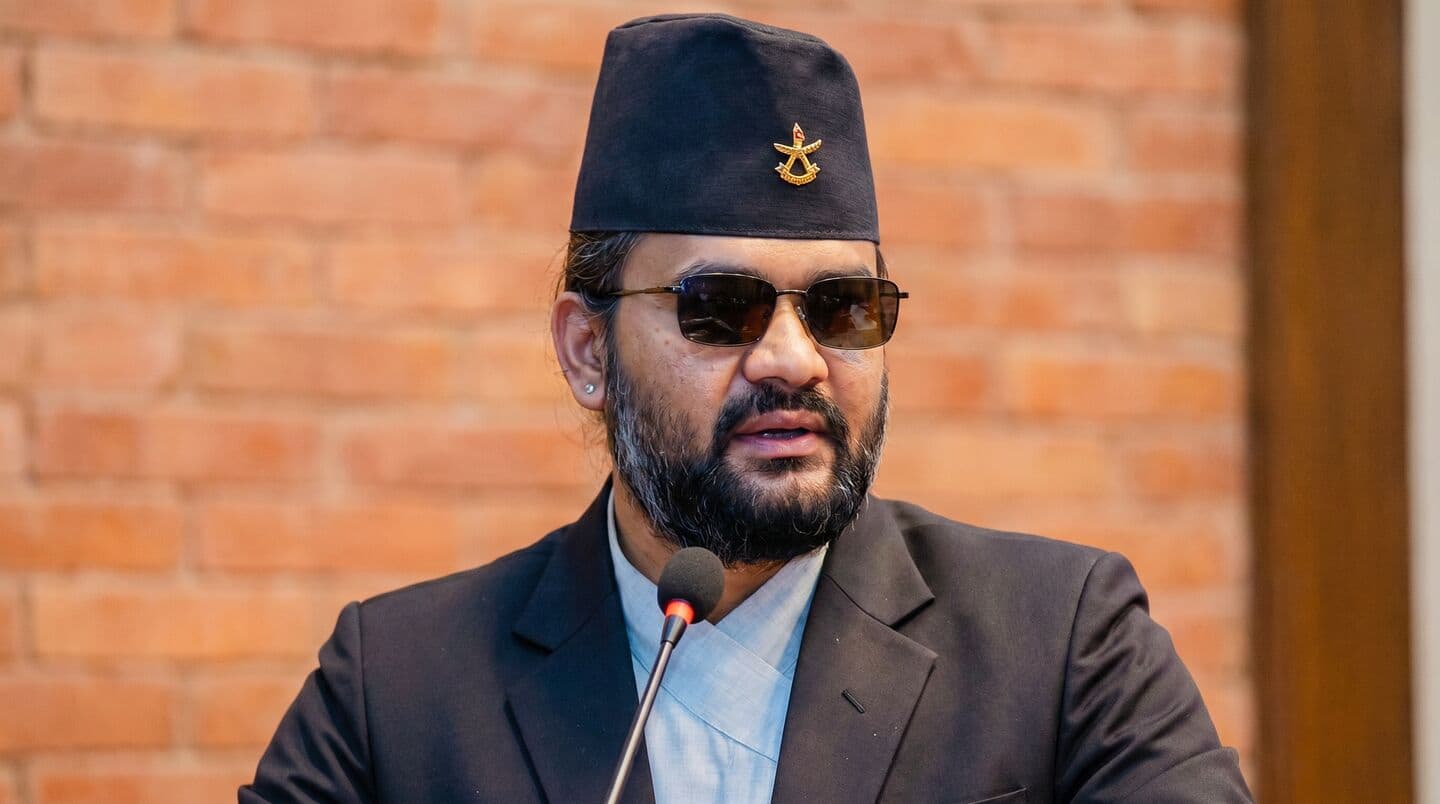
Why Balen Shah's 'encroached Indian territory' admission has angered Nepal
What's the story
Nepal's Prime Minister Balen Shah has sparked a controversy with his recent remarks on territorial disputes with India. "I have only recently found out that it is not only India that has encroached on Nepali territory, but Nepal has also encroached on Indian territory in many places," he said in parliament in response to a question on Lipulekh, Limpiyadhura, and Kalapani. The areas are located near the India-Nepal-China tri-junction and have been a point of contention between the two countries.
Parliament
Nepal sent diplomatic note to India
In his first appearance in the ongoing parliament session that started on May 11, Shah said both countries have agreed to take the help of historians, surveyors and experts to seek resolution to the border dispute.
"The Nepal government has officially sent a diplomatic note to India, mentioning the issue of encroachment of territories by India, including Lipulekh, and we have already received their response," Shah told the parliament.
"Both the countries have agreed to resolve the issue sitting together."
Border history
Understanding the India-Nepal border dispute
The border dispute dates back to the Treaty of Sugauli, signed in 1816 after the Anglo-Nepalese War.
The treaty established Kali River as Nepal's western boundary, but its origin has been disputed.
While most of the 1,850-kilometer India-Nepal border is settled, Kalapani-Lipulekh-Limpiyadhura and Susta remain contentious areas.
The tension is mostly over Kalapani-Lipulekh-Limpiyadhura region, where India has administrative and military presence. The Lipulekh Pass is a key route for the Kailash Mansarovar Yatra, which Nepal claims lies within its territory.
Territorial control
Kalapani-Lipulekh-Limpiyadhura region is sensitive for India
In 2020, India inaugurated an 80-km road from Dharchula to Lipulekh, further straining relations.
In response, Nepal amended its constitution and established a new political map that included Kalapani, Lipulekh, and Limpiyadhura.
It is important to note that mapping remains incomplete in areas such as Susta and Limpiyadhura-Lipulekh-Kalapani.
Nepal has often complained about Indian encroachment on Nepali soil, but Shah's statements now appeared to indicate that encroachment has occurred from both sides.
Official clarification
What Nepal's foreign ministry said
Experts said Shah's remarks "dumbfounded" the public, which had always believed that India is the one encroaching.
Nepal's foreign ministry also clarified that Shah was referring to cross-border occupation in the Dasgaja area, a legally defined "no man's land."
Toya Baral, former director general of the Department of Survey, said 1,200 hectares of Nepali land are occupied by Indians while 1,250 hectares of Indian land are in Nepal.
These findings were part of a boundary survey conducted in 2007.
Diplomatic tensions
India's stance
India has yet to respond, but earlier this month, while rejecting Nepal's objection to the upcoming Kailash Mansarovar Yatra via the Lipulekh Pass, India dismissed Kathmandu's territorial claims over the region as a "unilateral artificial enlargement" that New Delhi finds "untenable."
India claims that the disputed territories are part of Uttarakhand and has stated that the matter should be resolved through bilateral dialogue.