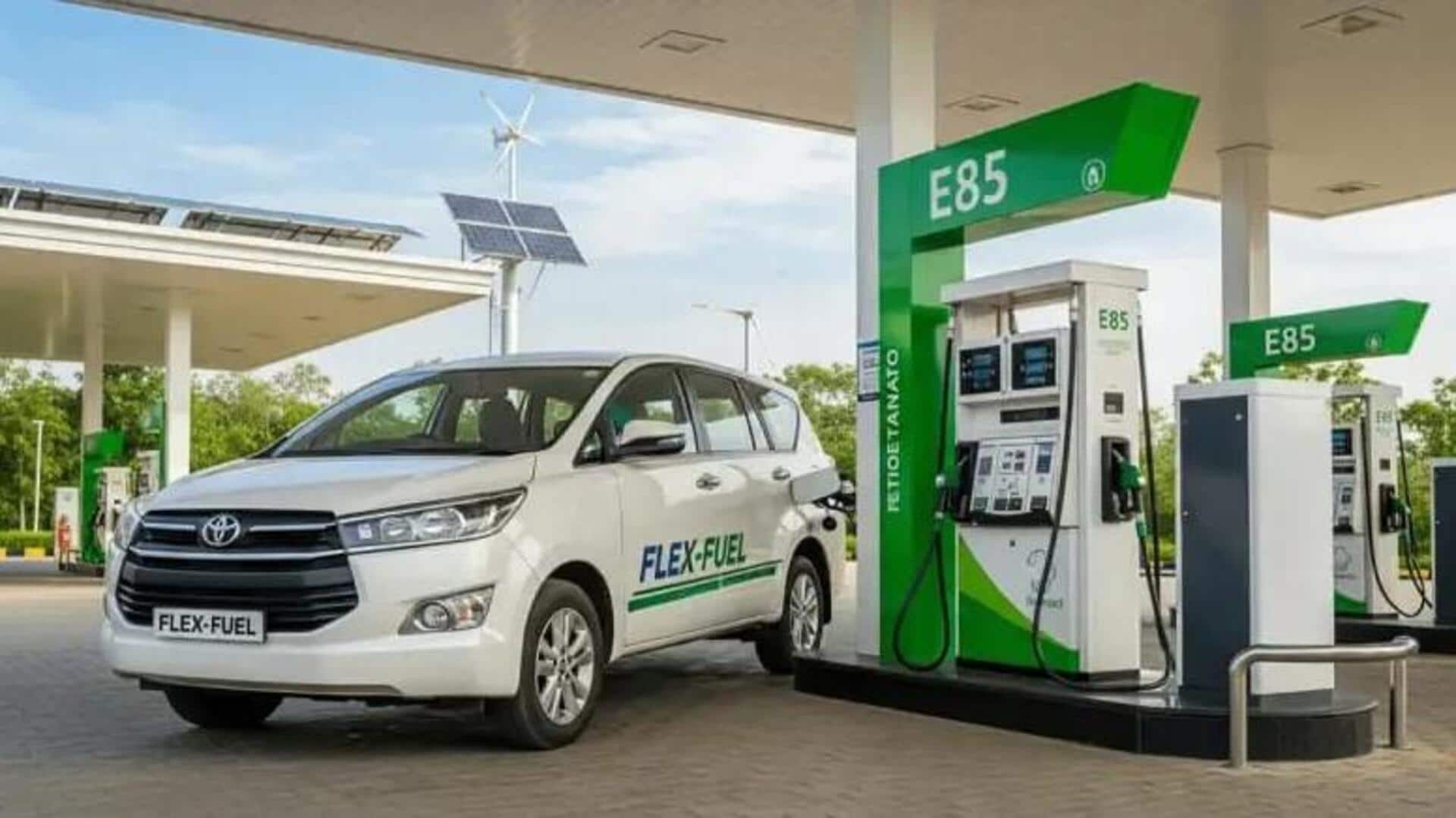
Why Modi government plans to promote flex-fuel vehicles in India
What's the story
In light of the ongoing conflict in West Asia, the Indian government is planning a major policy push to promote flex-fuel vehicles (FFVs). These are vehicles which can run on ethanol blends of up to E85 (85% ethanol and 15% petrol). The move comes as part of India's efforts to reduce its dependence on oil imports.
Policy impact
FFV rollout plan to be discussed in upcoming meeting
India's current ethanol blending mandate, which allows 20% ethanol in petrol, was introduced in 2025.
However, it has drawn criticism from the public over reduced mileage and concerns about engine performance.
The Union Petroleum and Natural Gas Ministry has convened a meeting to discuss this issue further.
A working group of experts from oil marketing companies, automobile manufacturers, and government officials will present their plan for FFV rollout during this meeting.
Economic impact
India imports 90% of its oil
The ongoing conflict in West Asia has led to fluctuating global crude prices, briefly crossing the $100 per barrel mark before easing after a ceasefire.
This poses a major fiscal risk for India, which imports 90% of its oil. A $1 per barrel increase over a year shall add around ₹16,000 crore to India's import bill.
The nation imported oil worth $109.5 billion in FY26, according to data from the Petroleum Planning & Analysis Cell (PPAC).
Sector contribution
Transport sector accounts for most petrol consumption here
The transport sector accounts for a major chunk of petrol consumption in India.
In FY26, over 12.59 million petrol vehicles were sold in the country, data from government portal Vahan shows.
These vehicles account for some 44% of total vehicle sales (28.3 million) in India, highlighting the scale of transition required to reduce fossil fuel dependence.
Industry apprehensions
Auto industry wary about FFV rollout
Despite the push for FFVs, the auto industry remains wary about their rollout. Concerns include lack of clarity on blended fuel pricing, uncertainty over distribution at retail pumps, and incentives for FFVs as they are costlier to produce than other petrol vehicles.
International adoption
Brazil has successfully adopted FFVs
Globally, FFVs are widely used in Brazil where they were introduced in 2003.
Today, they account for over 90% of new vehicle sales with cars and two-wheelers running fully on ethanol, petrol or a blend of both (in varying proportions). This is backed by a robust sugarcane-based ethanol ecosystem.
However, experts say that while FFVs are strategically important for India, building public trust will be key to their successful adoption here.