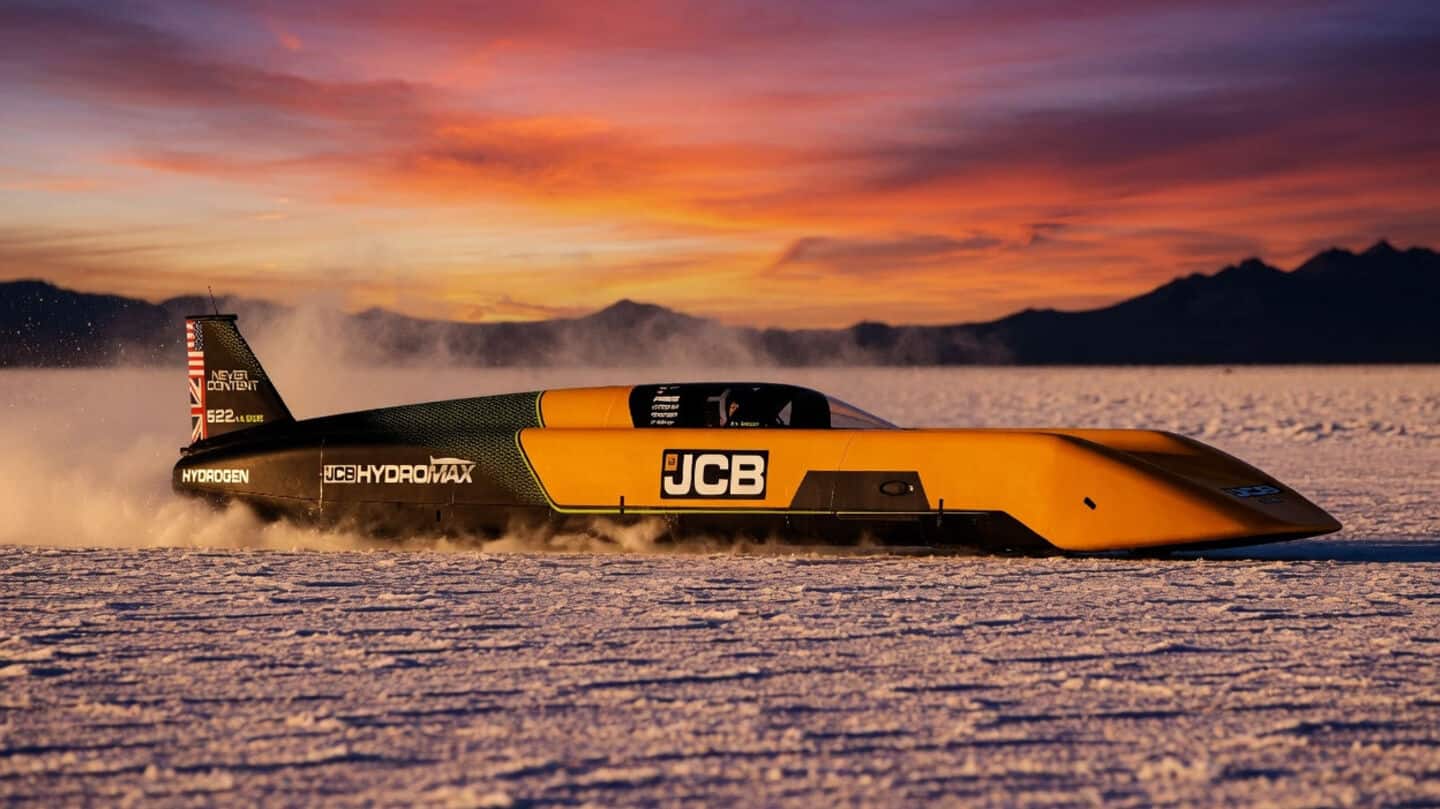
JCB's hydrogen car breaks world speed land record
What's the story
JCB, the British engineering giant known for its construction equipment, has set a new world land speed record for a hydrogen-powered combustion vehicle. The feat was achieved by JCB's in-house-developed Hydromax speedster, which hit an average top speed of 653.9km/h at the Bonneville Salt Flats in Utah, USA. Behind the wheel was Andy Green, who has now set his third world record with this achievement.
Speed milestones
Hydromax averages top speed of 653.9km/h
The Hydromax first hit an average speed of 644.74km/h and then 663.26km/h on its second run.
The combined average of these two runs was 653.9km/h, beating the previous record set by BMW H2R in 2004 at a speed of 298.53km/h.
JCB claims that at this average top speed, the Hydromax is the fastest hydrogen-powered vehicle ever built, surpassing even fuel cell vehicles in terms of performance.
Vehicle specifications
Powered by 2 hydrogen combustion engines
The 9.75-meter-long Hydromax is powered by two hydrogen combustion engines with a total capacity of 9.6-liter.
These engines produce a combined power output of 1,622hp and are equipped with a single-stage motorsport turbocharger to cope with the high altitude of Bonneville Salt Flats.
The vehicle also uses spark plugs designed for a Le Mans car.
Vehicle innovation
Features a steel-frame chassis and carbon fiber monocoque sub-chassis
The Hydromax features a steel-frame chassis with a carbon fiber monocoque sub-chassis for the driver.
To reduce drag, the windscreen is sculpted and sculpted channels under the nose of the car are designed to channel salt from its underbody.
JCB also commissioned an all-new tire that expands at high speeds, necessitating redesigning and enlarging front wheel arches.
Cooling mechanism
Uses ice to cool the engine instead of conventional methods
Instead of a cooling inlet to reduce engine temperature, the Hydromax uses two tanks of ice, with 250kg needed for each run.
On the full record run, it was estimated that the Hydromax would consume just over 2kg of hydrogen and produce 18-liter of water.
The vehicle is powered by two production-based hydrogen engines derived from units developed for JCB construction equipment.