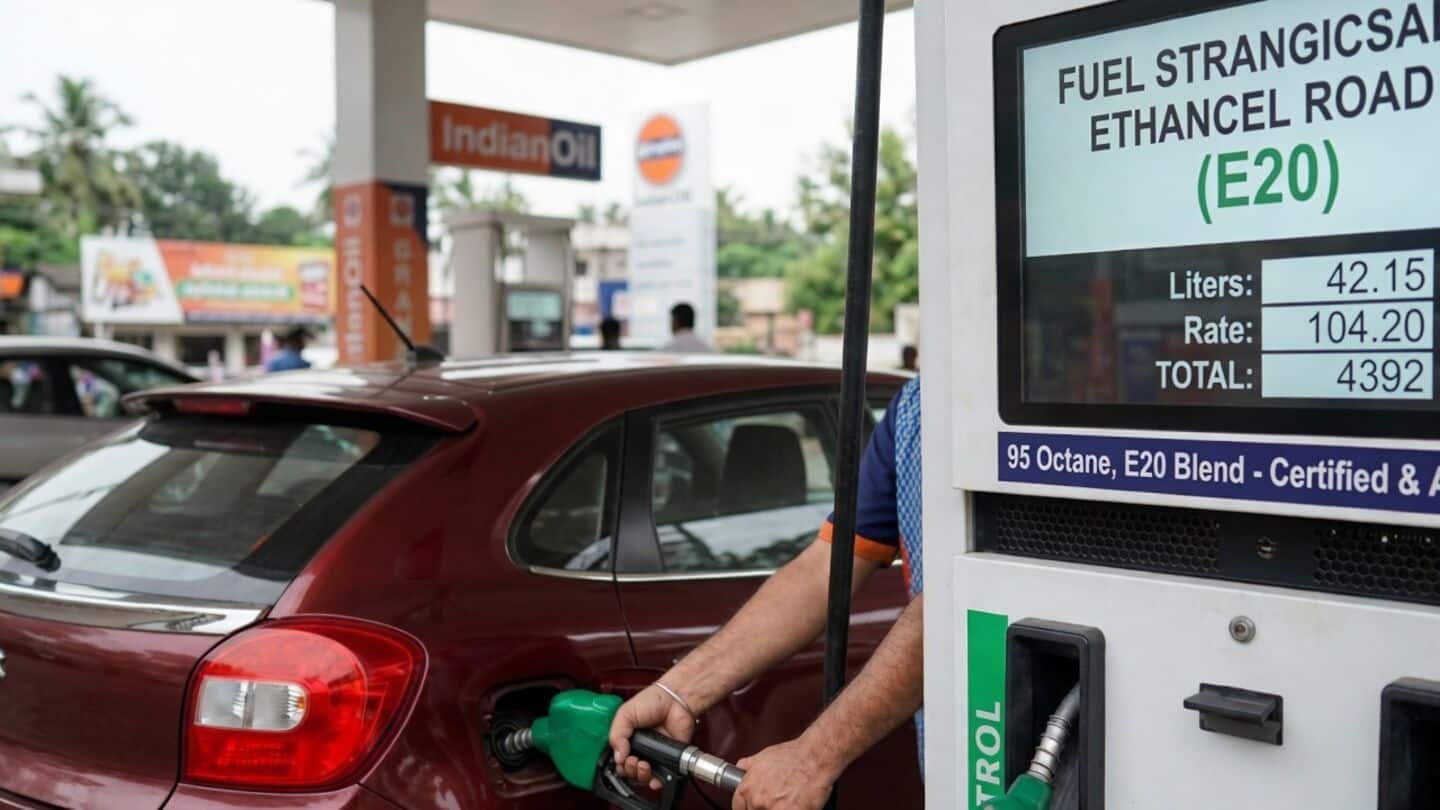
Can E20 fuel cause breakdowns during monsoon? What experts say
What's the story
Petrol pump owners have raised concerns over the contamination of E20 fuel during the monsoon season. The issue stems from ethanol's hygroscopic nature, or its ability to attract and hold water molecules from its surrounding environment. This problem is especially prevalent in coastal areas and during rainy seasons, as underground storage tanks are not designed for higher ethanol blends like E20.
Contamination process
What is phase separation?
An industry veteran explained to The Hindu that underground fuel storage tanks often have some water due to rain, moisture, condensation, or from the fuel tanker delivering petrol.
When the water content in the E20 stock exceeds 0.5%, ethanol's hygroscopic nature causes it to bind with water.
This results in phase separation where a water-ethanol mixture settles at the tank's bottom while petrol stays on top.
Vehicle impact
How can it affect vehicles?
As the dispensing unit draws fuel from the underground tank's bottom, some vehicles could get a water-rich mixture instead of E20.
This could lead to starting issues or breakdowns after a certain distance.
The problem is worse in coastal areas where subsoil water can further contaminate E20 stock if underground tank seals aren't properly fitted.
Corrosion fears
Concerns over corrosion in mild steel components
One petrol pump owner feared that underground tanks and pipelines made of mild steel could be more prone to corrosion.
This is because ethanol's moisture absorption properties could lead to further fuel contamination.
However, some have noted that Oil Marketing Companies (OMCs) have replaced seals and washers in petrol dispensing units with neoprene rubber for E20 compatibility.
FADA's response
FADA, government clarify on the issue
The Federation of Automobile Dealers Associations (FADA) has debunked the claim that E20 causes unique water contamination due to ethanol-blended petrol.
They said this is "misleading" as "ethanol's moisture absorption is a known property accounted for in fuel standards, storage, and vehicle design."
The Ministry of Information and Broadcasting also clarified that modern vehicles have design features and safeguards to prevent water entry into fuel tanks.