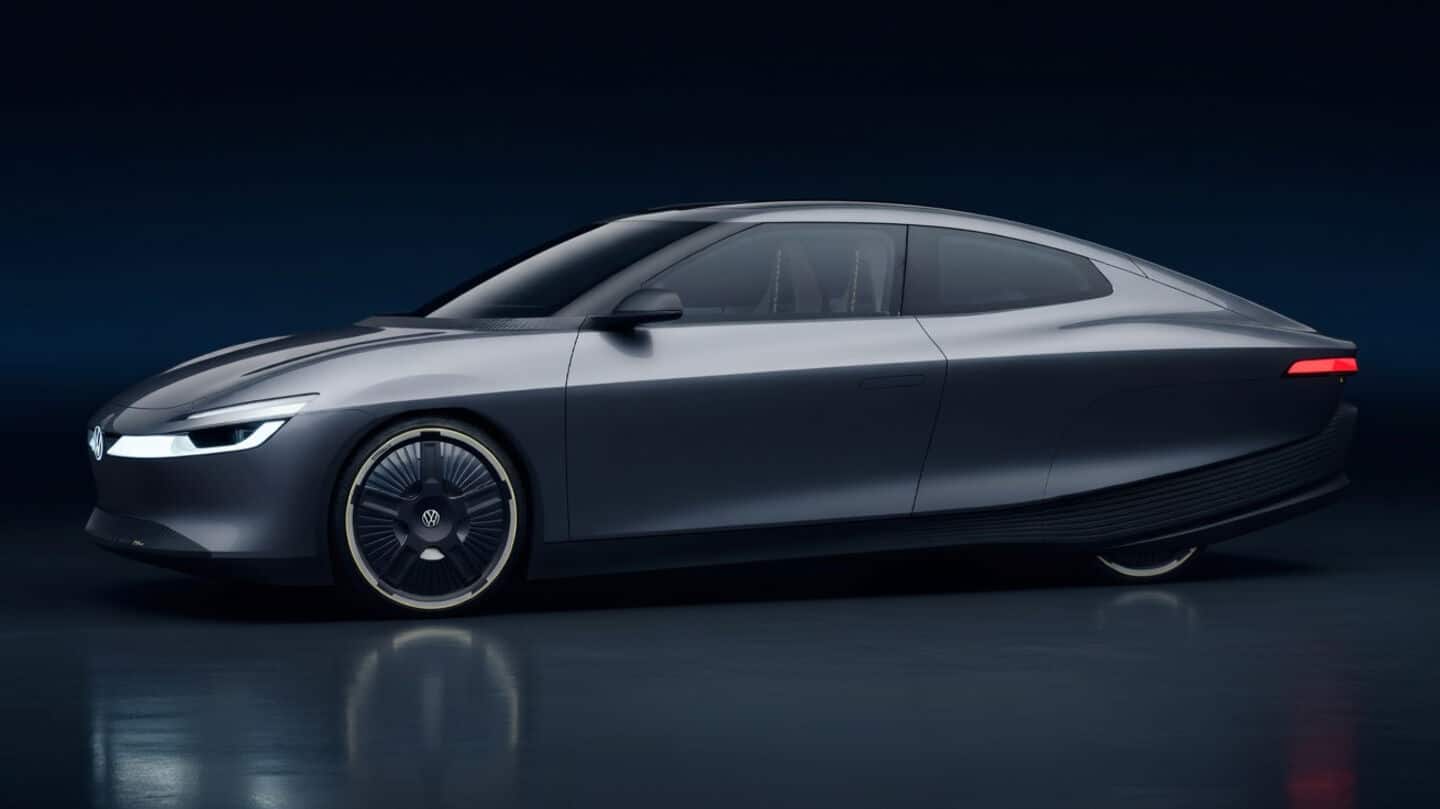
Volkswagen reveals world's most aerodynamic road-approved EV
What's the story
Volkswagen has unveiled its latest electric vehicle (EV) prototype, the Mission Efficiency. The near-production 2+2-seat coupe is built on VW's MEB+ platform and features front-wheel-drive components from the upcoming ID. Polo and ID. Cross models. With a drag coefficient of just 0.158, the Mission Efficiency claims to be the most aerodynamic road-approved vehicle in the world.
Efficiency record
It has broken records for energy efficiency as well
The Mission Efficiency also claims to have broken the record for energy efficiency, consuming just 6.48kWh of energy per 100km during a constant-speed test drive on flat terrain.
This was done with secondary features like AC deactivated.
The prototype has also been dubbed "the most economical near-production electric car in its class," thanks to its platform sharing with the ID. Polo.
Range demonstration
It can travel over 1,200km on a single charge
Volkswagen recently conducted a real-world test drive of the Mission Efficiency, covering an impressive 1,278.36km on a single charge of its 54.9kWh (net) battery.
The EV consumed just 6.89kWh/100km at an average speed of 67.72km/h and still had 164km of range remaining at the end of the journey from Wolfsburg to Vienna.
Design details
It shares features with ID. Polo
The prototype's teardrop shape and wheel coverings are designed to maximize efficiency.
The underbody is covered, the windows are frameless, and the door handles are flush.
It shares its 99kW front-wheel electric motor, high-voltage battery, aluminum structure, and high-strength carbon fiber materials with VW's ID. Polo.
At speeds over 80km/h, it uses more than 30% less energy than an ID. Polo at similar speeds.
Weight reduction
VW has also integrated solar panels on the roof
To further improve efficiency, VW has focused on reducing weight.
The paneling is lighter and the infotainment system is a "bring-your-own device," with a portable Bluetooth speaker and smartphone/tablet dock instead of a central touchscreen.
Integrated solar panels on the roof can provide up to 30km of additional range for all auxiliary electronics.