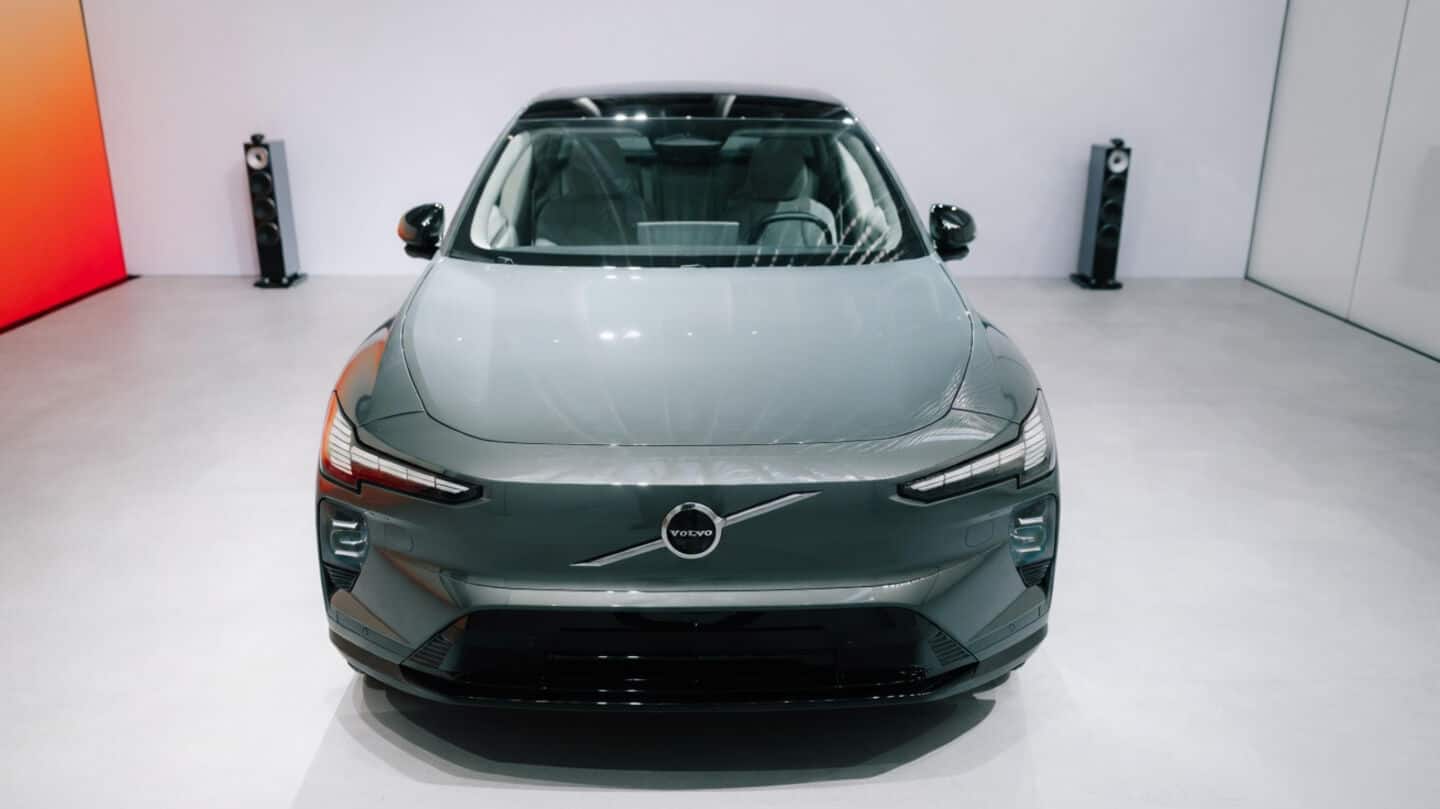
Volvo adopts NVIDIA's AI for hands-free driving
What's the story
Volvo has announced its plan to introduce hands-free, point-to-point driving by 2030. The innovative system will be powered by NVIDIA's advanced artificial intelligence (AI) technology. The Swedish automaker, owned by China's Geely, said it would use NVIDIA's autonomous driving stack for a new partially automated driving system. This would be similar to Tesla's Full Self-Driving (Supervised) and Mercedes-Benz's recently launched hands-free driving system in the new CLA sedan.
Advanced capabilities
The new system will be classified as Level 2++
The new point-to-point system from Volvo will be classified as Level 2++. This means it will be able to navigate complicated urban scenarios such as traffic lights, stop signs, and unprotected left turns without explicit driver control.
The setup will use NVIDIA's Hyperion platform with its high-powered silicon and extra sensors around the vehicle for environmental perception.
Technological integration
Volvo will also leverage NVIDIA's Alpamayo software
Volvo will also leverage NVIDIA's Alpamayo software in its new driving system.
The software uses "reasoning" models to interpret complex road conditions and decide where to steer, brake, or accelerate.
Although the setup won't include lidar for now, there is a possibility of its future inclusion if Volvo chooses to add it later on.
Safety integration
Volvo plans to integrate its safety expertise with NVIDIA's technology
Volvo plans to integrate its safety expertise with NVIDIA's technology for a better overall system.
The company intends to contribute its proprietary driver-understanding systems that analyze driver behavior in detail. This would be an improvement over a basic driver monitoring system.
Alwin Bakkenes, head of global software engineering at Volvo Cars, emphasized this collaboration for enhanced safety standards in their vehicles.
Tech enhancement
Volvo's connected safety tech will be part of the system
Volvo's connected safety tech, which lets its cars share information about upcoming hazards and conditions like roadworks, will also be part of the new system.
This could boost the self-driving capabilities by extending the system's awareness beyond what an individual vehicle's sensors can detect.
The company plans to offer this new point-to-point driving system across its entire vehicle lineup before 2030.