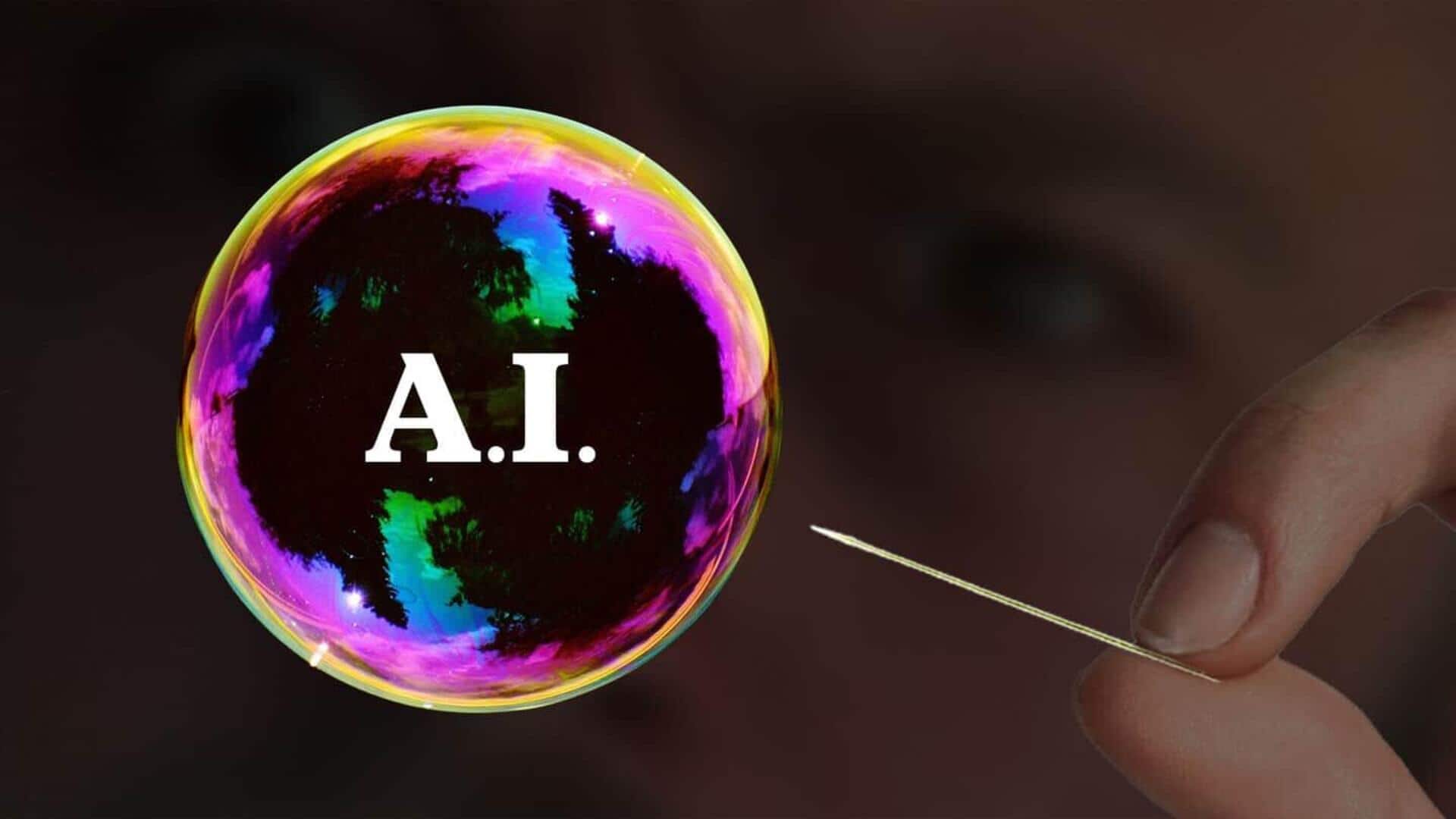
AI bubble burst could trigger US recession, Fitch warns
What's the story
A sharp decline in equity markets and a slowdown in artificial intelligence (AI) investments could push the United States into recession, Fitch Ratings has warned. The firm also said that this could drag global growth below 1% by 2027. The warning comes as the AI boom has been a major driver of the US economy, with rapid growth in technology capital expenditure and rising equity-market wealth supporting consumer spending.
Market predictions
Fitch's downside scenario predicts US GDP contraction
In its September Global Economic Outlook, Fitch modeled a downside scenario where US equity prices could fall by 35% and non-US equities by 15%.
The model also included a confidence-driven shock to US private investment.
Under these conditions, the agency predicted that US GDP could contract by 0.6% in 2027, potentially pushing the world's largest economy into recession.
Global impact
Global growth could fall below 1% by 2027
Fitch's model also predicts that global growth could fall below 1% by 2027.
The agency said the fallout from a sharp correction in share prices and companies cutting spending on AI infrastructure and technology would not be limited to the US.
It could also affect growth in the eurozone and China, which would be 0.8% points below their baseline forecasts in 2027 under Fitch's downside scenario.
Trade effects
Fallout on neighboring economies and disinflationary pressure
Canada and Mexico could be among the hardest-hit countries due to their strong trade links with the US.
Other economies with large information technology and semiconductor industries, such as South Korea, could also come under pressure from this potential economic shock.
The fallout would create strong disinflationary pressure, prompting the US Federal Reserve to cut interest rates aggressively by an estimated 325 basis points.
Economic resilience
Fitch raises global GDP growth forecast for 2026
Despite the potential risks highlighted by its downside scenario, Fitch's base case remains resilient.
The agency expects the global economy to remain robust in 2026 and has raised its global GDP growth forecast to 2.6% from an earlier estimate of 2.4%.
It has also maintained its forecasts for 2027 and 2028 at 2.5% and 2.6%, respectively, while raising US growth forecasts for both years to a healthy 2.1%.