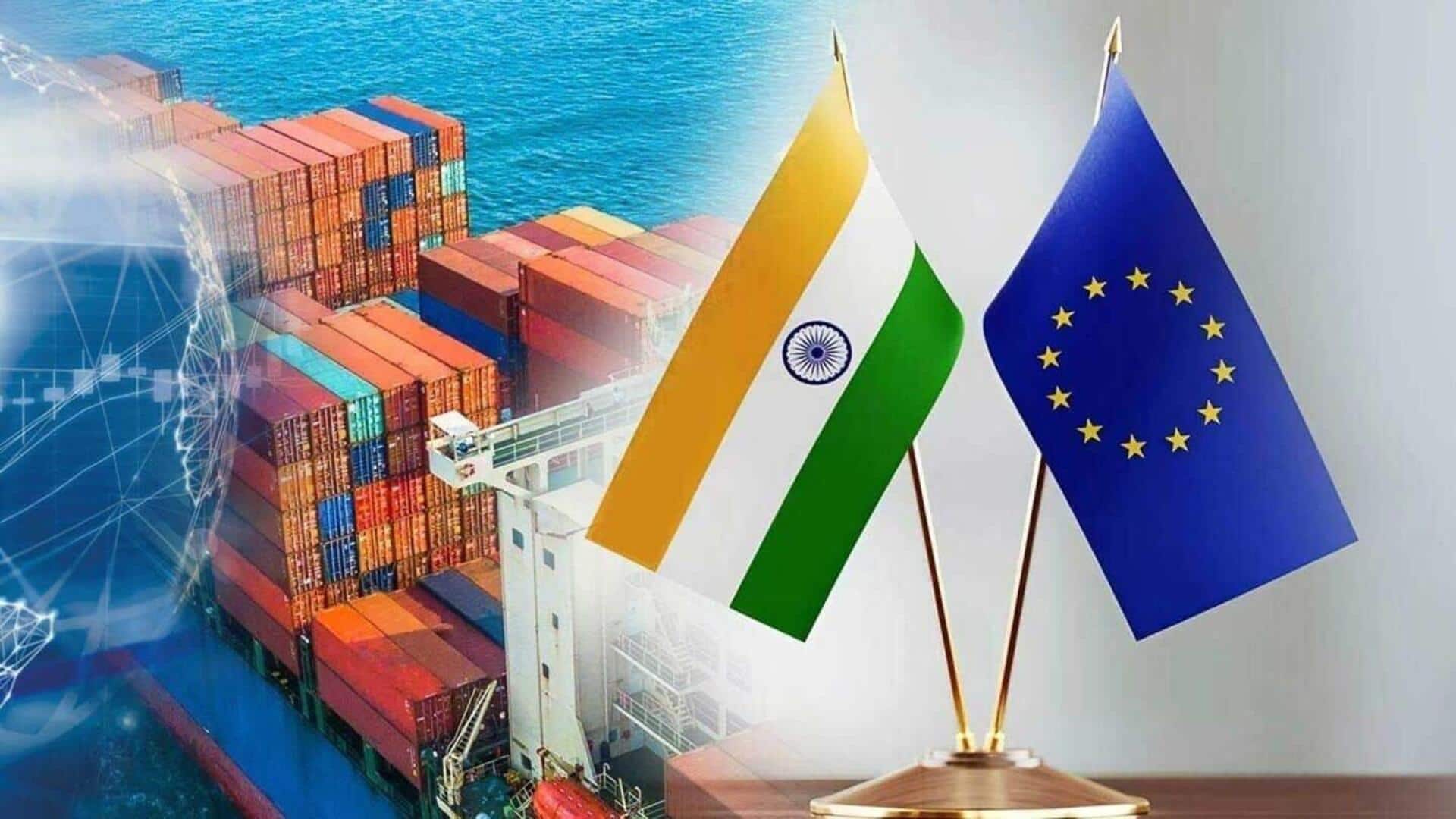
India taps into EU's $750B electronics market with trade deal
What's the story
India's electronics sector is poised for a major expansion, thanks to a new trade deal with the European Union (EU). The agreement will give Indian manufacturers preferential access to the EU's nearly $750 billion electronics market. Industry executives expect this could lead to an increase of up to $50 billion in India's electronics exports by 2031.
Market impact
Trade deal to boost electronics exports and reduce costs
The trade deal is expected to significantly boost India's electronics exports, in line with the country's strategy.
It also includes mutual recognition of certifications, which will shorten qualification cycles and ensure India-made products meet European benchmarks.
Sunil Vachani, Chairman and Managing Director at Dixon Technologies, said sectors like LED televisions, lighting systems, and home appliances will benefit the most from this agreement.
Sectoral benefits
Trade deal to benefit various sectors
The trade deal is expected to rationalize duties on several products, including TVs and lighting systems.
Currently, these categories attract higher tariffs (14% duty for TVs and 3% for lighting). However, under the new agreement, these duties are likely to be reduced to zero.
This will open up market access for contract manufacturers who were not exporting to the EU before.
Market diversification
Trade deal to diversify market access
For products like smartphones, tablets, and IT hardware, the deal will make European markets more accessible. This is expected to help local companies diversify their market reach.
Currently, India's electronics trade with the EU is around $18 billion. The India Cellular and Electronics Association (ICEA) estimates that effective implementation of this free trade agreement could see electronics trade soar to $50 billion by 2031 and beyond $100 billion by 2035.
Investment influx
Trade deal to attract European companies to India
The trade deal is also expected to attract European companies to set up manufacturing and sourcing operations in India.
ICEA said, "Reduced trade frictions and improved regulatory alignment can support deeper industrial collaboration across electronics, semiconductors, semiconductor manufacturing equipment, capital goods, and other advanced manufacturing sectors."
Ashok Chandak of the India Electronics & Semiconductor Association expects high-end machinery can now be imported at a lower cost.