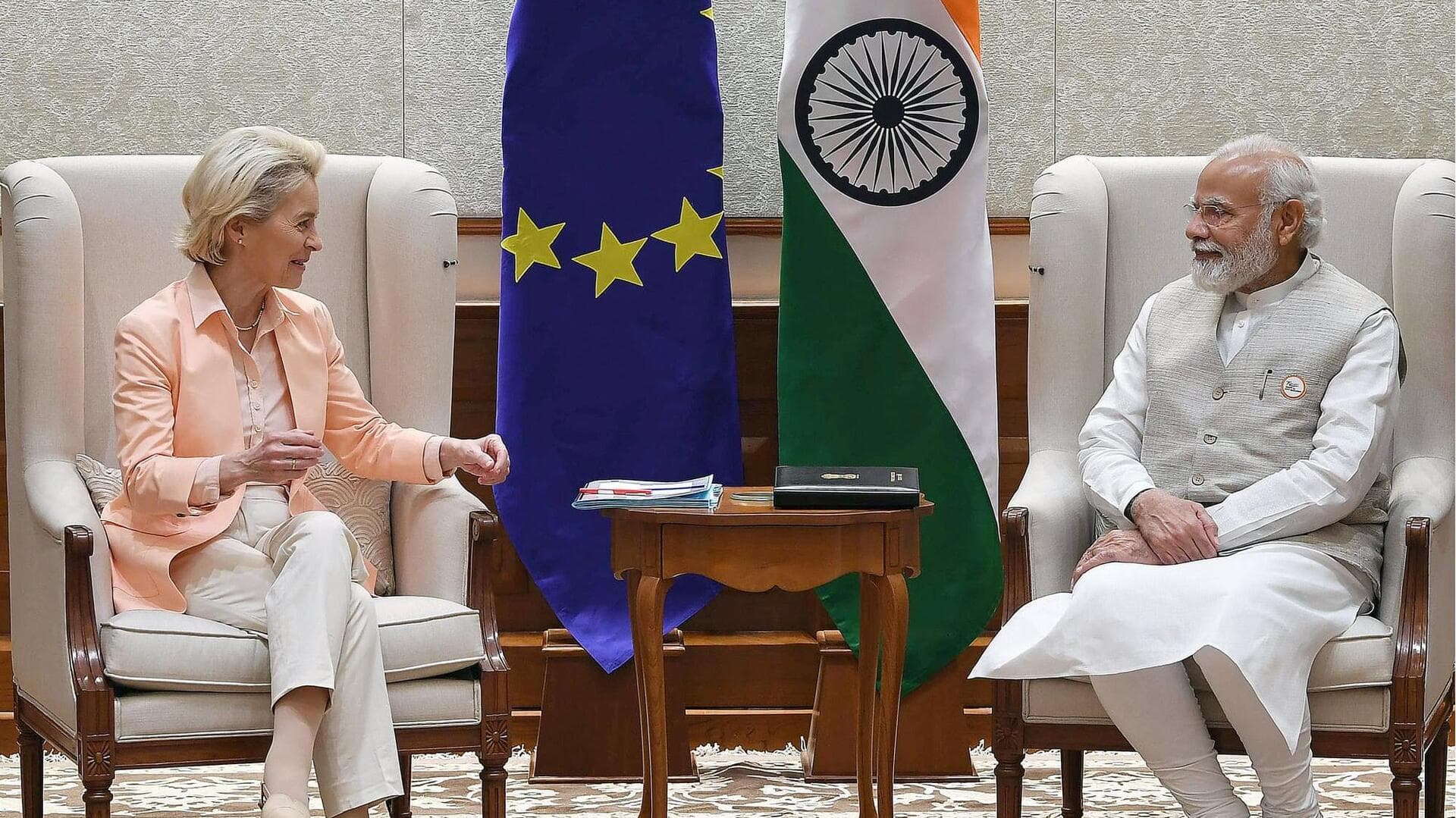
India-EU trade agreement: What makes it 'mother of all deals'
What's the story
The long-awaited India-European Union (EU) free trade agreement (FTA) is on the verge of being finalized, European Commission President Ursula von der Leyen announced at the World Economic Forum. She described the impending deal as the "mother of all deals," which would create a combined market of nearly two billion people and account for almost 25% of global GDP.
Deal details
India-EU trade deal: A historic agreement in the making
Von der Leyen said, "The negotiations are entering a decisive phase. We are on the cusp of a historic trade agreement."
She will be visiting India soon as a chief guest for the Republic Day celebrations, where trade discussions may occur.
The FTA would be India's 19th and one of its most important, given the EU's influence on global trade dynamics.
Negotiation history
India-EU trade deal: A complex negotiation process
The journey to the India-EU FTA has been long and complex, with talks first starting in 2007 under the name Broad Based Trade and Investment Agreement (BTIA).
After several rounds of negotiations between 2007 and 2013, discussions stalled over issues like market access, tariffs, intellectual property rights, labor and environmental standards.
However, negotiations were revived in 2022 with a renewed focus on reaching a comprehensive FTA.
Market exploration
India-EU trade deal: A response to changing global trade dynamics
The urgency for the India-EU FTA has increased after Donald Trump's protectionist trade policies, which have forced trade partners to look for new markets.
The negotiations gained momentum after von der Leyen's visit to India last February, with Commerce Secretary Rajesh Agarwal noting that both sides have made significant progress in their discussions.
Deal scope
India-EU trade deal: A comprehensive agreement covering multiple sectors
The India-EU FTA would be India's largest and most complex trade agreement to date, covering goods, services, and trade rules across the EU's 27-member customs union.
It is expected to cover a wide range of areas such as goods, services, investment, technology transfer, and regulatory cooperation.
This will integrate India deeper into European supply chains while giving EU firms greater access to one of the world's fastest-growing major economies.
Mutual benefits
India-EU trade deal: A boon for both sides
The FTA is expected to benefit both sides greatly. Sectors like textiles and clothing, which currently face high duties of about 10%, could see these tariffs removed under the agreement.
High-value, knowledge-intensive sectors such as pharmaceuticals and chemicals could also benefit from streamlined regulatory approvals and aligned standards for easier market access.
Diversification opportunity
India-EU trade deal: A chance for diversification
The FTA also gives India a chance to diversify its trade at a time when trade tensions with the US have led to higher tariffs of 50%.
Notably, India has not had to compromise on sensitive sectors like agriculture and dairy in this deal.
The Economic Times reports that the FTA would help Indian exporters cushion higher US tariffs and restore competitiveness.