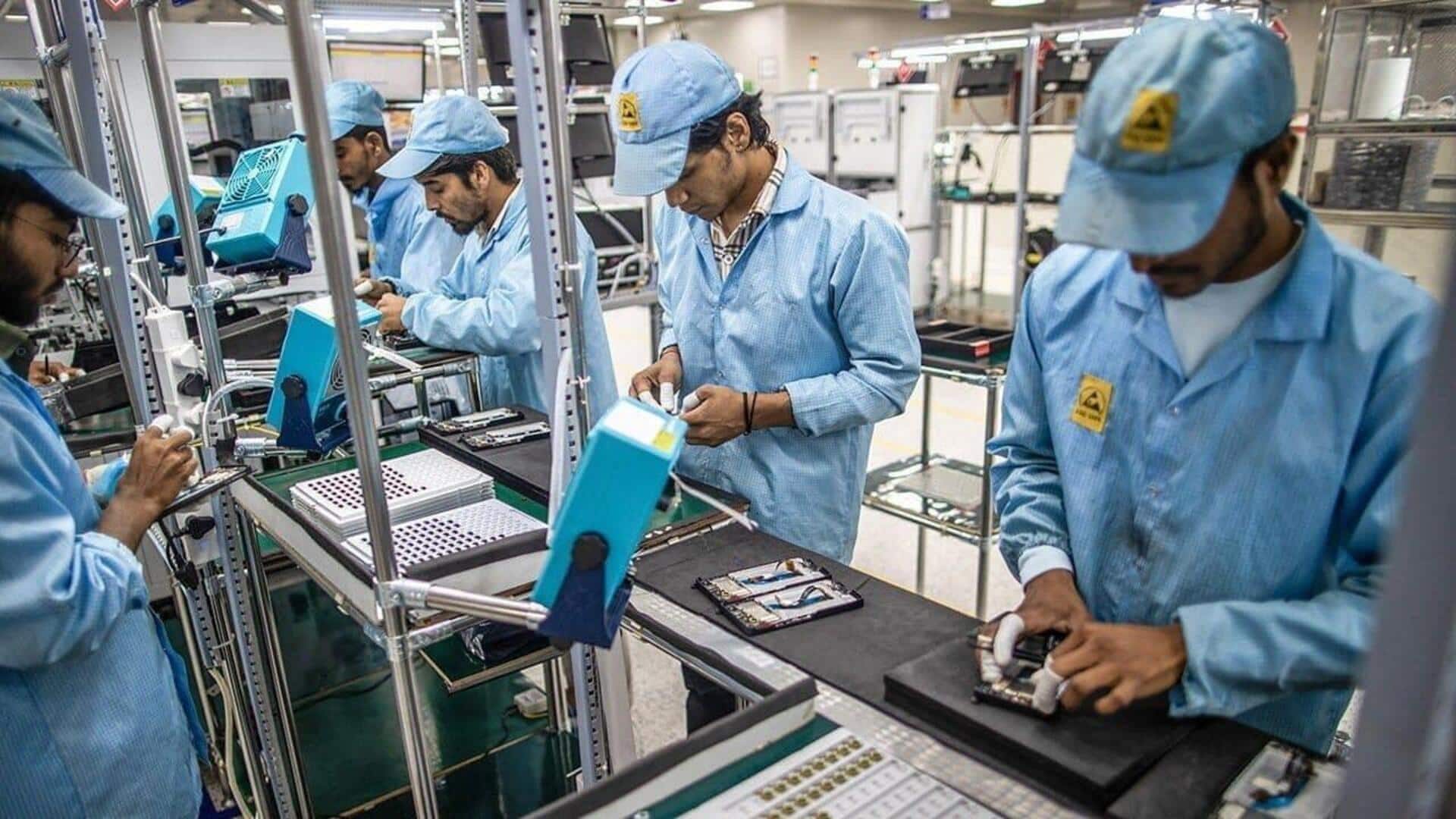
India's electronics and IT to generate $1T revenue by 2030
What's the story
India's electronics industry, which generated $125 billion in revenue last year, is expected to grow at a compounded annual growth rate of 32%, according to the Ministry of Electronics and Information Technology (MeitY). The growth will be nearly three times faster than the IT services sector. By 2030, both sectors are expected to generate $500 billion each, contributing to a $1 trillion digital economy.
Policy impact
Government support fuels electronics sector growth
The Indian government's financial assistance for mobile phone and electronic goods assembly since April 2020 has significantly boosted the electronics industry.
This support has led to the emergence of several listed companies, private firms, and foreign players such as Foxconn.
Four major listed electronic component manufacturers—Dixon Technologies, Amber Enterprises, Kaynes Technology, and Syrma SGS—reported a combined revenue of $6.1 billion in the last fiscal year.
Global shift
India's growing role in global electronics supply chain
Ankush Wadhera, Managing Director and Partner at Boston Consulting Group, emphasized India's growing importance in the global electronics supply chain.
He noted that many companies are now considering their India strategy to diversify beyond facilities in China, Taiwan, Malaysia, Thailand and Vietnam.
The government's Electronics Components Manufacturing Scheme (ECMS) is incentivizing local production of phone and computer components.
This could lead to a significant revenue increase as major global firms ramp up manufacturing in India.
Sector comparison
Electronics sector's employment and salary disparities
Despite its rapid growth, the electronics sector still lags behind IT in terms of employment and salaries.
The IT industry employs 5.8 million people with an average salary of ₹3.5 lakh per year, while the electronics sector employs only 2.5 million with an average salary of ₹1.8 lakh per year for engineers.
However, initiatives like ECMS could help improve these numbers by encouraging local production and creating more high-paying jobs in the future.