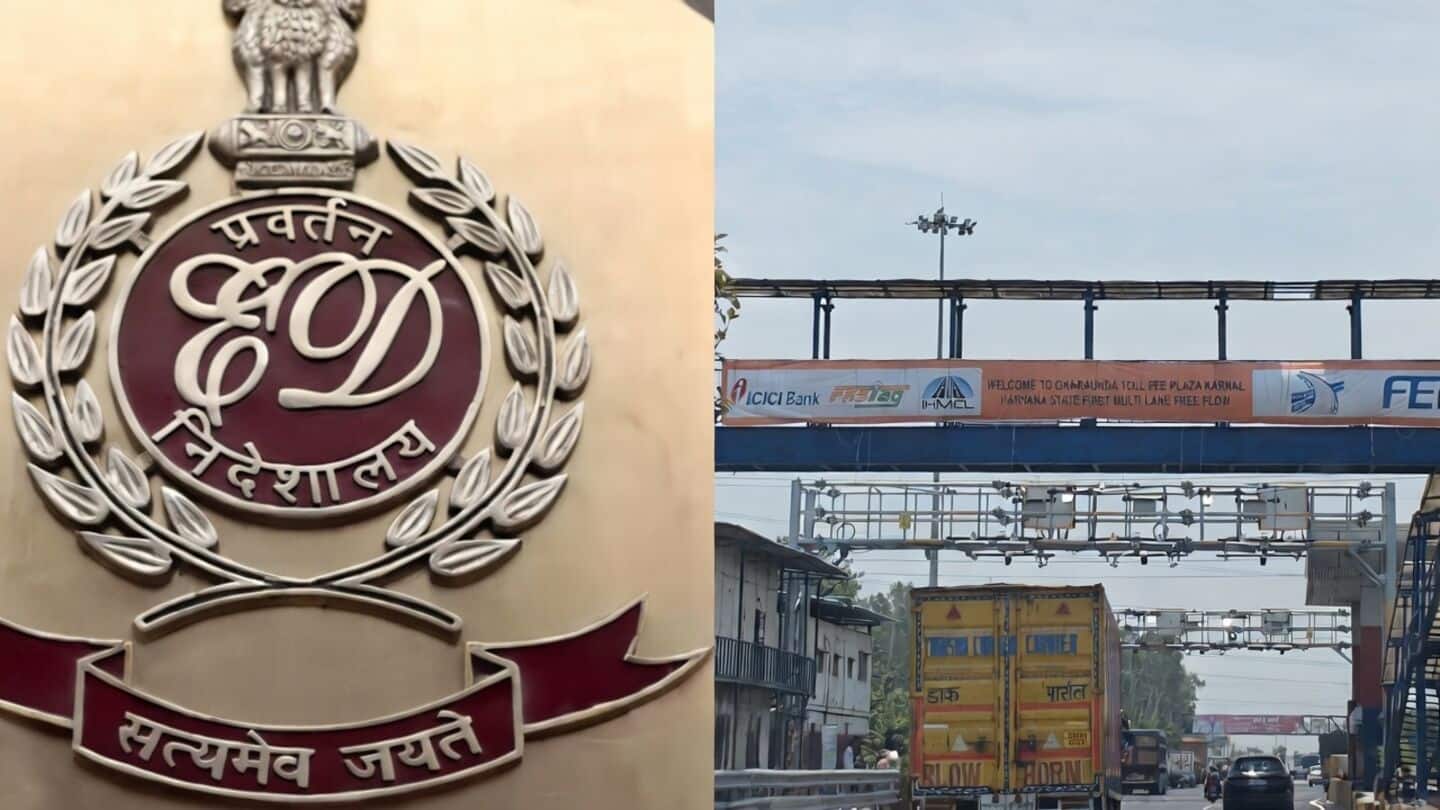
ED busts toll collection scam at 100 highway plazas
What's the story
The Enforcement Directorate (ED) has unearthed a major toll collection scam, according to PTI. The investigation revealed that around 100 highway plazas authorized by the National Highways Authority of India (NHAI) had used unauthorized digital applications to illegally collect money from vehicles without FASTag stickers. The two apps involved in this fraudulent activity were identified as 'Mobdata' and 'Any.'
Scam details
How the fraud was executed
The fraudsters used these unauthorized apps to generate fake toll receipts for non-FASTag vehicles.
This way, they could collect cash without letting the NHAI's official system know about it.
By bypassing legal toll reporting, these middlemen and authorized toll collection agencies pocketed crores of rupees, causing massive revenue losses to the NHAI.
Investigation progress
ED's crackdown on toll scam
In light of these revelations, the ED launched multi-state searches on September 2.
The agency raided 14 locations in Uttar Pradesh, Rajasthan, Madhya Pradesh, Jammu and Kashmir, West Bengal, and the Delhi-NCR region.
"Forensic examination of digital devices seized from the accused revealed that this mechanism was used on around 100 toll plazas," an official statement from the ED read.
Assets seized
Cash, documents seized during raids
During these raids, the ED seized nearly ₹1.03 crore in cash along with account books, bank documents, and digital devices.
The agency also froze eight bank accounts linked to this fraudulent activity.
The investigation was initiated based on a First Information Report (FIR) lodged by Mirzapur district police in Uttar Pradesh in January 2025.
Network expansion
Probe to continue to uncover all players involved
The ED's investigation has revealed that many middlemen and NHAI-authorized agencies were involved in using these rogue apps. The agency is continuing its probe to dismantle this larger network.
This case highlights the vulnerability of India's toll collection system and the need for stricter regulations to prevent such fraudulent activities in the future.