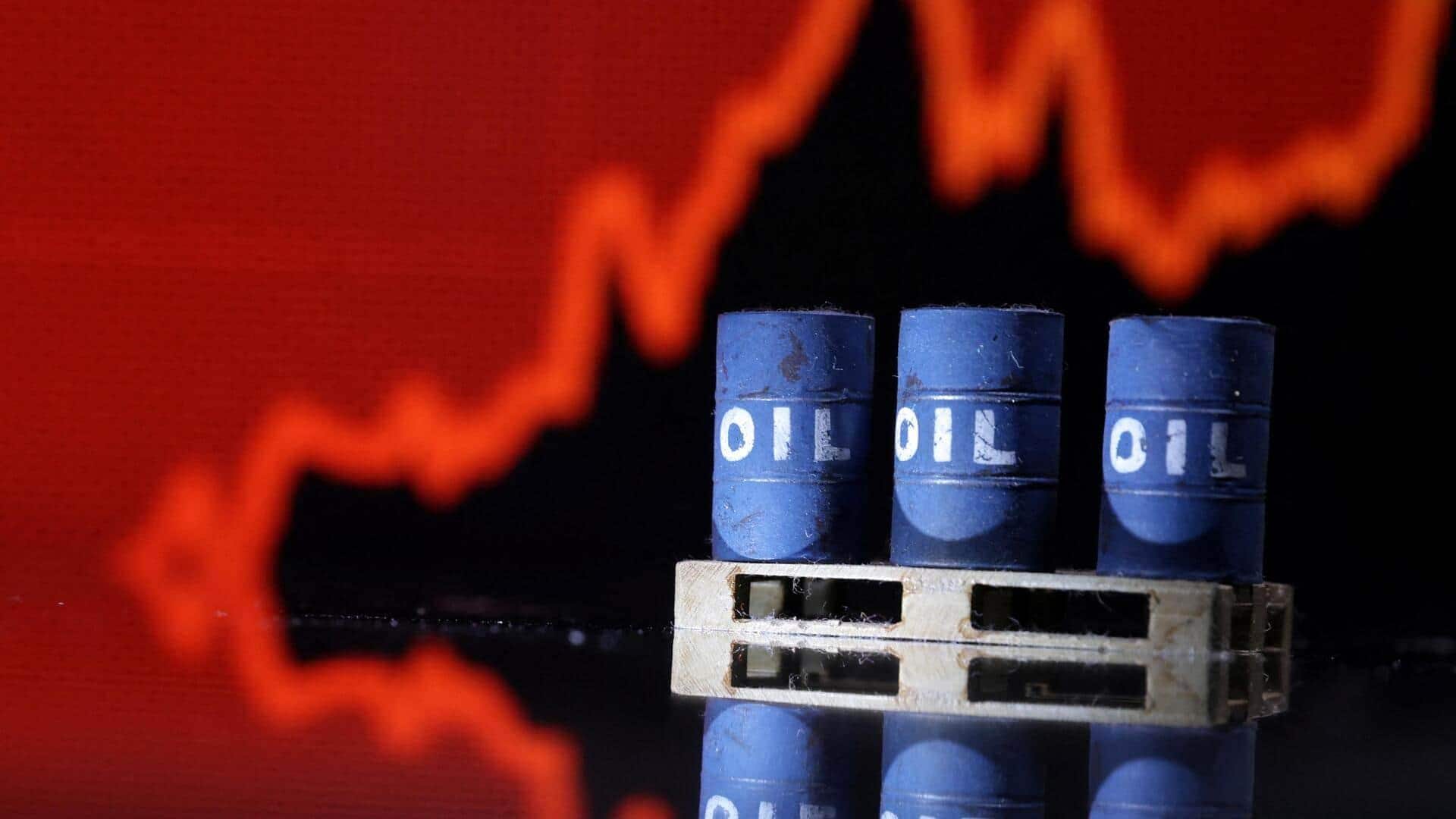
Oil prices soar as US-Iran war disrupts global supply routes
What's the story
Oil prices have soared on Thursday, owing to fears of supply disruptions from the ongoing US-Iran conflict. The prolonged closure of the Strait of Hormuz has also contributed to this spike. The Strait is a major route for oil and gas exports from the Middle East, with nearly 20% of global energy consumption passing through it. Brent crude was up 2.05% at $83.07 per barrel by 01:41 GMT while US West Texas Intermediate crude rose 2.6% to $76.6 per barrel.
Conflict escalation
Iraq and Qatar declare force majeure on oil and gas
The US-Iran war escalated on Wednesday when a US strike hit an Iranian warship off Sri Lanka. This has further complicated the situation in the region.
Iraq, OPEC's second-largest crude producer, has cut its output by nearly 1.5 million barrels a day due to lack of storage and export routes.
Meanwhile, Qatar has declared force majeure on gas exports with normal production levels expected to take at least a month to resume.
Shipping disruption
Shipping through Strait of Hormuz comes to standstill
Shipping through the Strait of Hormuz, a key route for nearly a fifth of global energy consumption, has almost come to a standstill for the fifth consecutive day amid the war on Iran and Tehran's retaliation.
A large explosion was reported by Britain's maritime trade operations agency near a tanker anchored southeast of Kuwait's Mubarak Al Kabeer.
Response strategy
J.P. Morgan warns of rising risks
Iran has so far spared most critical energy infrastructure while keeping shipping risk extremely elevated, J.P. Morgan said in a client note.
The bank estimates that about 329 oil vessels are stuck in the Gulf due to these tensions.
However, it also notes that storage capacity in Gulf Cooperation Council countries and prevailing energy prices could limit how long the US campaign can continue.
Restart potential
Potential for quick recovery in oil production levels
J.P. Morgan also said most oil fields can restart within days with full capacity usually restored within two to three weeks.
"While operators must gradually rebuild reservoir pressure, particularly in Iraq where water injection is critical, the primary constraint today is logistics rather than geology," the bank added.