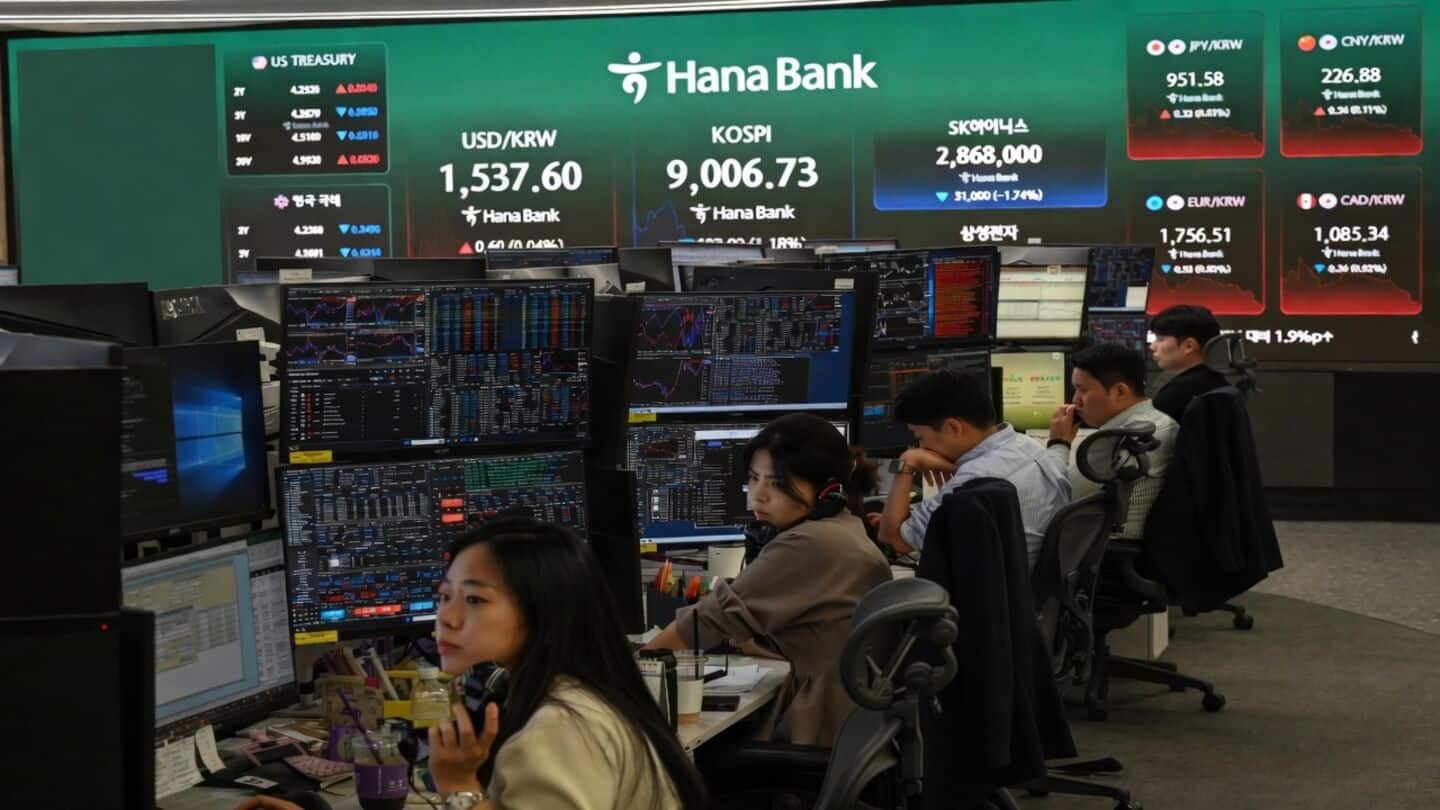
South Korea's Kospi index tumbles 8% as AI-driven sell-off deepens
What's the story
South Korea's stock market has become a prime example of how the artificial intelligence (AI) boom is reshaping global equities. The benchmark Kospi index witnessed an 8.2% drop on Friday, triggering a 20-minute circuit breaker as heavy selling engulfed the market. This comes just three days after the index had plummeted nearly 10% before staging a dramatic recovery. The extreme volatility highlights the impact of AI technology on global markets and investor sentiment.
Market impact
AI boom's cost weighs on markets
The latest sell-off is part of a wider Asian equity pullback after a stellar quarter for tech stocks.
However, South Korea's losses are particularly pronounced as it plays a crucial role in the AI supply chain.
Samsung Electronics and SK Hynix manufacture high-bandwidth memory chips that power advanced AI systems.
Despite strong earnings from Micron Technology and robust demand for AI memory chips, market sentiment remains shaky amid rising costs of sustaining the AI boom.
Market concentration
Kospi heavily weighted toward two companies
Unlike other major equity markets, the Kospi index is heavily weighted toward two companies: Samsung Electronics and SK Hynix.
Together, they account for over half of the benchmark's market capitalization.
This means that fluctuations in semiconductor stocks have a major impact on the overall market direction.
On Friday alone, Samsung Electronics fell more than 9% before trimming losses to 6.69% by midday, while SK Hynix dropped as much as 9% before recovering slightly to trade at 7.03%.
Investor behavior
Foreign investors offloading Korean equities
Foreign investors sold Kospi-listed shares worth about 2.6 trillion won ($1.68 billion) during the session, further adding to market volatility.
The market breadth was weak, with only 111 of the 915 traded stocks advancing, while a whopping 792 declined.
The extreme swings in South Korea's stock market are not just a result of changing sentiment but also heavy retail participation and rising leverage amid AI enthusiasm.
Market dynamics
Retail investors dominate trading
South Korea's volatility index has hit record highs as retail investors increasingly dominate trading.
Regulators have expressed concerns after approving leveraged exchange-traded funds linked to Samsung Electronics and SK Hynix, warning these products may have amplified market swings.
Margin debt has also hit record levels, indicating that investors are borrowing aggressively to chase the AI rally.
Investor contrast
Divergence between foreign and domestic investors
A stark contrast has emerged between foreign and domestic investors in the Korean market this year.
Foreign investors have been persistent sellers of Korean equities while retail investors have stepped in to absorb much of that supply.
According to JPMorgan, foreign investors have sold about $95 billion worth of Korean stocks so far this year, a pace that could set an annual record for foreign outflows from a single Asian market.