'Mast Mahila Mandali': Unique feminist film rewrites rules
What's the story
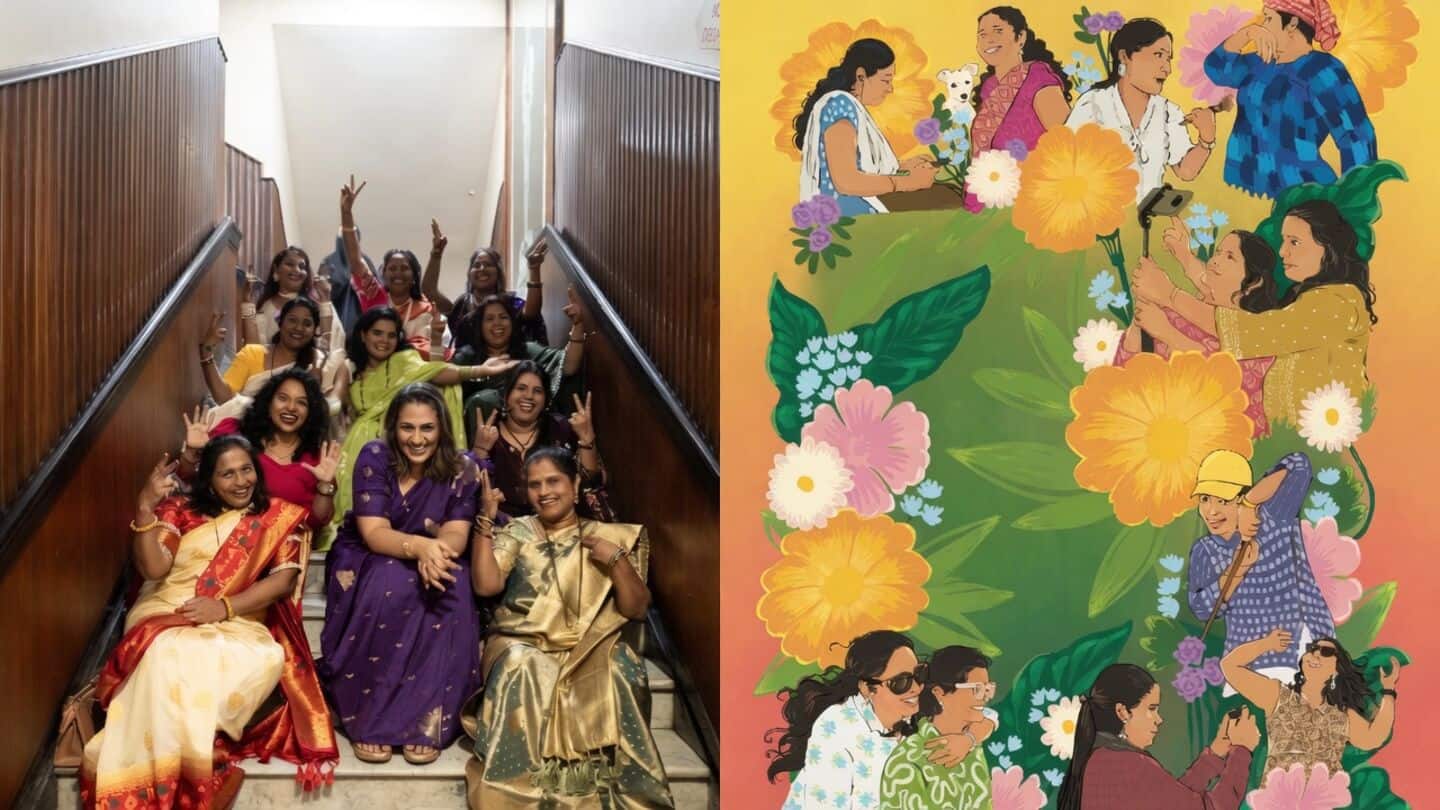
A unique documentary-feature titled Mast Mahila Mandali (Cool Ladies Club) has drawn widespread attention for its unique structure and style. The one-of-a-kind film is co-directed and headlined by 10 working-class women from Mumbai's Chembur. It captures their dreams, desires, and aspirations intimately and was screened at Mumbai's Regal Cinema in April 2026. The smartphone camera serves as a tool of agency for these women, turning their cramped living spaces into a portal of endless possibilities. Let's dive deeper.
Origin
Where did the idea come from?
CORO India, an organization implementing community-led social initiatives in Maharashtra and Rajasthan, planned to make a film with women from marginalized communities.
To put its plans into motion, CORO India's Supriya Jan invited Dr Shilpi Gulati, a National Award-winning filmmaker, to co-direct the project with the women.
Dr Gulati and the women, Anjum Shaikh, Nazneen Siddiqui, Darshana Mayekar, Rehana Shaikh, Gauri Rane, Rohini Kadam, Kavita Ghuge, Sheetal Navle, Kavita Khomne, and Vaishali Man, worked on the project for 18 months.
Vision
The women received training in filmmaking
Speaking about her vision, Dr Gulati told Feminism in India, "I proposed facilitating a filmmaking workshop because I felt that if the women were truly to co-direct the film, they first needed to be trained in the medium. We then began identifying the women who would participate in the process."
During the workshops, the women spent hours together, recording each other doing everyday tasks such as cooking, eating, and talking, etc.
Film highlights
Everyday moments captured in documentary
The 72-minute project captures raw, real, slice-of-life moments that speak directly to the viewer.
One of the standout scenes features Shaikh's impromptu dance to Aaj Ki Raat while cooking.
Another memorable moment is when Khomne reads the Indian Constitution during an interview about her infectious laughter.
Meanwhile, Mayekar notes, "For 20 years, I have been busy raising a family and working. While making the film...I was able to live a little for myself. I am 50, but I feel 20."
Breaking norms
Not about suffering, but living freely: Siddiqui
Siddiqui emphasized that their project is not about suffering but about living freely.
She said, "When a film is made about a basti, people imagine it to be all about suffering... All of us live in a basti too; but we laugh, play and live freely."
"Where a stove is burning in front, and a song plays over about all the sadness in the world...we wanted to show that women can live happily anywhere and not only in high rises."
Shooting process
How the women felt about shooting on phones
Kadam talked about the process of shooting on smartphones.
Feminism in India quoted her as saying, "Many of us had not even used phones apart from calling and messaging. Filmmaking on a phone was new to us."
"We did wonder who would want to watch a film about us, our friendships, and our neighborhood. But gradually we realized that we can document our own lives and present them as a wonderful film."
Film's core
Themes of friendship and unity
The documentary also explores themes of friendship and female solidarity, with the women supporting each other to overcome their anxieties.
CORO India's founding director, Dr. Sujata Khandekar, called it a feminist film for these qualities.
The documentary is unique in combining the experiences of 10 women and telling 10 diverse stories without a traditional, coherent structure, breaking away from conventional "NGO filmmaking."
Community spirit
A remarkable achievement in collaborative filmmaking
Mast Mahila Mandali is a remarkable achievement in collaborative filmmaking where the subjects are also behind the camera.
Jan reflected on the film's unique community spirit, telling The Hindu, "Through the film, we tried to create a safe space built on trust where we can fearlessly have heart-to-heart conversations."
The copyright for this project is shared equally by all 11 directors, emphasizing their co-creation process.