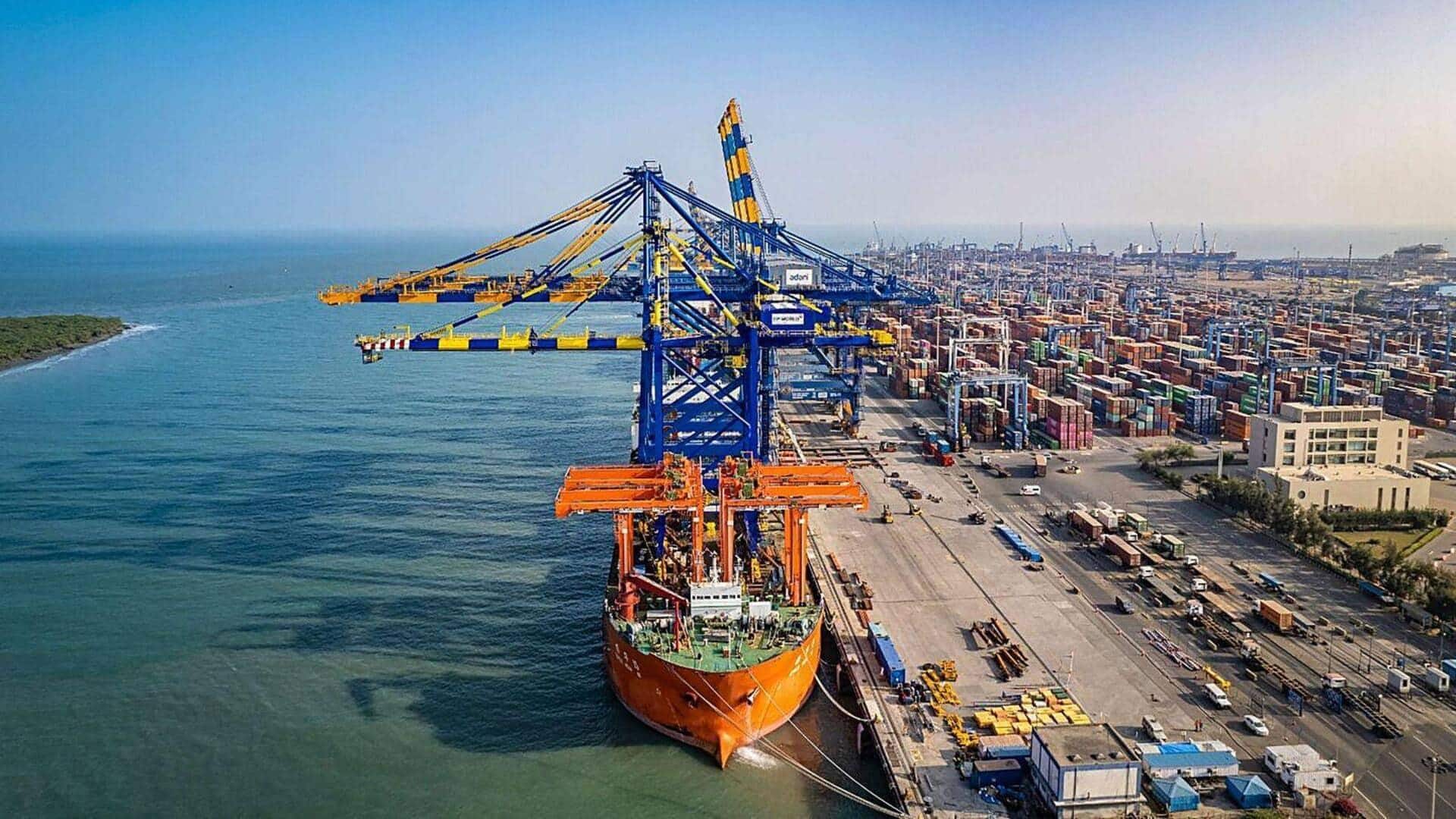
100 ships stuck at Kerala port amid Hormuz blockade
What's the story
The Vizhinjam Port in Thiruvananthapuram, Kerala, has become a major hub for increasing vessel traffic due to the US-imposed blockade of the Strait of Hormuz. The Week reported that nearly 100 ships from eight global shipping companies are now waiting for berths at Vizhinjam. These vessels are unable to reach ports in the United Arab Emirates (UAE) because of the ongoing Gulf conflict.
Location advantage
Strategic location of Vizhinjam Port
Vizhinjam Port is strategically located near a major international shipping route, being "just 10 nautical miles off the route" normally taken by vessels heading to the UAE.
This location allows ships to avoid the longer journey along India's western coast to reach ports like Mumbai or Mundra.
The port's proximity not only saves travel time but also reduces fuel costs for these vessels.
Capacity constraints
Capacity constraints at Vizhinjam Port
Despite the increased demand from vessels coming from Europe, South America, China, and Singapore, Vizhinjam Port is unable to fully take advantage of this opportunity due to limited capacity.
The port's container berth, which is 800 meters long under phase one, can only accommodate two mother ships or four feeder vessels at a time.
Much of this space has been booked by the Mediterranean Shipping Company, leaving little room for other vessels and limiting potential revenue from additional cargo operations.
Future expansion
Expansion plans underway
To address these capacity constraints, expansion plans are already in motion.
Phase two of the project, funded by ₹10,000 crore from Adani Vizhinjam Port Private Limited (AVPPL), will extend the berth length from 800 meters to 1,200 meters by 2027 and further to 2,000 meters by 2028.
Once completed, this expanded berth will be able to accommodate three mother ships by 2027 and five by 2028—an increase from the current capacity of two.