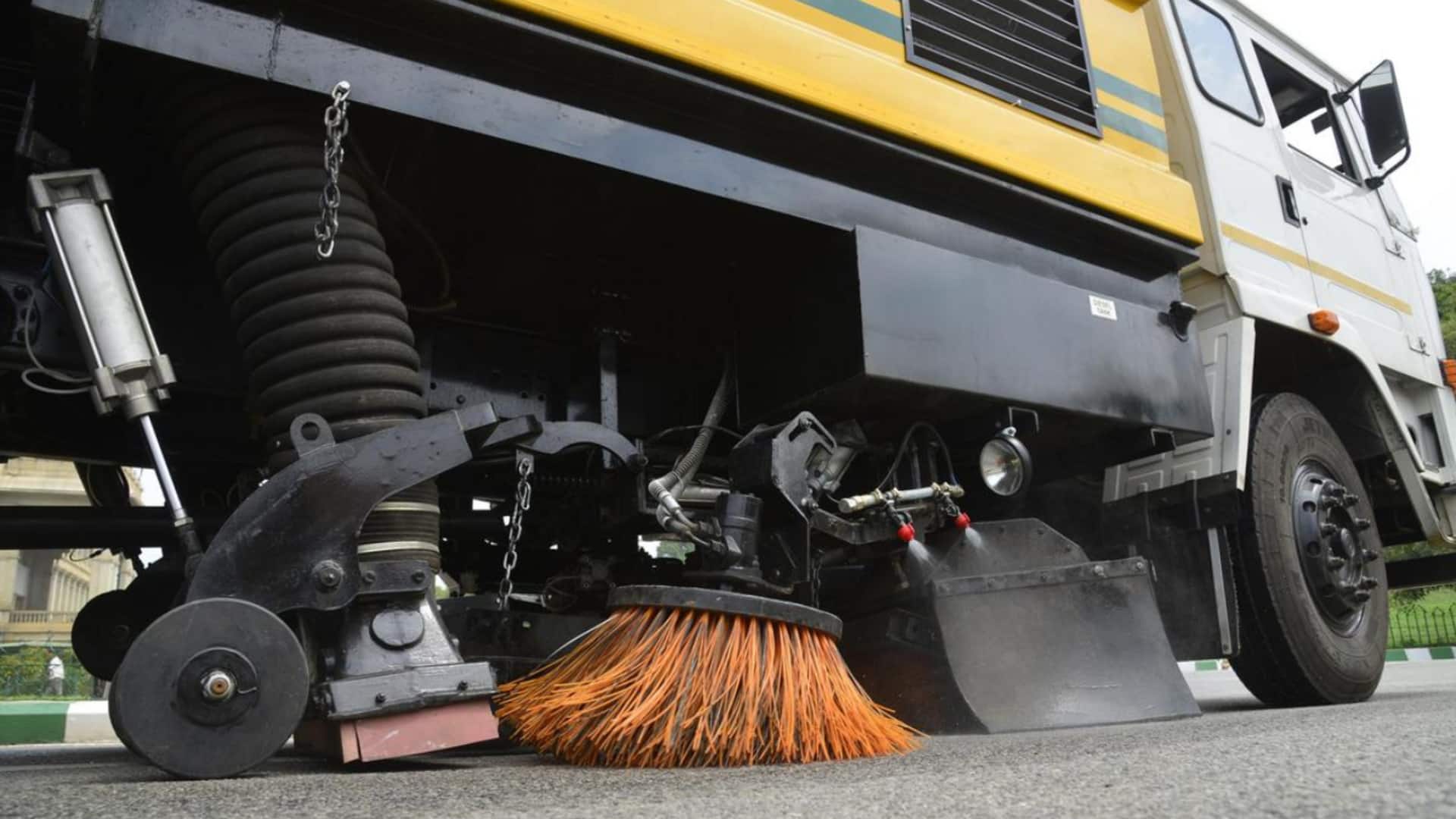
Only 5% of Delhi roads swept by pollution-reducing machines: Report
What's the story
As pollution worsens in Delhi, the city's fleet of Mechanical Road Sweeping Machines (MRSMs) is falling short. A report by The Indian Express found that these machines only cover a small portion of the city's roads. The study tracked 52 geo-tagged MRSMs managed by the Municipal Corporation of Delhi (MCD) from March 2025 to March 2026 using geospatial mapping and route-level analysis.
Pollution source
Road dust contributes significantly to Delhi's air pollution
Despite public focus on vehicles and stubble burning, road dust is a major contributor to Delhi's air pollution.
A 2016 study by IIT Kanpur found that road dust contributes 56% of PM10 emissions and 38% of PM2.5.
In summer, when dust levels peak, it accounts for 38% of PM2.5 and 41% of PM10, according to a TERI study in 2018.
Fleet shortage
Only 5 routes account for sweeping distance
Delhi had only 76 MRSMs during the study period, far fewer than the 505 recommended by the Centre to the Commission for Air Quality Management (CAQM).
Recent additions have increased this number to 95, but it still falls short by over 80%.
The report also found that MRSMs are not deployed where they are most needed. Only five of 52 designated routes accounted for nearly 18% of the total sweeping distance.
Coverage disparity
Skewed distribution of machines across the city
The fleet also has a skewed distribution across the city. Central and South zones have the largest fleets, while Narela, Shahdara North, and Karol Bagh are poorly served.
A senior MCD official said routes are decided by traffic congestion and requests from senior officials, with more machines going to areas with VIP residences.
Seasonal impact
Machines more active during winter due to political pressure
The report also highlighted that MRSMs are more active during winter due to political pressure, not public health needs.
In summer 2025, only 25 sweeping routes were active daily. Major roads saw similar trends, with only 51.59% covered in summer compared to higher coverage during stricter GRAP measures in November.
A TERI audit found that these machines can pick up 80% or more of PM10 particles from paved roads.