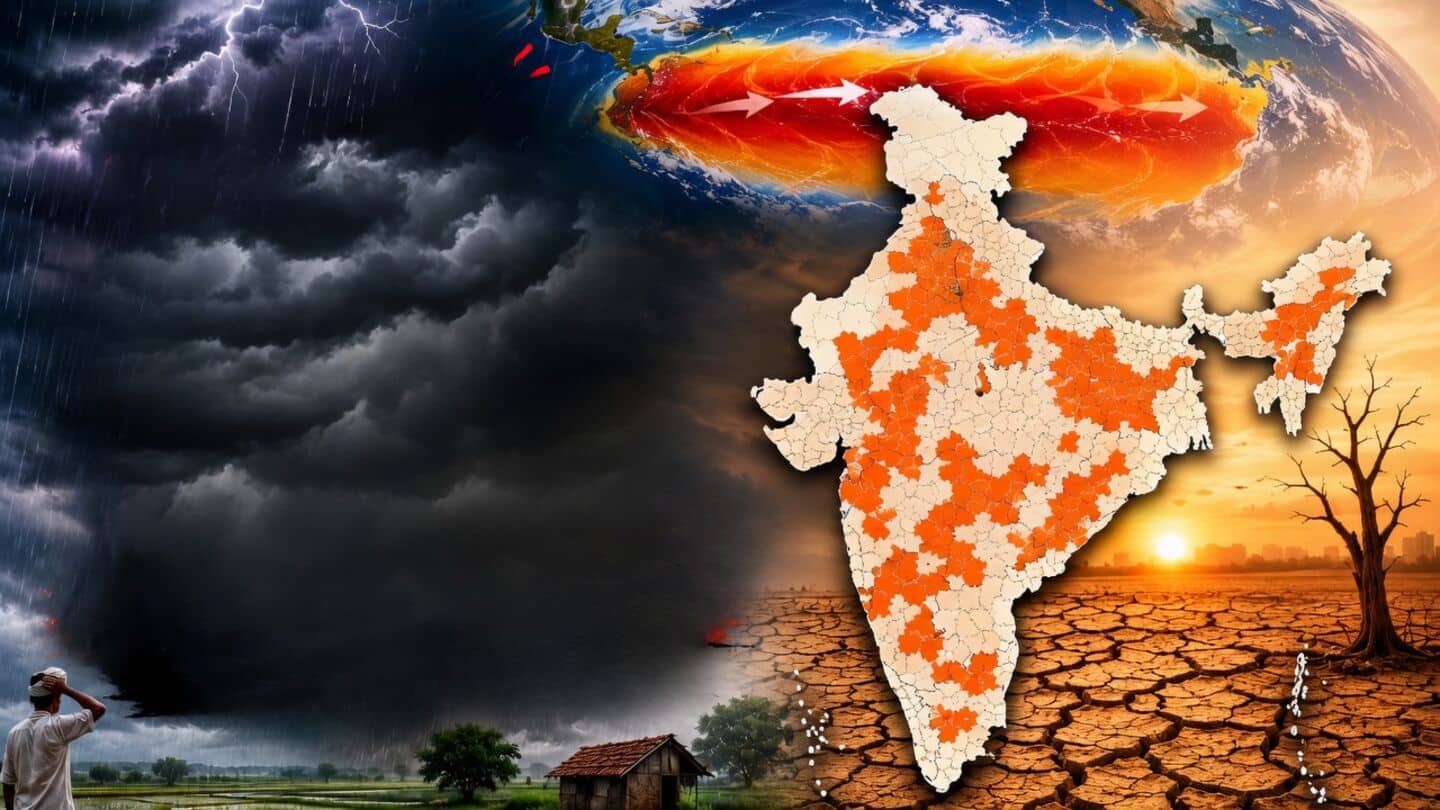
El Nino alert: 315 Indian districts face low rainfall risk
What's the story
India is preparing for the possible impact of El Nino, a weather phenomenon that can cause reduced monsoon rainfall. The central government has identified 315 districts at risk of rainfall deficit this season. Of these, 111 districts are high-priority areas that depend on monsoon rains and have little irrigation coverage.
Preparedness measures
Contingency plans include promoting drought-resistant crops
The government has put in place a system of special monitoring to help farmers and protect crop production. Contingency plans include promoting drought-resistant crops and water management systems.
An 'El Nino Monitoring Cell' and 'Crop Weather Watch Group' have been set up to monitor rainfall patterns, crop conditions, and water levels during the monsoon season.
Weather phenomenon
What is El Nino?
El Nino is a climate pattern characterized by unusually warm ocean temperatures in the Pacific Ocean.
It usually weakens India's monsoon season, which provides nearly 70% of the country's annual rainfall needed for agriculture, drinking water, and hydropower.
Central, western, and northwestern India are usually the worst affected by El Nino-related rainfall deficits.
Mitigation strategies
Union minister directs officials to monitor rainfall patterns
Union Agriculture Minister Shivraj Singh Chouhan has directed officials to closely monitor rainfall patterns and crop conditions in vulnerable regions.
He stressed that preparedness must translate into timely action on the ground.
The government is updating District Agriculture Contingency Plans (DACP) to minimize crop losses and ensure farmers have access to alternative strategies if monsoon conditions deteriorate.
Conservation efforts
Water conservation major focus area
Water conservation is a major focus area, with states being asked to strengthen water-harvesting infrastructure.
Farmers are encouraged to adopt short-duration and low-water-consuming crops.
The government is ensuring advance availability of agricultural inputs such as seeds and fertilizers.
States have been directed to monitor prices and prevent hoarding or black marketing that could disrupt supplies.
Food security
Centre paying special attention to districts with low irrigation coverage
The government expressed confidence that adequate foodgrain stocks and advance planning would help prevent any major impact on food security.
Officials noted that large-scale kharif sowing has not yet begun in Madhya Pradesh, making rainfall in the coming weeks crucial for farmers.
The Centre is paying special attention to districts with low irrigation coverage and high dependence on monsoon rains as El Nino conditions become more pronounced.