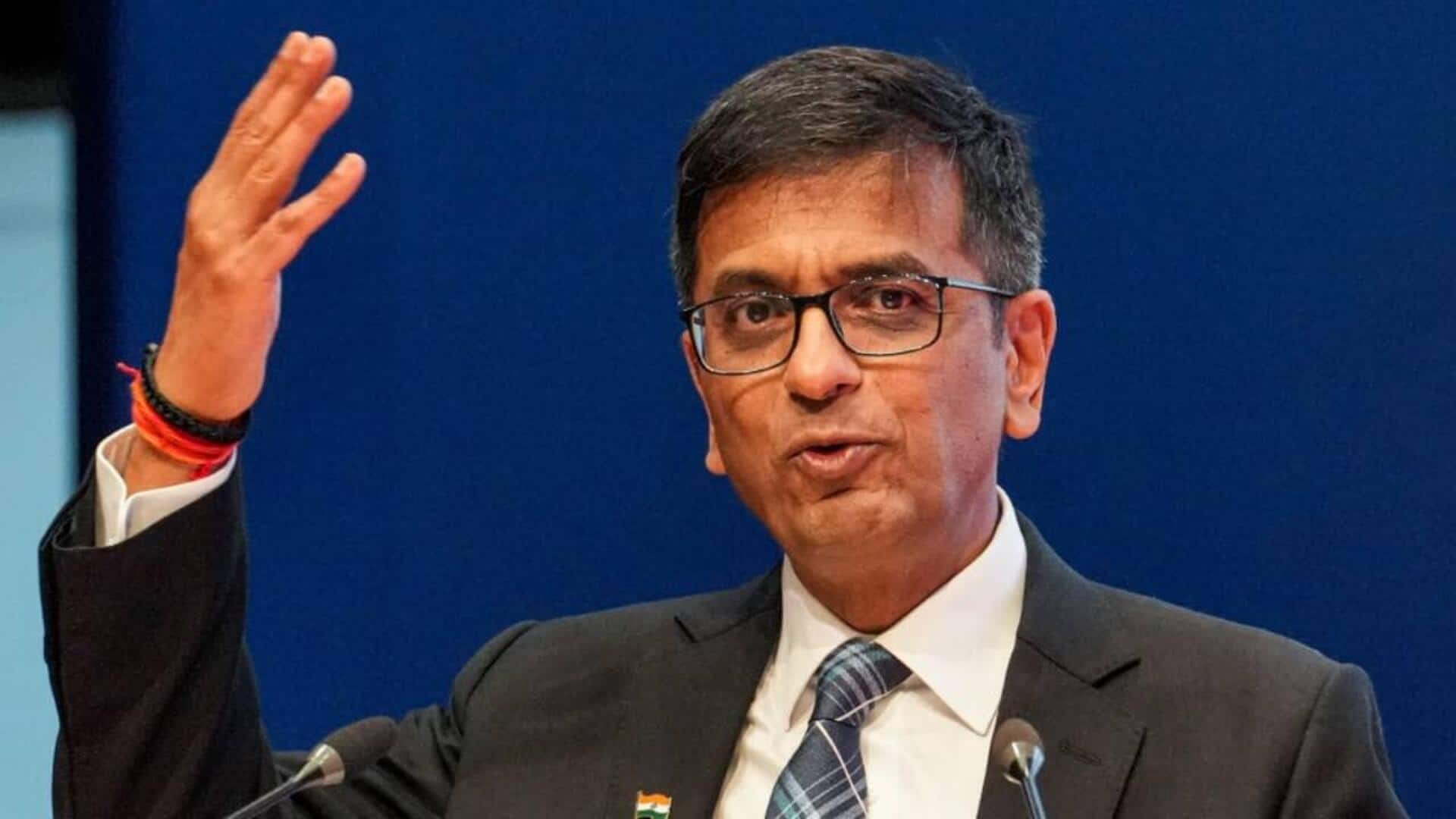
'Bail must be norm...': Ex-CJI Chandrachud on Umar Khalid's case
What's the story
Former Chief Justice of India (CJI) DY Chandrachud has said that bail should be the rule if an expeditious trial is not possible. He made the remarks in response to a question from a journalist, who asked him about the Supreme Court recent verdict denying bail to activist Umar Khalid in the 2020 Delhi riots conspiracy case. Khalid has been in jail since September 2020 pending trial. "Bail, before the constitution, should be a matter of right," Chandrachud said.
Legal principle
'Pretrial detention can't be a form of punishment'
Chandrachud emphasized that pretrial detention should not be punitive.
"If someone is jailed for five to seven years before trial and then is acquitted finally, how would you compensate for that lost time?" he asked.
He highlighted that bail is denied only when there are chances of re-offending, tampering evidence, or fleeing.
"If these three exceptions are not made out, bail has to be the rule," he said.
Judicial scrutiny
'Presumption of innocence...turned on its head'
However, he said the problem that we are facing today is this: a "lot of our laws, particularly those relating to national security, have turned the law on its head by substituting the presumption of innocence with almost a presumption of guilt."
He added that the right to life under Article 21 includes the right to a speedy trial, and unless exceptions are made out in a particular case, accused persons are entitled to bail.
Systemic issues
'Distrust of system instills fear among judges'
Chandrachud also spoke about a growing public distrust of the legal system, which he said instills fear among judges.
This fear often leads to referrals to higher courts instead of granting bail in simple cases.
He noted that the Supreme Court now handles around 70,000 cases annually due to this culture of distrust.
"No Supreme Court, except perhaps Brazil's, deals with such volume...But how do we answer this general culture of distrust for public authority? That's the problem," he said.
Transparency call
'Most criticism of collegium system is misplaced'
Chandrachud also called for greater transparency in the collegium system to build public confidence.
He said most criticism of this system is misplaced, as judge appointments are vetted at different levels, including High Courts and state governments.
He proposed public criteria for judge selection on the Supreme Court's website to enhance transparency further.
"The members of the collegium should be recommended by the Chief Justice, and his recommendations should be placed before the President...for final selection," he said.