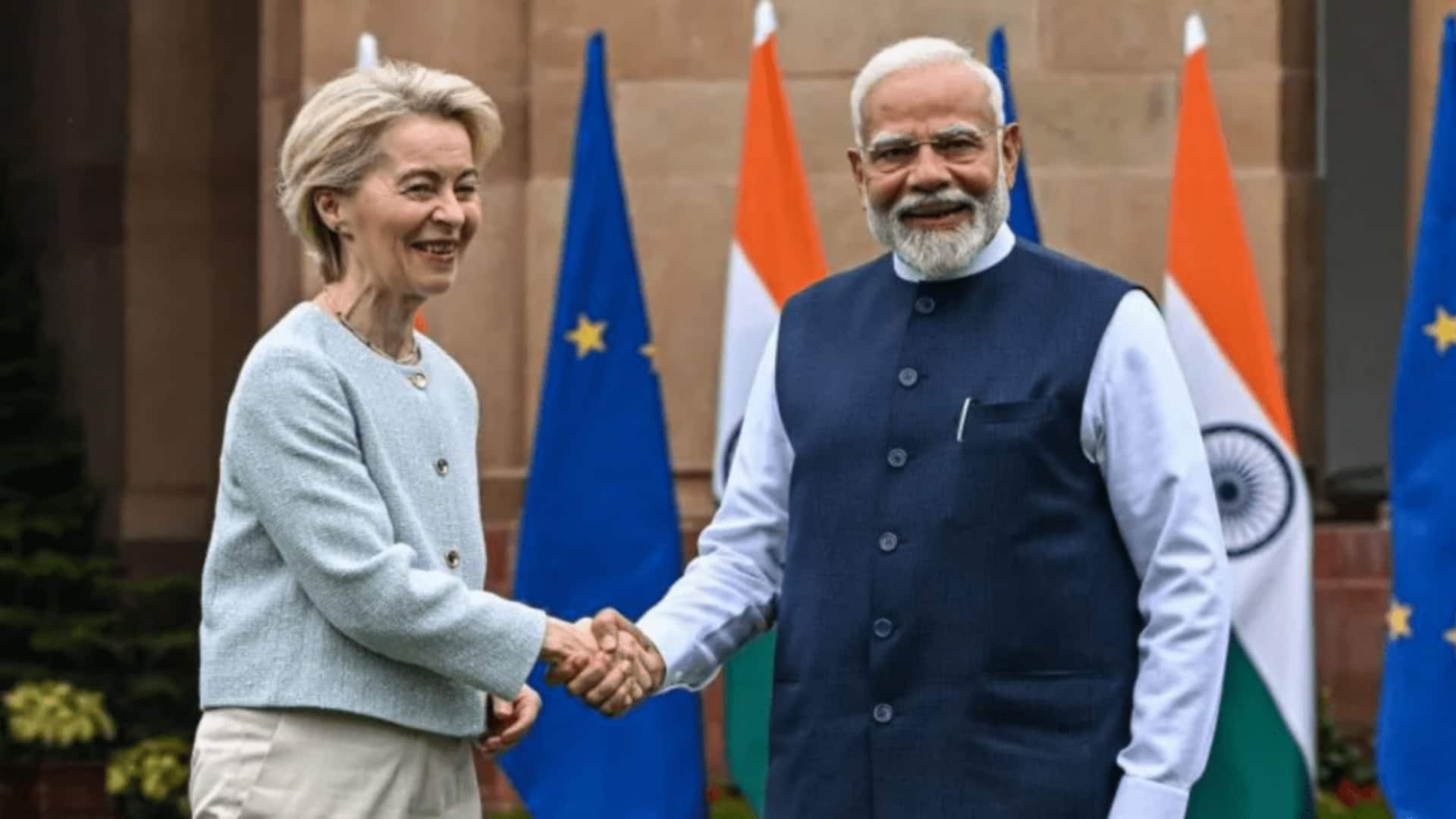
India, EU finalize free trade agreement after 18 years
What's the story
India and the European Union (EU) have finalized negotiations for a free trade agreement (FTA). The announcement was made at Hyderabad House following a high-level summit between Prime Minister Narendra Modi, European Commission President Ursula von der Leyen, and European Council President António Costa. At a joint press conference, PM Modi described the moment as historic, underlining the deepening partnership between India and the European Union.
Summit details
Historic announcement on cards
The two sides had initiated negotiations for the FTA in 2007, although talks were suspended in 2013. PM Modi praised von der Leyen as a global role model, saying, "Ursula is the first woman president and an inspiration for the world." Last week, Von der Leyen said India and the EU are on the cusp of a "historic trade agreement" that would create a market comprising two billion people.
Economic impact
FTA to enhance trade, investment between India and EU
The FTA is expected to boost trade and investment between India and the EU. It will provide zero-duty access to several key Indian product segments such as textiles, leather, and marine products. In return, India will have to make concessions in sectors like automobiles, wines, and spirits. European Commissioner for Trade Maros Sefcovic said they are looking at full or partial tariff reduction on 97-99% of goods while considering sensitivities in the agriculture and dairy sectors.
Legal proceedings
FTA's legal vetting and ratification process underway
The FTA will now undergo a legal vetting process over the next five-six months before it is signed. After this, it will be ratified by the European Parliament. However, each member-state of the 27-nation bloc won't have to approve it as it doesn't contain "mixed competence." The deal is likely to be signed this year and may be implemented early next year.
Trade liberalization
FTA to liberalize trade in services sectors
Apart from goods, the FTA will also liberalize trade in the services sectors such as telecommunications and transportation. This is expected to help Indian exporters diversify their shipments and reduce dependence on China. India-EU bilateral trade was $136.53 billion in 2024-25, with exports worth $75.85 billion and imports worth $60.68 billion. India saw a trade surplus of $15.17 billion for the year. The EU accounts for about 17% of India's total exports while constituting 9% of its total imports.
Trade focus
Defense framework pact, strategic agenda
Tuesday's meeting focused on trade, defense and security, climate change, critical technologies, and strengthening the rules-based global order. The EU and India also announced a defense framework pact and a strategic agenda, Security and Defence Partnership (SDP), with the bloc looking to reduce dependence on the US and China. Highlighting the scale of engagement, Modi said bilateral trade between India and the EU has reached $180 billion, while over eight lakh Indians currently live and work across European nations.