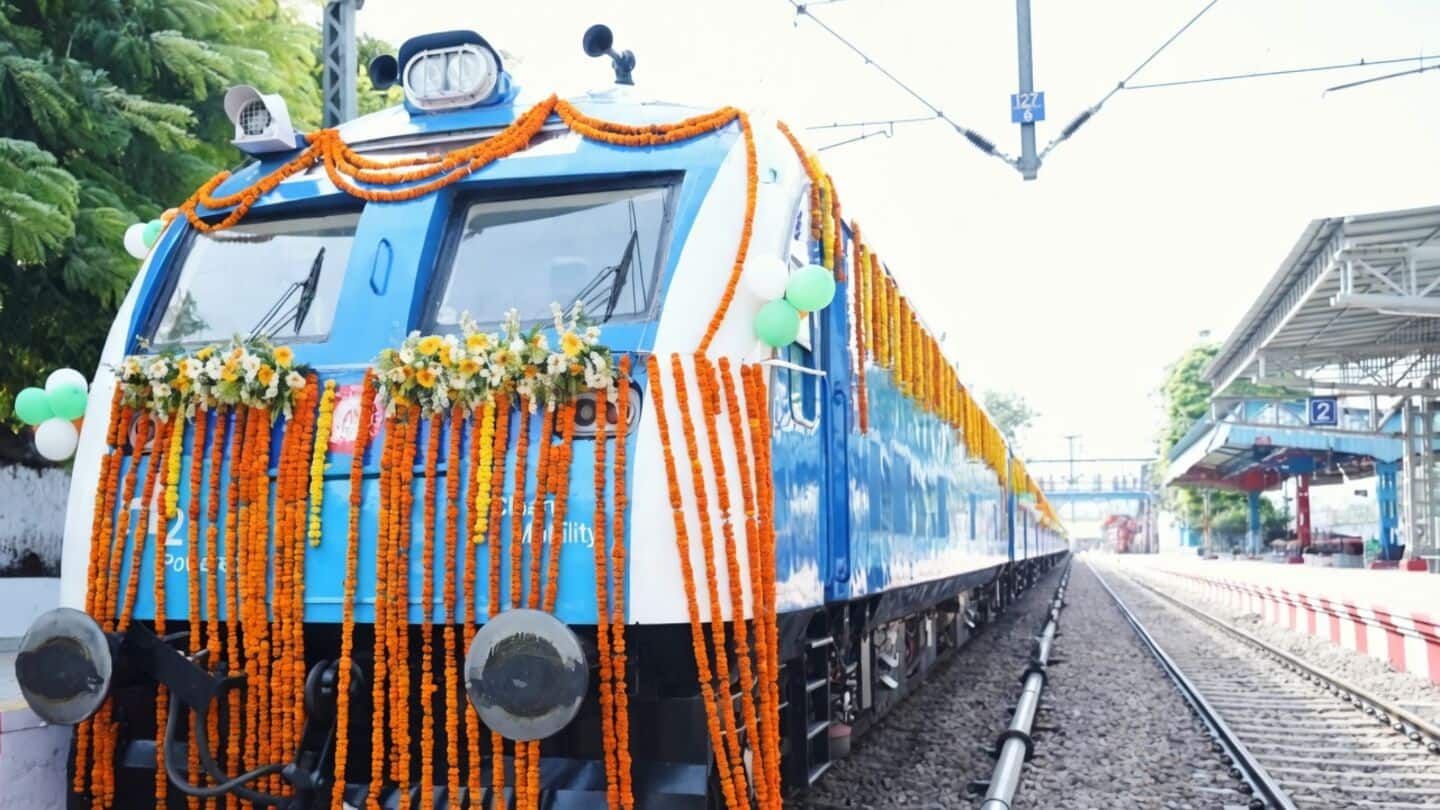
PM flags off India's 1st hydrogen-powered train: All about it
What's the story
Prime Minister Narendra Modi has flagged off India's first hydrogen-powered train. The train will operate on the 89-km Jind-Sonipat route in Haryana under the Northern Railway. Ahead of the launch, Modi posted, "India has become one of the select group of nations that have such trains." This is the first time hydrogen fuel cell technology is being used in India, which will use hydrogen fuel cells to generate power, making it a greener alternative to diesel trains.
Train details
Train can carry around 2,600 passengers
The hydrogen-powered train is a 10-car hydrogen fuel cell-based trainset. It has a 1200 kW hydrogen fuel cell propulsion system and can run at a maximum speed of 75km/h.
The train can carry around 2,600 passengers and will connect Jind Junction, Gohana Junction, and Sonipat while stopping at several intermediate stations.
Proposed halts include Jind City, Pandu Pindara Junction, Lalit Khera Halt, among others.
Twitter Post
Visuals of train ahead of launch
VIDEO | Jind, Haryana: Prime Minister Narendra Modi will flag off India's first hydrogen-powered train between Jind and Sonipat at Jind railway station today. School children to experience 'green transport'. Visuals from Jind Railway Station. #Jind #HydrogenTrain
— Press Trust of India (@PTI_News) July 17, 2026
(Full video… pic.twitter.com/831ht0eeUv
Global context
Hydrogen trains in other countries
With this development, India has joined an elite group of countries with hydrogen-powered rail transportation.
Germany was the first to launch such a train, the Alstom Coradia iLint, which completed a record 1,175km journey without refueling in 2022.
Japan is set to introduce its first hydrogen hybrid train by fiscal year 2027 on select railway lines near Tokyo.
US initiative
Hydrogen train in the US
In 2024, California launched the US's first hydrogen-powered passenger train, Zemu, in San Bernardino.
The zero-emission train uses a hybrid hydrogen fuel cell and battery system for operation and was designed to improve air quality in the region.
According to The Guardian, Zemu produces only water vapor as a byproduct and runs on a nine-mile (14.4km) line known as the Arrow Corridor.