Japan joins India to condemn cross-border terrorism from Pakistan
What's the story
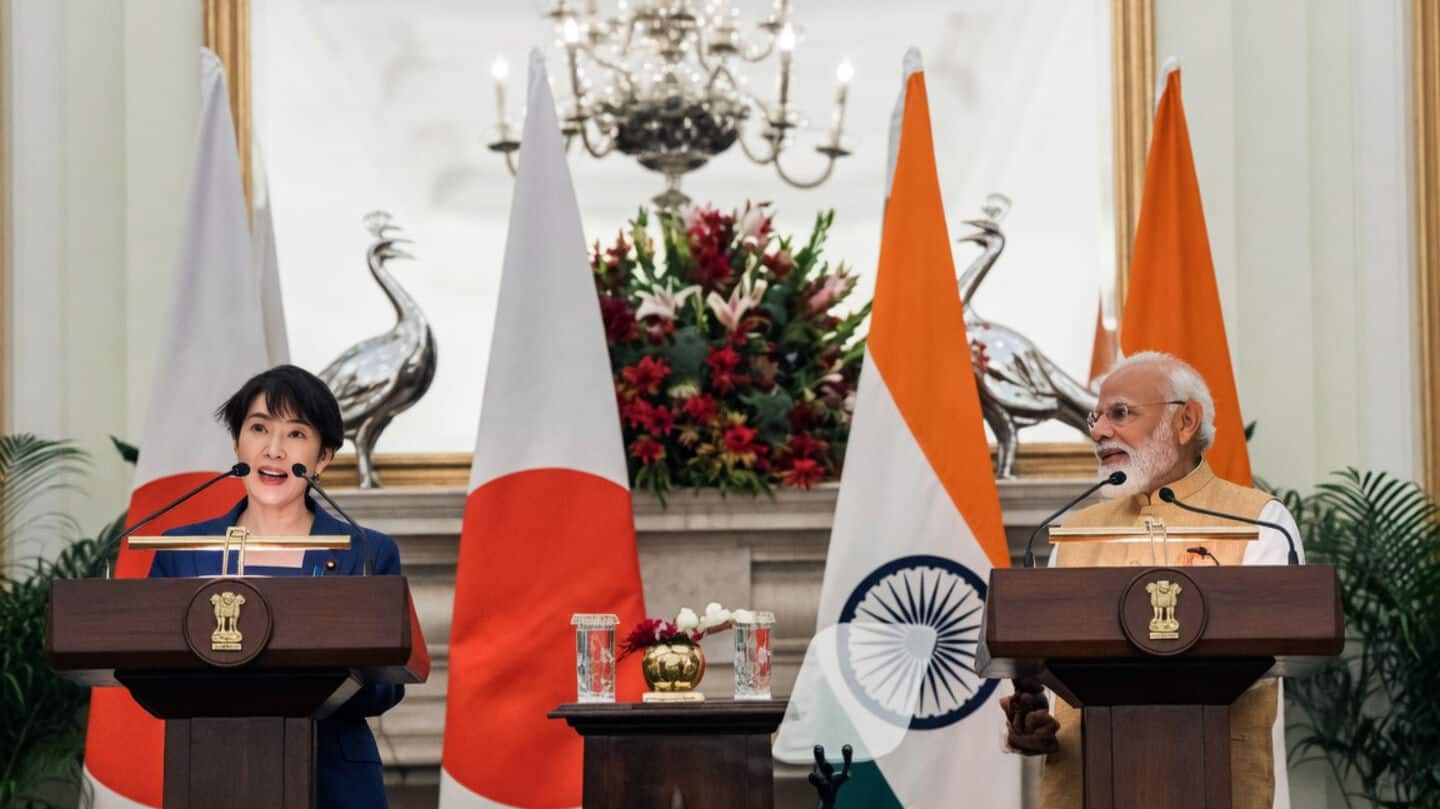
India and Japan have jointly condemned cross-border terrorism from Pakistan. The condemnation was issued after bilateral talks between Indian Prime Minister Narendra Modi and Japanese PM Sanae Takaichi. The two leaders took a strong stand against the rising threat of terrorism in South Asia, specifically mentioning the April 2025 terrorist attack on tourists in Pahalgam, Jammu and Kashmir, which was blamed on The Resistance Front (TRF).
Justice demanded
Leaders demand immediate action against attackers
They also condemned the car bombing near Red Fort in November 2025, which killed 14 people.
They called for the perpetrators, organizers, and financiers of this "reprehensible act to be brought to justice without...delay."
They also called for concerted actions against all UN-listed terrorist groups and entities, including Al Qaeda, ISIS/Daesh, Lashkar-e-Tayyiba (LeT), Jaish-e-Mohammad (JeM) and their proxies, and to take resolute actions to root out terrorists' safe havens and eliminate terrorist financing channels and their nexus with transnational crime.
Regional stability
Discuss South China Sea, East China Sea tensions
Apart from terrorism, the two leaders also discussed the East China Sea and South China Sea tensions.
They opposed unilateral actions threatening freedom of navigation and overflight and attempts to change the status quo by force or coercion and called for peaceful resolution of maritime disputes under international law.
They reaffirmed that maritime disputes must be resolved peacefully and in accordance with international law, as reflected in the United Nations Security Council (UNSC).
Diplomatic support
Leaders pledge support for UNSC bids
Further, both countries expressed their mutual support for each other's candidature for a permanent seat in a reformed UNSC.
They underscored the need for UN reform to increase the efficiency and effectiveness of the UN that contributes to global governance in a changing world.
They also discussed North Korea's nuclear program and called for denuclearization and sanctions enforcement.
The leaders underscored the need to secure free navigation through the Strait of Hormuz amid Middle East tensions.