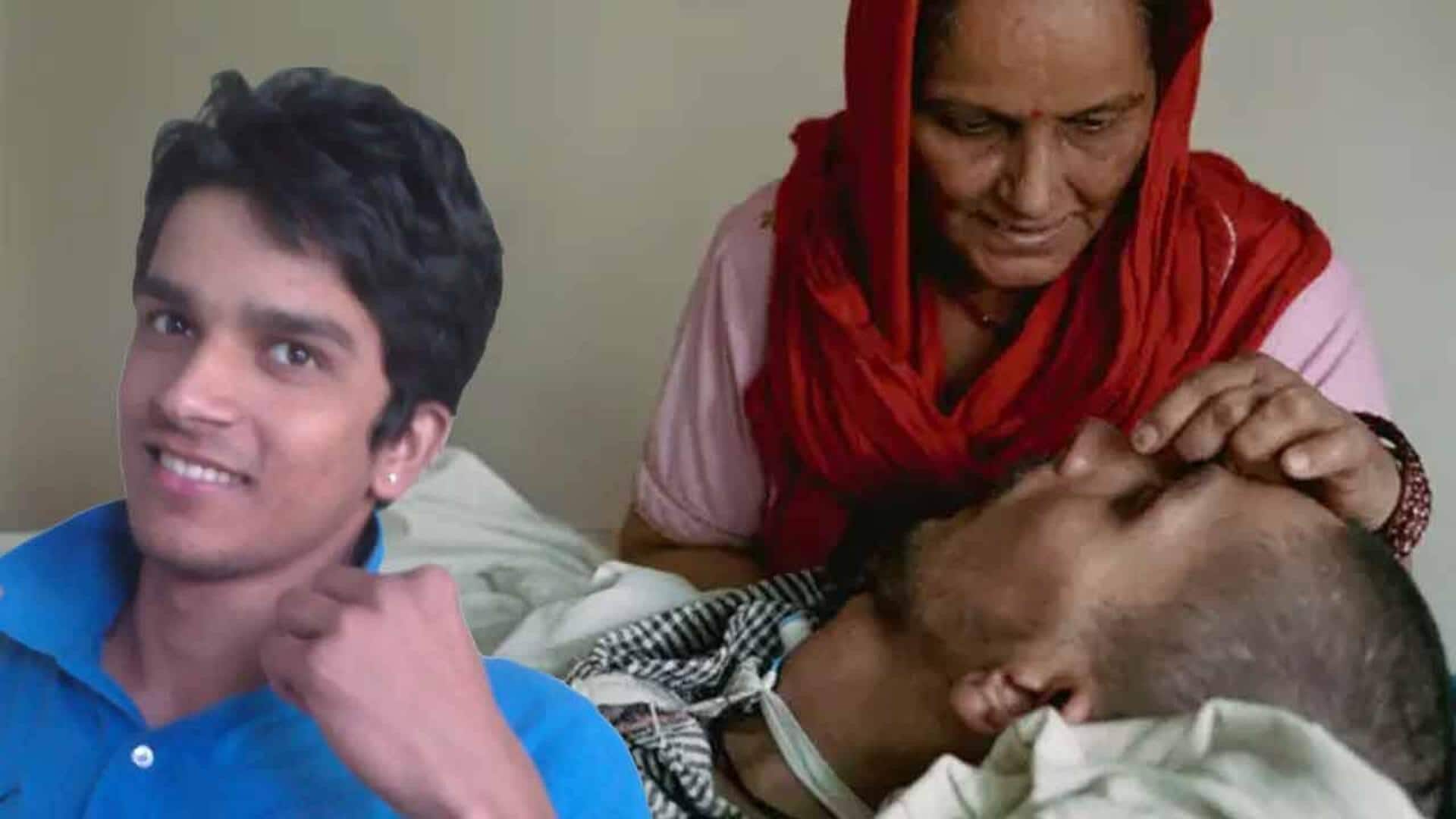
Judge tears up while allowing passive euthanasia for Harish Rana
What's the story
Justice JB Pardiwala got emotional while delivering a verdict that allowed passive euthanasia for Harish Rana, in his early 30s, who has been in a vegetative state for 13 years. The Supreme Court bench of Justices Pardiwala and KV Viswanathan permitted Rana's parents to withdraw life-sustaining medical treatment. The court held that the key question is not whether death is in the patient's best interest, but if continuing treatment serves their best interest.
Patient welfare
Rana has been on CAN through peg tube
The court noted that Rana experiences sleep-wake cycles but has no meaningful interaction and is completely dependent on others for self-care.
He has been on Clinically Administered Nutrition (CAN) through a PEG tube without any improvement in his condition.
The bench said, "In line with our considered view, it would be permissible for the medical board to exercise its clinical judgment regarding the withdrawal of treatment in accordance with the guidelines laid down in Common Cause v. Union of India."
Emotional verdict
Bench recalled how Rana was 'a bright young boy'
Reading out the judgment, Justice Pardiwala became emotional and said that Rana was once "a bright young boy" studying before his accident.
Rana had suffered severe brain injuries after a fall 13 years ago and has been in a persistent vegetative state since.
Earlier, the bench, while reserving the verdict, acknowledged the complexity of the issue, saying, "These issues are delicate....We are also mortals. Who are we to decide who lives or dies?"
Treatment withdrawal
Withdrawal of life support should be done in dignified manner
After allowing Rana's father's miscellaneous plea to remove all life-sustaining treatment, the court emphasized that the withdrawal of life support should be done in a dignified manner.
It directed AIIMS to admit Rana to its palliative care center for this purpose.
The court also asked high courts to direct Judicial Magistrates to receive intimation from medical boards about such decisions and suggested that Chief Medical Officers maintain panels of Registered Medical Practitioners for secondary medical boards.