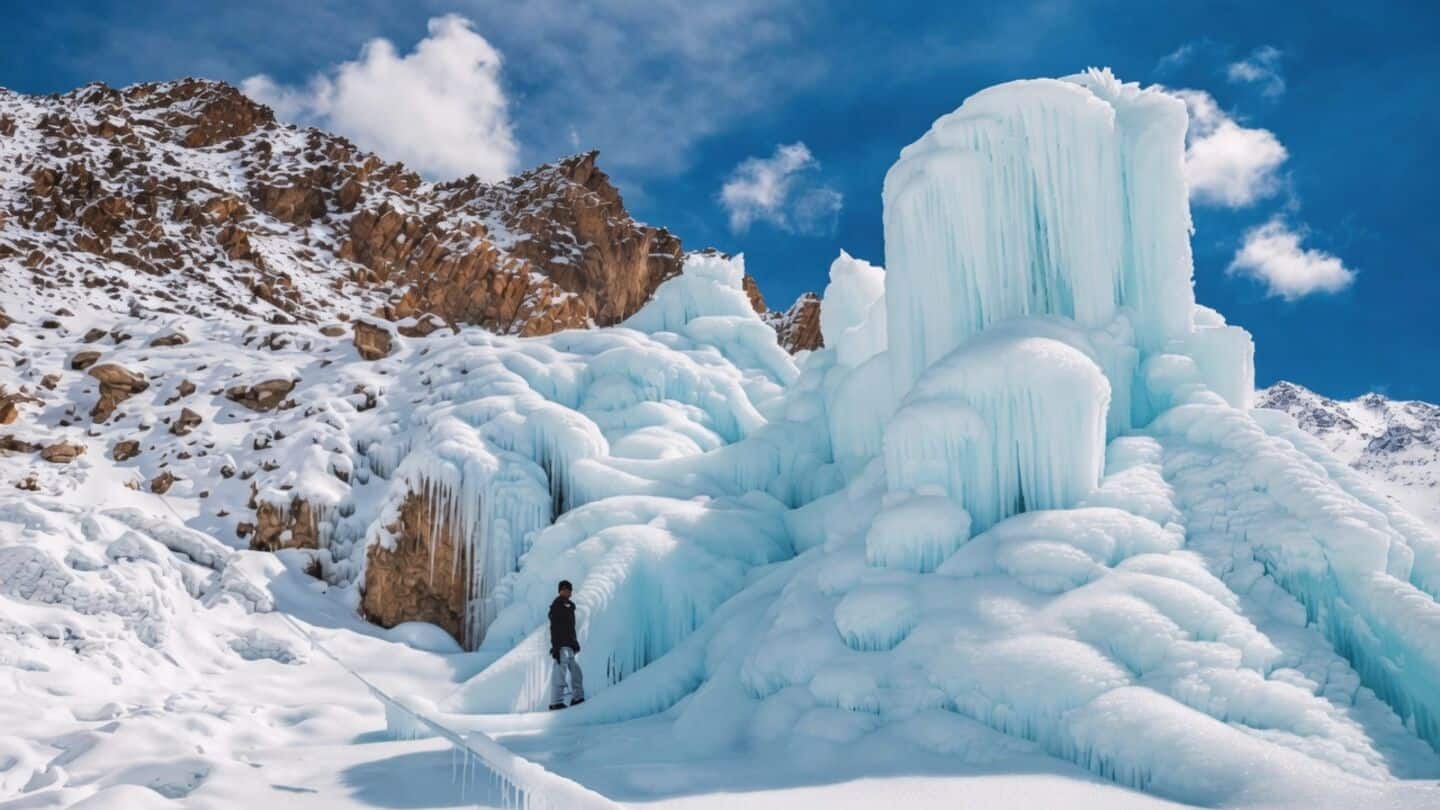
As glaciers vanish, Ladakh turns to man-made ice pyramids
What's the story
Farmers in Ladakh's remote Himalayan villages are resorting to building artificial glaciers to tackle severe water shortages. The problem is due to the disappearance of small mountain glaciers, a BBC report said. The report highlighted the case of Sakti village, located nearly 4,000 meters above sea level. Here, farmer Gelak Gutme has been growing crops for over six decades but is now facing extreme desert conditions and a single-cultivation season due to climate change.
Water crisis
Natural reservoirs disappearing due to global warming
Traditionally, small glaciers above valleys acted as natural reservoirs, holding water through winter and releasing it in spring for farming.
However, these lower glaciers have now disappeared into bare rock due to global warming.
Lobzang Fardod, a member of a local water management committee in Ladakh, explained that with no ice left at higher altitudes to melt, securing a reliable water source has become increasingly difficult.
Innovative solution
Villagers started building ice reservoirs in early 2010s
In a bid to secure water supply, villages started building ice reservoirs in the early 2010s.
This involved piping water from higher altitudes in winter and spraying it into the air to freeze, forming large ice towers called ice stupas.
However, managing these under harsh winter conditions proved challenging as rapid temperature drops, which could be as low as -30°C, could freeze pipes and crack them.
Technological advancement
The technology has been upgraded over the years
To address these challenges, the technology has been upgraded over the years. In collaboration with a private company called Acres of Ice, an Automated Ice Reservoir (AIR) system has been developed.
This system uses sensors, valves, and a control panel to automatically control ice formation for high efficiency.
The AIR process pipes water down from higher altitudes under pressure through a vertical nozzle, like a large fountain.
Positive impact
The computer-controlled system is powered by solar panels and battery
The computer-controlled system is powered by solar panels and a battery. It is connected to a weather station that monitors environmental conditions such as water temperature in pipes.
If temperatures drop too quickly, the control system drains standing water to prevent pipe cracking.
The AIR system releases short bursts of mist that freeze solid based on wind and humidity conditions before spraying again.
This technology has improved village life by recharging groundwater and reviving spring sources with timely water supply.
Ongoing developments
Farmer Gutme has become more optimistic about the future
Acres of Ice and local authorities operated 10 AIR projects across Ladakh in winter 2025. The main challenge now is to advance technology to scale up the number of ice reservoirs that can be built using this system.
Gutme has become more optimistic about the future with an AIR system installed in his village, providing a reliable water source.
He hopes more artificial glaciers will be built there, preventing youth migration due to harsh climate conditions and water scarcity.