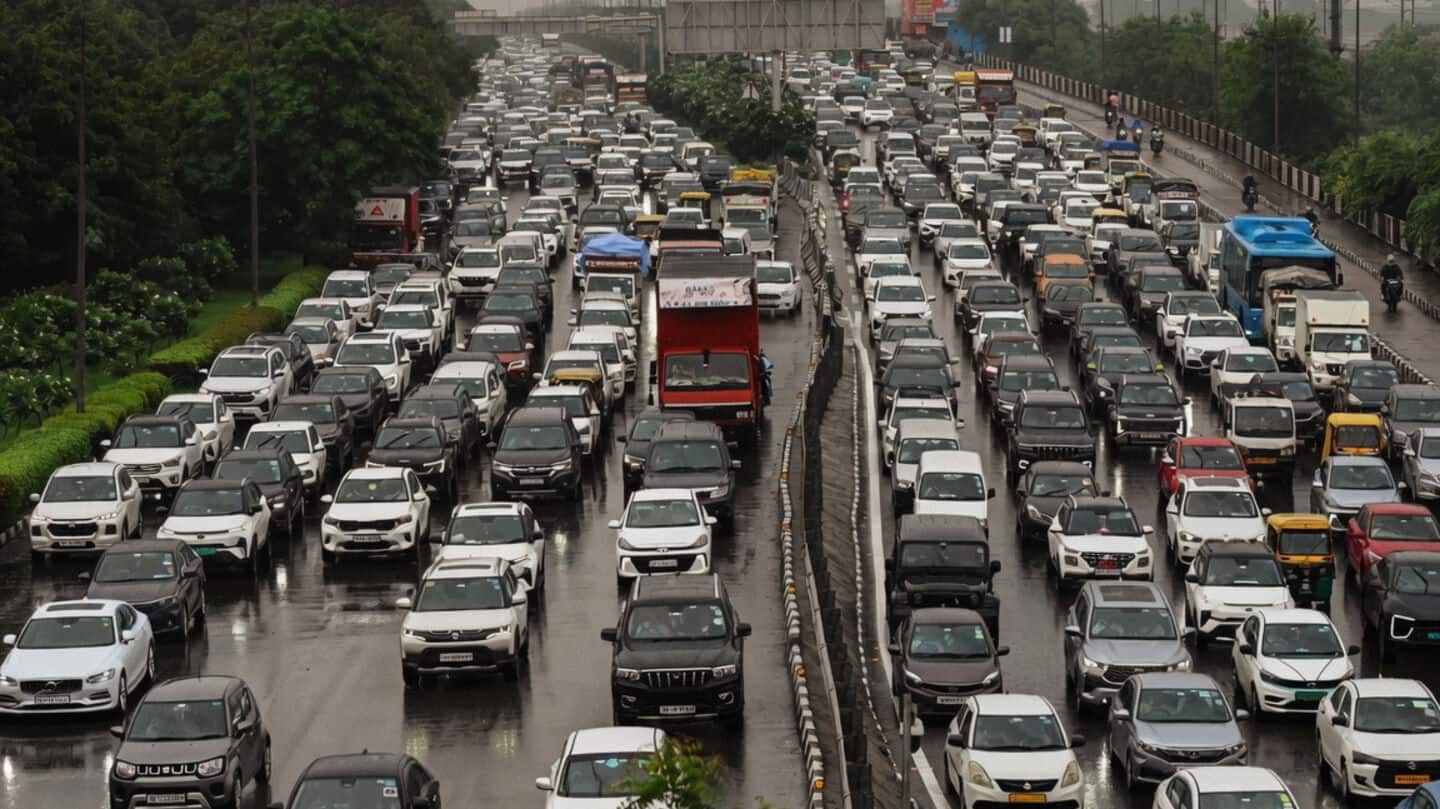
Delhi-Meerut Expressway to test variable speed limits from August 15
What's the story
The Delhi-Meerut Expressway will soon see a new traffic management experiment. Starting August 15, an 8.7-km stretch between Sarai Kale Khan and the Uttar Pradesh border will be India's first real-world test of Variable Speed Limits (VSL). The project is being led by Professor Satish Chandra from IIT Roorkee and Dr Chalumuri Ravi Sekhar, Director of CSIR-Central Road Research Institute (CRRI).
Smart technology
How will the VSL system work?
The VSL system will use electronic signboards connected to traffic sensors and cameras.
These signboards will automatically adjust speed limits according to real-time traffic conditions, unlike the current fixed limits of 70km/h for cars and 50km/h for heavy vehicles.
The pilot project aims to reduce stop-and-go waves that cause traffic jams by staggering vehicle speeds before reaching bottlenecks.
Speed schedule
What are the proposed speed limits?
The proposed speed limits under the pilot project are:
From midnight to 7:00am, cars will be allowed to drive at 65km/h while heavy vehicles can go up to 50km/h.
Between 7:00am and 5:00pm, cars will have a limit of 55km/h and heavy vehicles will be restricted to a maximum of 45km/h.
From 5:00pm till midnight, cars can drive at speeds up to 60km/h while heavy vehicles can only go up to a maximum of 40km/h.
Data-driven approach
How was the proposal developed?
The proposal is based on an analysis of traffic footage collected near Akshardham Plaza in July 2024.
Researchers found that cars make up over 80% of traffic on the corridor, while heavy vehicles account for between 4% and 12%.
To ensure compliance with these new speed limits, Delhi Traffic Police will issue challans during the pilot project.
Researchers will evaluate the system after 30, 90, and 120 days based on several parameters including traffic flow and driver compliance.
Future plans
Potential for wider implementation across India
If this pilot project proves successful, it could lead to the introduction of variable speed limits on other expressways across India.
The aim is to provide a cheaper alternative to road widening projects by reducing congestion and improving traffic flow.
This could also help develop national guidelines for wider implementation of this technology in the future.