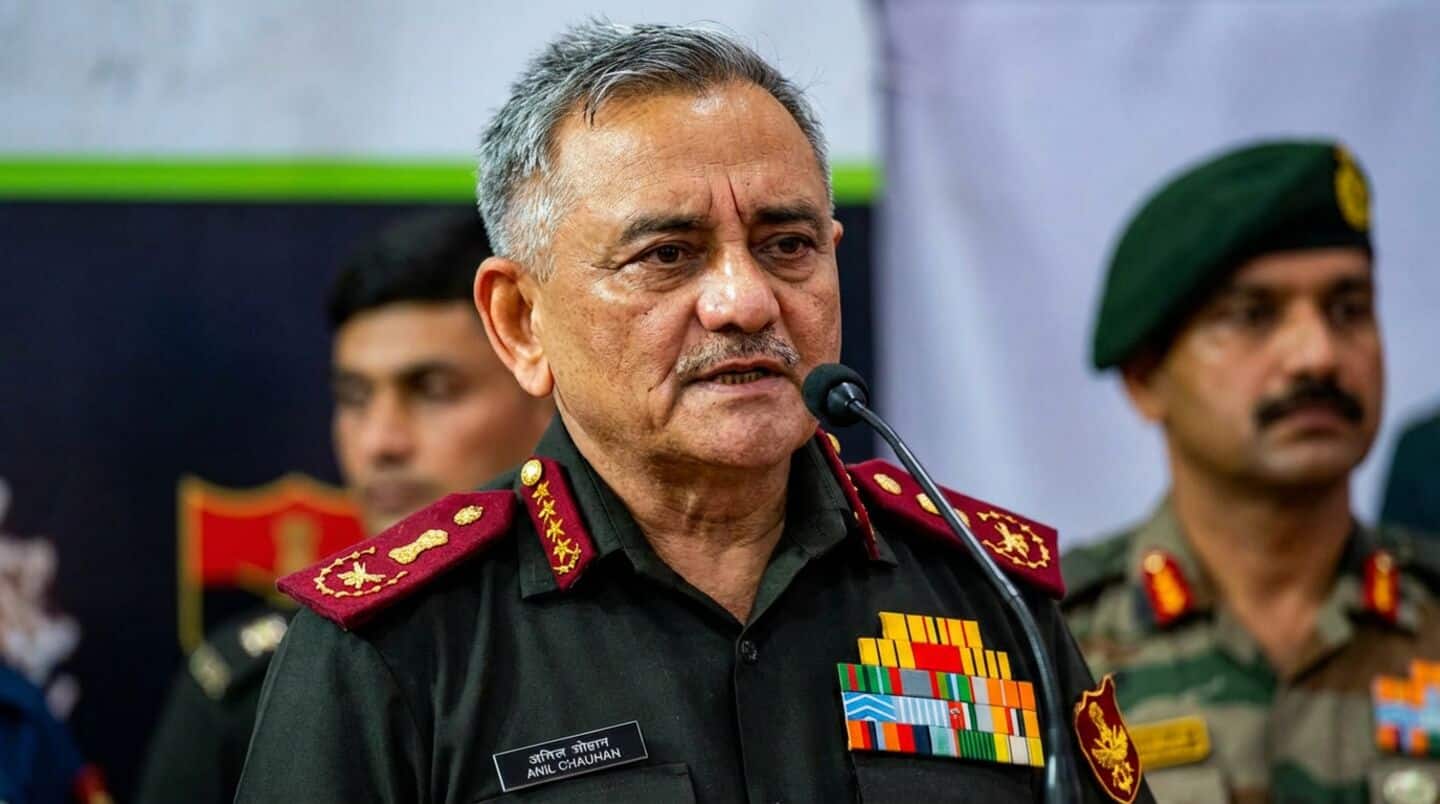
'Nehru recognized Tibet as part of China in 1954': CDS
What's the story
India's Chief of Defence Staff, General Anil Chauhan, has said that India recognized Tibet as a part of China in 1954. Speaking at an event in Dehradun, Uttarakhand, he explained the significance of the Panchsheel Agreement signed that year. The agreement was signed by Nedyam Raghavan for India and Chang Han-fu for China, under the leadership of India's then Prime Minister Jawaharlal Nehru and Chinese Premier Zhou Enlai.
Agreement ambiguity
Disparity in India's and China's understanding of the agreement
The Panchsheel Agreement was India's first formal recognition of Tibet as part of China.
However, General Chauhan pointed out that while India saw the agreement as a resolution to its northern boundary issues, Beijing viewed it only as a trade arrangement.
He said, "The Chinese stand was that this agreement was negotiated only for trade, and it in no way reflected the Chinese stand on the border."
Border decisions
Nehru may have opted for Panchsheel due to border claims
General Chauhan also spoke about the uncertainty of India's borders after the British left.
He said that it was up to India to decide where its frontiers lay.
He speculated that Nehru may have opted for the Panchsheel Agreement because he knew about certain border claims, such as the McMahon Line in the eastern sector.
Border implications
Loss of 'Himalayan buffer' after China's takeover of Tibet
General Chauhan also spoke about China's control over Tibet and its impact on India.
He said that after China took over Tibet, the "Himalayan buffer" between India and Tibet "evaporated," turning it into a live boundary.
This change was further compounded by India's support for China's permanent seat at the United Nations.
Border disputes
Tensions along the Line of Actual Control continue to simmer
India believed that the legitimacy of its frontier lay in the Panchsheel understanding.
This was based on six passes for trade and pilgrimage: Shipki La, Mana, Niti, Kingri-Bingri, Lipulekh, and Dharma.
However, tensions simmer along the Line of Actual Control.
The most serious clash in recent years was in June 2020, when 20 Indian soldiers were killed in action along the LAC. Beijing has maintained that it lost only four personnel, though reports indicate the number may be 30.