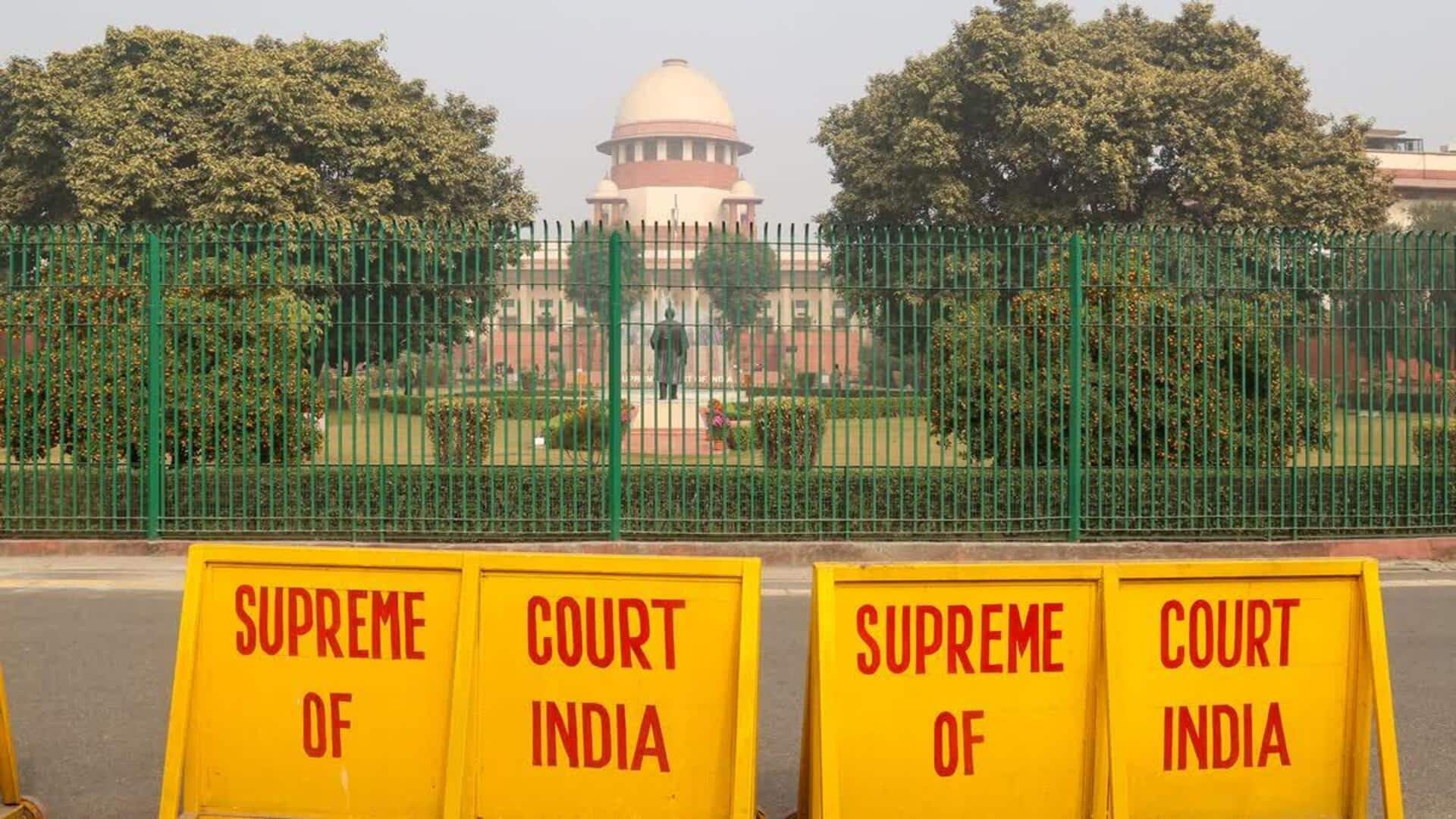
'Learning language not...waste': SC refuses to stay CBSE's 3-language policy
What's the story
The Supreme Court has refused to stay the Central Board of Secondary Education's three-language policy introduced for the 2026-27 academic year, with Chief Justice of India Surya Kant remarking that "learning of language never goes waste." It deferred further hearings till next week. The decision came during a hearing on petitions challenging the policy, which requires students to study two Indian languages from Class IX. This would mean students would have to drop languages learned since Class V, petitioners argued.
Policy criticism
Petitioners highlight legal backing issues
They also raised concerns about English being treated as a non-native language and the lack of teachers and textbooks for native languages.
Appearing for one petitioner, senior Advocate Anand Grover contended that the circulars lacked legal backing, as only NCERT had the authority to frame such academic requirements, not CBSE.
"No teachers...books are available if I want to learn Punjabi instead of Sanskrit. As a child, I must have...opportunity to learn a language which will give me employment," Grover argued.
Language debate
English treated as non-native language
Senior Advocate Gopal Sankaranarayanan also criticized the policy for treating English as a "non-native" language.
"They have taken a 300-year-old language and treated English as a non-native language," he submitted.
Senior Advocate Shyam Divan argued that despite the dilution introduced in the June 29, 2026 circular, substantial problems continued to exist.
He highlighted that the National Education Policy was originally intended to be implemented by 2030, but CBSE had advanced it to this academic year.
Implementation issues
Practical difficulties for students learning foreign languages
Senior Advocate Mukul Rohatgi pointed out the practical difficulties for students learning foreign languages under the new policy.
"A student of Class 9 who is studying French till date is told to take up a third language and give the examination in April. Unless you get a pass in internal assessment, you can't... How can anyone in Class 9 be told to start learning, say, Tamil? Which school in Delhi can provide a teacher who can teach?" Rohatgi said.
Court proceedings
Only three textbooks were available on the NCERT website
Sankaranarayanan sought interim protection, arguing that schools were unprepared with textbooks and teachers for multiple Indian languages.
He told the Court that only three textbooks were available on the NCERT website and not 22.
"They had said that by July 1 textbooks would be ready. Teachers have to be ready for 22 languages. This is damaging the status quo," he argued.
CJI
If teachers dismissed, we can reinstate: CJI
Sankaranarayanan also raised concerns that teachers may lose jobs if schools are forced to quickly change language offerings.
However, the CJI responded, "If dismissed, we can reinstate."
The bench also remarked that it was worth re-looking at whether English could be considered an indigenous language.
Additional Solicitor General Aishwarya Bhati, appearing for the Union government, sought two weeks to file a response. The court directed that the reply be filed within 10 days.