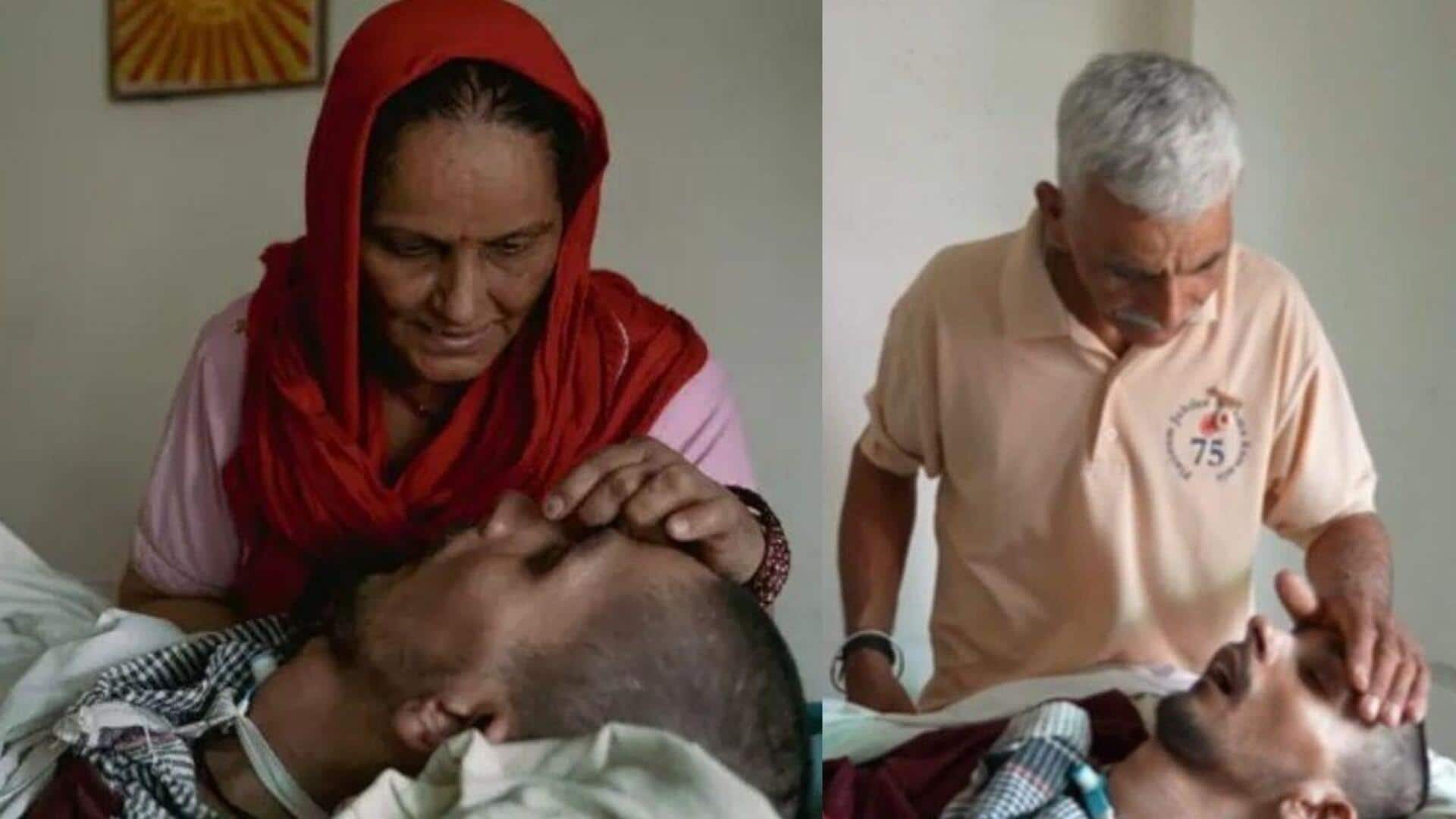
'Who are we to decide...': SC reserves euthanasia verdict
What's the story
The Supreme Court has reserved its order on a petition seeking passive euthanasia for Harish Rana, a 32-year-old man who has been in a vegetative state since 2013. The court, headed by Justices JB Pardiwala and KV Viswanathan, acknowledged the complexity of the issue after hearing detailed arguments from both sides. The case was filed by Harish's parents, who have been battling legal hurdles to seek mercy killing for their son.
SC
Practice was legalized in 2018
According to India Today, the SC said, "These issues are delicate....We are also mortals. Who are we to decide who lives or dies? We'll consider withdrawing life-sustaining medical treatment."
In 2018, the SC recognized the right to die with dignity as a fundamental right and prescribed guidelines to help terminally ill persons assert that right. In 2023, it amended the criteria to make the right to die with dignity more accessible.
The current case is the first since its legalization.
Accident details
Harish's tragic accident and parents' plea for euthanasia
Harish, a resident of Delhi's Mahavir Enclave, was pursuing civil engineering at Chandigarh University when he met with a tragic accident on August 20, 2013.
He fell from the fourth floor of his PG accommodation and suffered severe head injuries, leaving him with 100% disability.
Since then, he has been in a permanent vegetative state and is dependent on tubes for breathing and nutrition.
Legal battle
Legal journey of Harish's parents for euthanasia
Harish's parents first approached the Delhi High Court in July 2024 seeking passive euthanasia.
However, their plea was rejected, as Harish was deemed able to sustain himself without extra external aid.
The court argued that removing his feeding tube would lead to starvation, amounting to active euthanasia.
Then, in November 2024, they approached the Supreme Court but were also denied relief on similar grounds.
Expert evaluation
Supreme Court's expert opinion on Harish's condition
In December 2025, after another plea from Harish's parents, the Supreme Court constituted primary and secondary medical boards to assess his condition.
The primary board found Harish had a negligible chance of recovery and was in a "pathetic condition."
Justice Pardiwala remarked during the hearing, "It is a very sad report. We cannot keep this boy in this stage."
Euthanasia laws
Euthanasia in India: Legal status and landmark cases
Euthanasia, or ending a person's life to relieve suffering from an incurable illness, can be active or passive.
While active euthanasia is illegal in India, passive euthanasia was legalized by the Supreme Court in 2018.
The landmark case that paved the way for passive euthanasia was Aruna Shanbaug's case in 2011.
Shanbaug had been in a vegetative state for 42 years after being sexually assaulted by a ward boy.