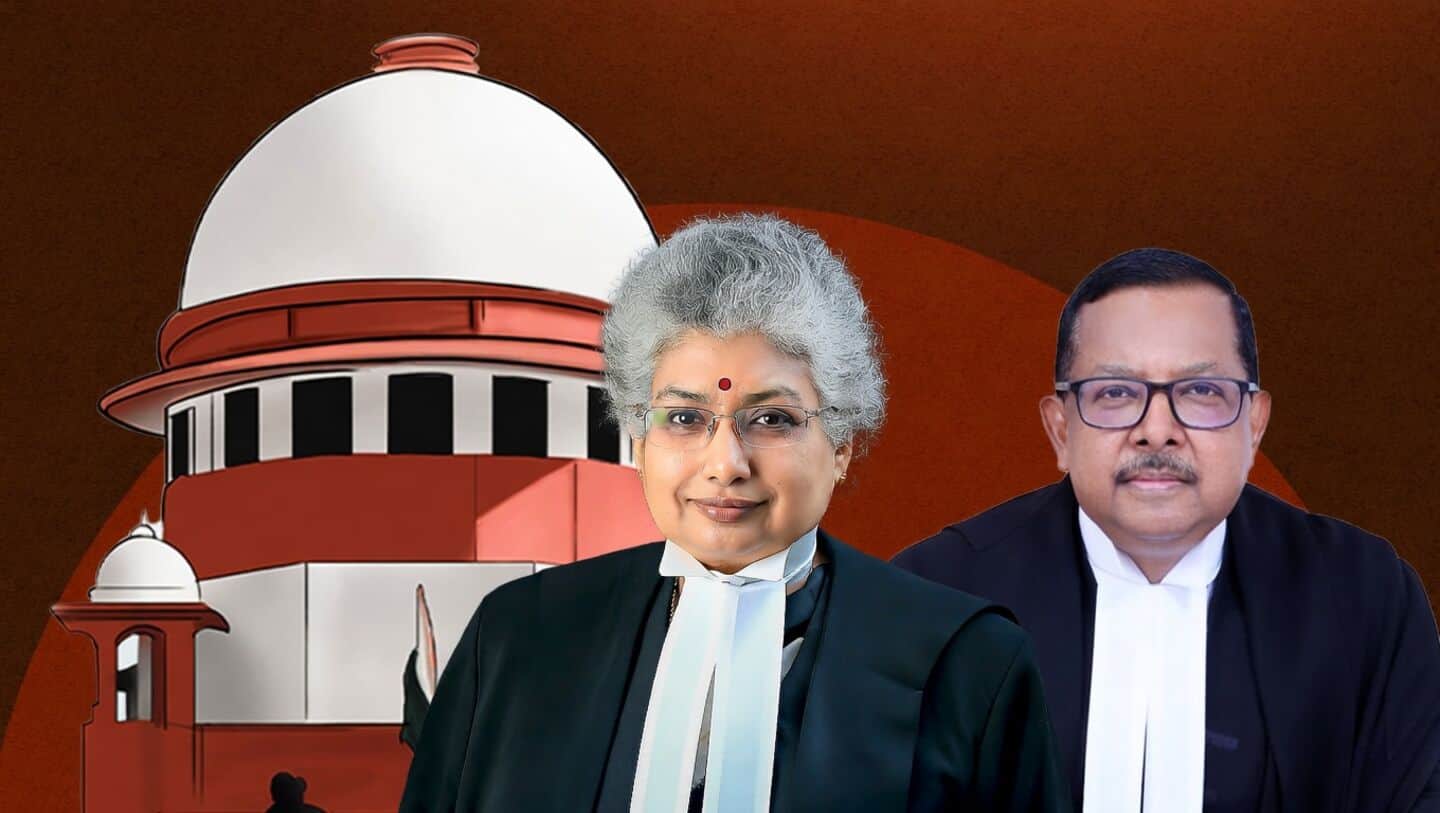
SC questions own bench's judgment denying bail to Umar Khalid
What's the story
The Supreme Court has expressed its disapproval of a two-judge bench's decision in January to deny bail to Umar Khalid and Sharjeel Imam in the Delhi riots conspiracy case. The court said the decision did not follow the precedent set by a three-judge bench in 2021's Union of India v. KA Najeeb case. The three-judge bench had held that long delays in trial could be grounds for granting bail under the Unlawful Activities Prevention Act (UAPA).
Bail granted
Andrabi's bail plea was pending for over 11 months
The SC bench, comprising Justice BV Nagarathna and Justice Ujjal Bhuyan, made the observation while granting bail to Kupwara resident, Syed Iftikhar Andrabi.
Andrabi had been in custody for over five years under UAPA for allegedly financing terrorism through drug trafficking.
The court emphasized that judicial discipline requires smaller benches to follow or refer to larger bench decisions when in doubt.
"Judicial discipline mandates that such...binding precedent must either be followed or, in case of doubt, be referred to...larger bench."
Test criticized
'Two-prong test' from Gurwinder Singh case disapproved by SC
The court also disapproved of the "two-prong" test from the 2024 Gurwinder Singh v. Union of India case.
According to this test, bail will be considered only if the accused proves that there is no prima facie merit in the case.
The court held that this was manifestly opposed to Najeeb's stance that if there was a significant delay in trial, bail must be considered, regardless of other factors.
Bail principle
'Bail is the rule, jail is the exception'
The court reiterated that "bail is the rule, jail is the exception" even under the UAPA.
It stressed Article 21's guarantee of personal liberty applies regardless of offense severity.
"Ideally, the more serious the accusations are, the speedier the trial should be," the court stated.
The court also voiced worry about a trend in which smaller benches were diluting larger bench decisions.
"If a smaller bench cannot agree with...larger Bench, it can only refer the case to CJI for allocation."
Case background
Andrabi's arrest and denial of bail
Andrabi was arrested by the National Investigation Agency (NIA) on June 11, 2020, for allegedly being part of a cross-border drug syndicate funding terrorist organizations.
His bail application was rejected by a Special NIA Court in August 2024 and later by the high court of Jammu and Kashmir and Ladakh in August 2025.
While the HC acknowledged Andrabi's long incarceration, it held that the seriousness of the charges and the material on record outweighed the case for bail.