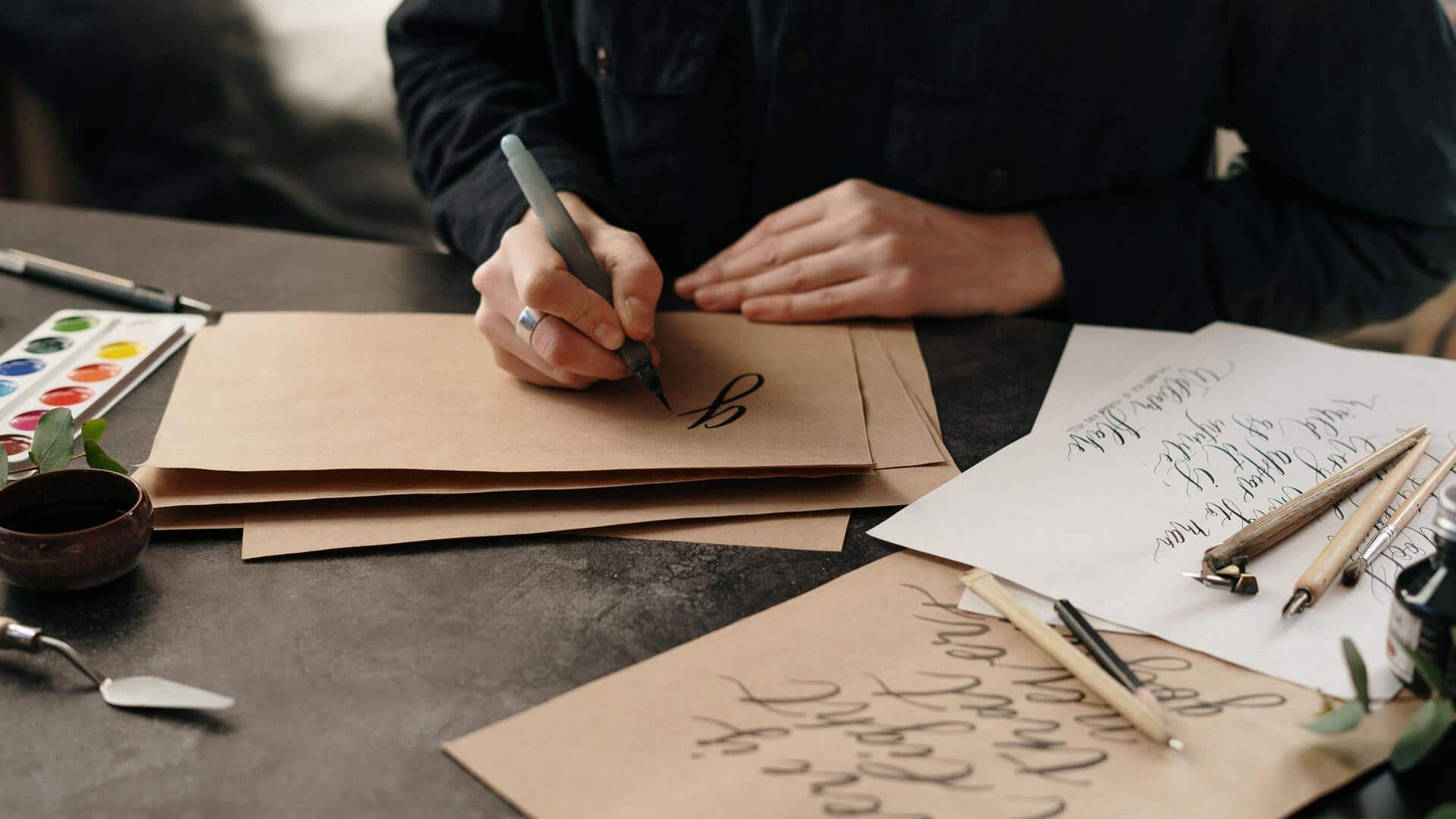
A beginner's guide to calligraphy
What's the story
Calligraphy is an art that marries beauty with precision in writing. For beginners, it can be a bit overwhelming, but with the right techniques, anyone can master it. This guide offers practical tips to help you start your calligraphy journey. From choosing the right tools to practicing basic strokes, these insights will set a strong foundation for your calligraphic skills.
Tip 1
Choosing the right tools
Selecting the right tools is essential for beginners.
A basic calligraphy set usually includes a nib, holder, and ink.
Beginners may find it easier to start with a medium nib size that offers a balance between control and flexibility.
Also, use smooth paper that doesn't bleed ink.
Experimenting with different tools can help you find what feels comfortable in your hands.
Tip 2
Practicing basic strokes
Mastering basic strokes is the key to good calligraphy.
Start by practicing simple lines, loops, and curves that form the foundation of most letters.
Consistency in these strokes will improve your overall technique.
Use lined paper or guides to keep your strokes uniform in size and spacing.
Regular practice of these fundamental movements will build muscle memory over time.
Tip 3
Understanding letter formation
Once you're comfortable with basic strokes, move on to letter formation.
Focus on one letter at a time, and pay close attention to its unique characteristics and structure.
Break down each letter into its component strokes, and practice them individually before attempting the whole character.
Consistent practice will help you develop confidence in forming letters accurately.
Tip 4
Exploring different styles
Calligraphy isn't just about one style; it's about exploring various styles to find what resonates with you.
From elegant scripts to modern designs, each style has its own charm and challenges.
Experimenting with different styles not only keeps your practice interesting but also broadens your skill set as an artist.
This exploration encourages creativity and personal expression in your calligraphy journey.
Tip 5
Joining a community for support
Joining a community of fellow enthusiasts can give you valuable support and feedback on your work.
Online forums or local workshops provide opportunities to connect with others who share similar interests in calligraphy.
Engaging with experienced artists can give you insights into advanced techniques, while motivating you through shared experiences of learning together.