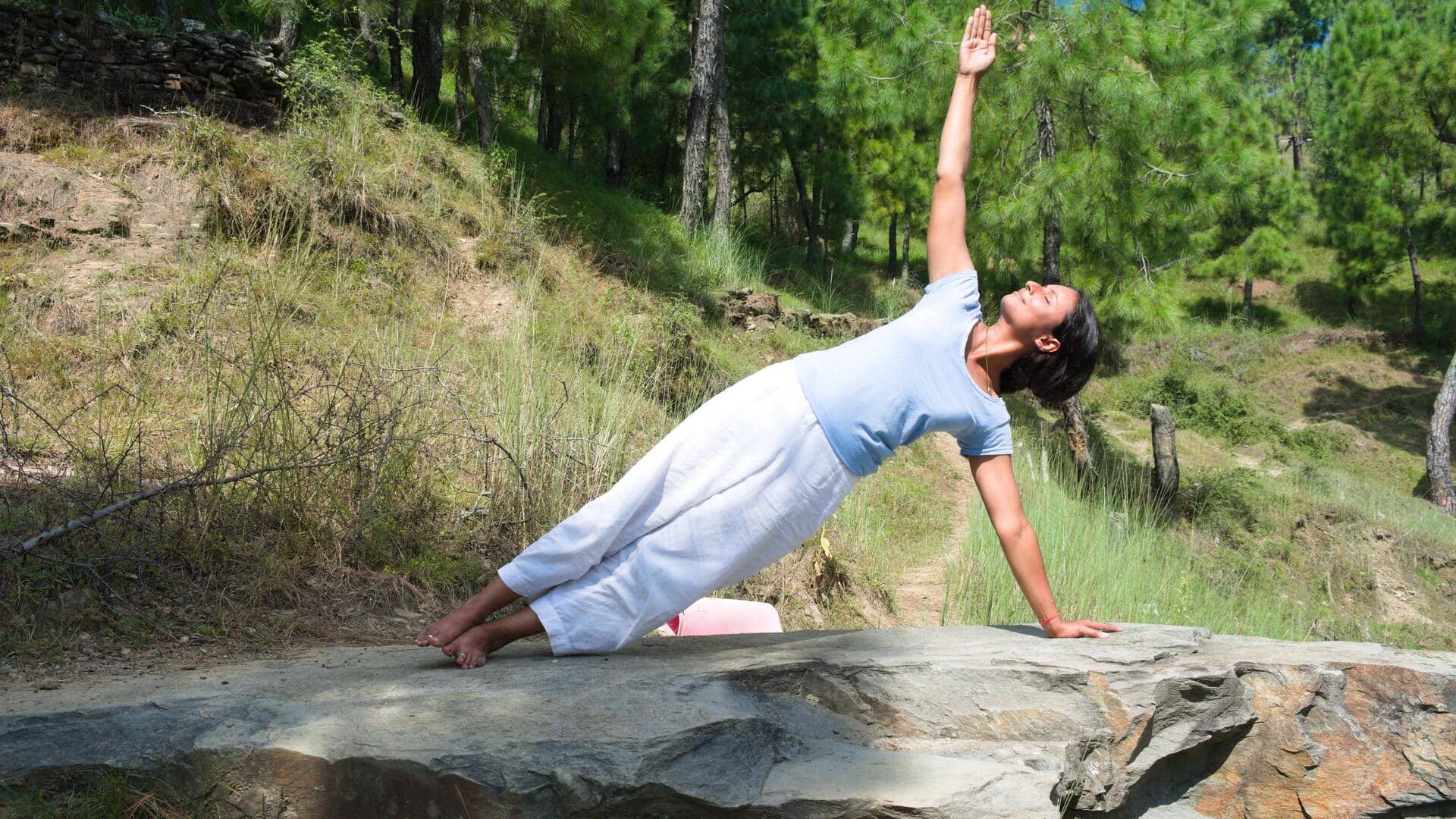
Take your side plank up a notch with these variations
What's the story
The side plank is a well-known exercise for core strengthening. It targets the obliques and helps improve stability and balance. Adding variations to the side plank can make your workout more challenging and effective. These variations not only engage different muscle groups but also keep your routine interesting. Here are five side plank variations that can help you build a stronger core.
Leg lift
Side plank with leg lift
Adding a leg lift to the side plank increases the intensity by engaging more muscles in the lower body.
While maintaining the traditional side plank position, lift the top leg slowly and hold it for a few seconds before lowering it.
This variation improves balance and strengthens both the core and legs.
Hip dip
Side plank with hip dip
The hip dip variation involves lowering your hips toward the ground and lifting them back up while holding a side plank position.
This movement targets the obliques more intensely and improves flexibility in the hips.
Performing controlled dips enhances muscle engagement, contributing to a stronger core over time.
Star plank
Star plank variation
The star plank is an advanced version of the side plank, in which you extend both arms and legs away from your body, forming a star shape.
This variation challenges your balance significantly more than traditional planks. It engages multiple muscle groups simultaneously, for improved overall strength.
Rotation
Side plank rotation
In this variation, you rotate your torso under your body while extending one arm outwards, and then return to the starting position.
The side plank rotation enhances spinal mobility and works on your obliques effectively.
It also improves coordination between different muscle groups in your core.
Elevation
Elevated side plank
Elevating either your feet or hands during a side plank adds difficulty by increasing instability.
The elevated position requires greater effort from stabilizing muscles, enhancing overall core strength over time.
This variation is especially useful for those looking to progress from basic planks toward more challenging exercises.