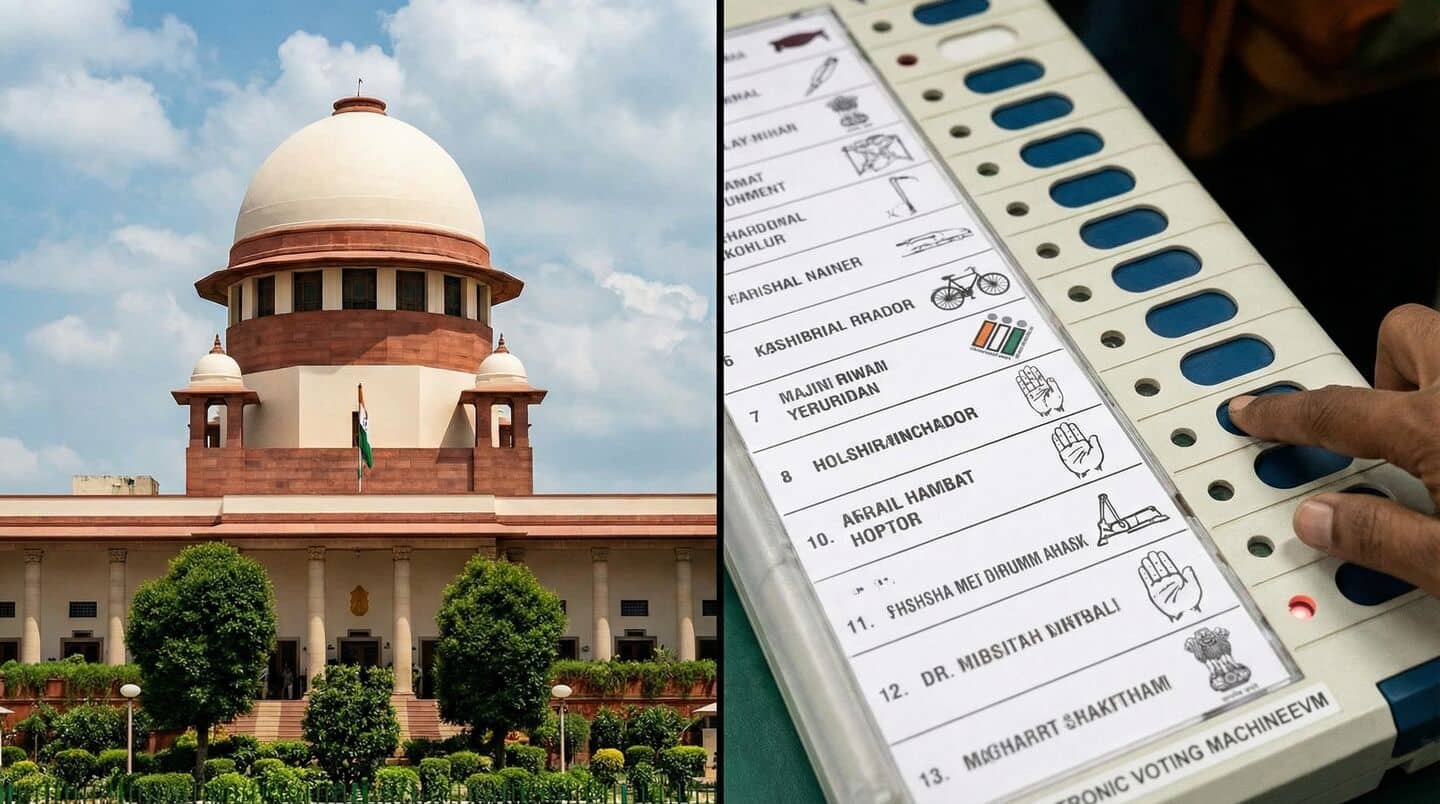
'Has quality of elected leaders improved?' SC doubtful of NOTA
What's the story
The Supreme Court has raised doubts over the efficacy of the "None of the Above" (NOTA) option in improving the quality of elected representatives in India. The court was hearing a plea to make NOTA mandatory in all elections, even those with a single candidate. The bench, headed by Chief Justice Surya Kant and Justice Joymalya Bagchi, examined NOTA's impact on voter behavior and representation across social strata.
Leadership quality
Concerns over voter behavior and representation
Justice Bagchi asked if the introduction of NOTA had improved the quality of elected leaders, noting that educated and affluent voters tend to vote less than their economically weaker counterparts.
"Has the quality of elected leaders improved with NOTA? Because what tells us is that educated, well-off people vote less and economically weaker section vote more," said Justice Joymalya Bagchi.
CJI
'Sometimes we think we need to issue...'
CJI Kant suggested that low voter turnout among educated and affluent sections may need innovative solutions.
"Sometimes we think we need to issue some kind of compulsory but not harsh mechanism to ensure that people go and vote. It (mechanism) may not be punitive in nature. In rural areas....women who are exempted from taking up labor or construction works.....they have sigh of relief as they go in groups to cast votes, while singing songs etc," he observed.
NOTA's role
NOTA's introduction and limitations
The NOTA option was introduced in 2013 on electronic voting machines after a Supreme Court ruling to protect voter secrecy and allow voters to formally reject all candidates.
Before this, dissent was recorded through Form 49-O under the Conduct of Elections Rules, 1961, which lacked secrecy.
However, the court has previously refused to order re-elections even if NOTA receives the highest votes.
Legal challenge
Petition challenges NOTA's application in uncontested elections
The plea under consideration challenges Section 53(2) of the Representation of the People Act, 1951.
"In direct elections (elections to the House and state legislative assemblies) which are uncontested, the impugned sub-section (2) prevents voters from being able to cast a negative vote by choosing 'none of the above' option if there is only one candidate," it argued.
It said since 1952, over 82 lakh electors have been denied the right to vote due to the functioning of the sub-section.