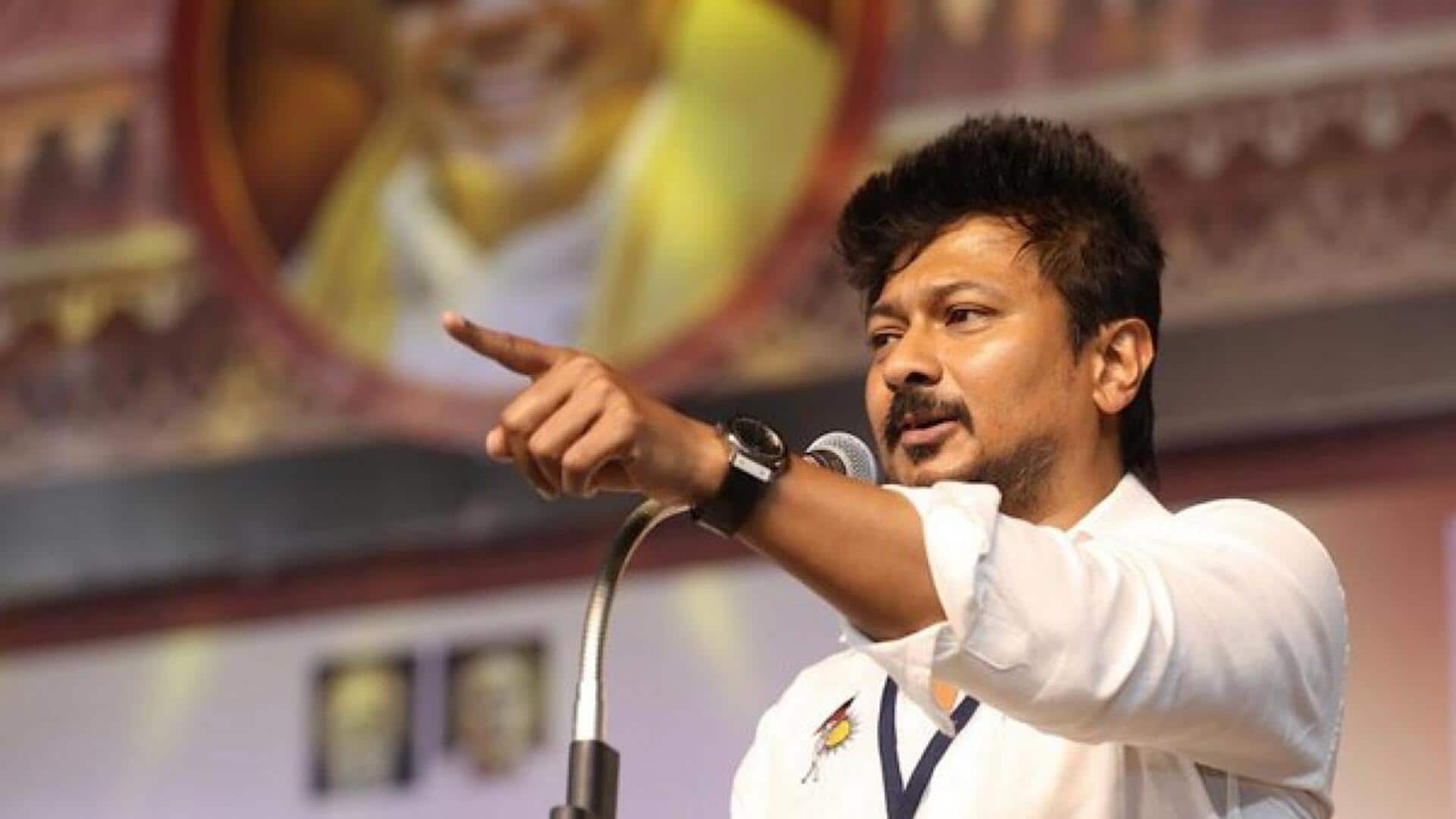
'Hindi devoured many languages...': Udhayanidhi warns of regional identity erasure
What's the story
Tamil Nadu Minister Udhayanidhi Stalin has slammed the imposition of Hindi, claiming it has led to the gradual disappearance of regional mother tongues in northern states. Speaking at a Language Martyrs Day event, he paid homage to those who died during the 1960s anti-Hindi agitation and reiterated his party's opposition to the three-language policy. "Today in many states their mother tongue has vanished... Hindi is a language that has devoured many languages," he said.
Language impact
Stalin's concerns over Hindi imposition
Stalin said, "All of you think this through, many states lost their mother tongue. Like Haryana lost Haryanvi, Biharis lost Bihari, Bhojpuri, and Chhattisgarh lost their own mother tongue."
He added, "There are multiple states that lost their mother tongue after implementing Hindi in their state as a language for communication and learning."
He said this trend shows how language dominance can erase regional identity and culture.
Policy defense
Stalin defends Tamil Nadu's two-language policy
Stalin defended the state's two-language policy of Tamil and English, calling it a successful model for progress in education, industry, healthcare, and overall development.
He accused the central government of "cultural invasion" through language policy via the National Education Policy.
He also slammed Union Minister Dharmendra Pradhan for withholding funds over non-implementation of the three-language policy.
Political stance
DMK's stance on three-language policy
The Dravida Munnetra Kazhagam (DMK) party argues that making Hindi compulsory could increase school dropouts and make non-Hindi speakers "second-class citizens."
Interestingly, even the Bharatiya Janata Party's Tamil Nadu ally, the AIADMK, opposes this policy.
The BJP, however, maintains that it is not an imposition but an opportunity to learn another Indian language and lessen dependence on English.
The issue has heated up with Tamil Nadu headed to the polls in April-May.