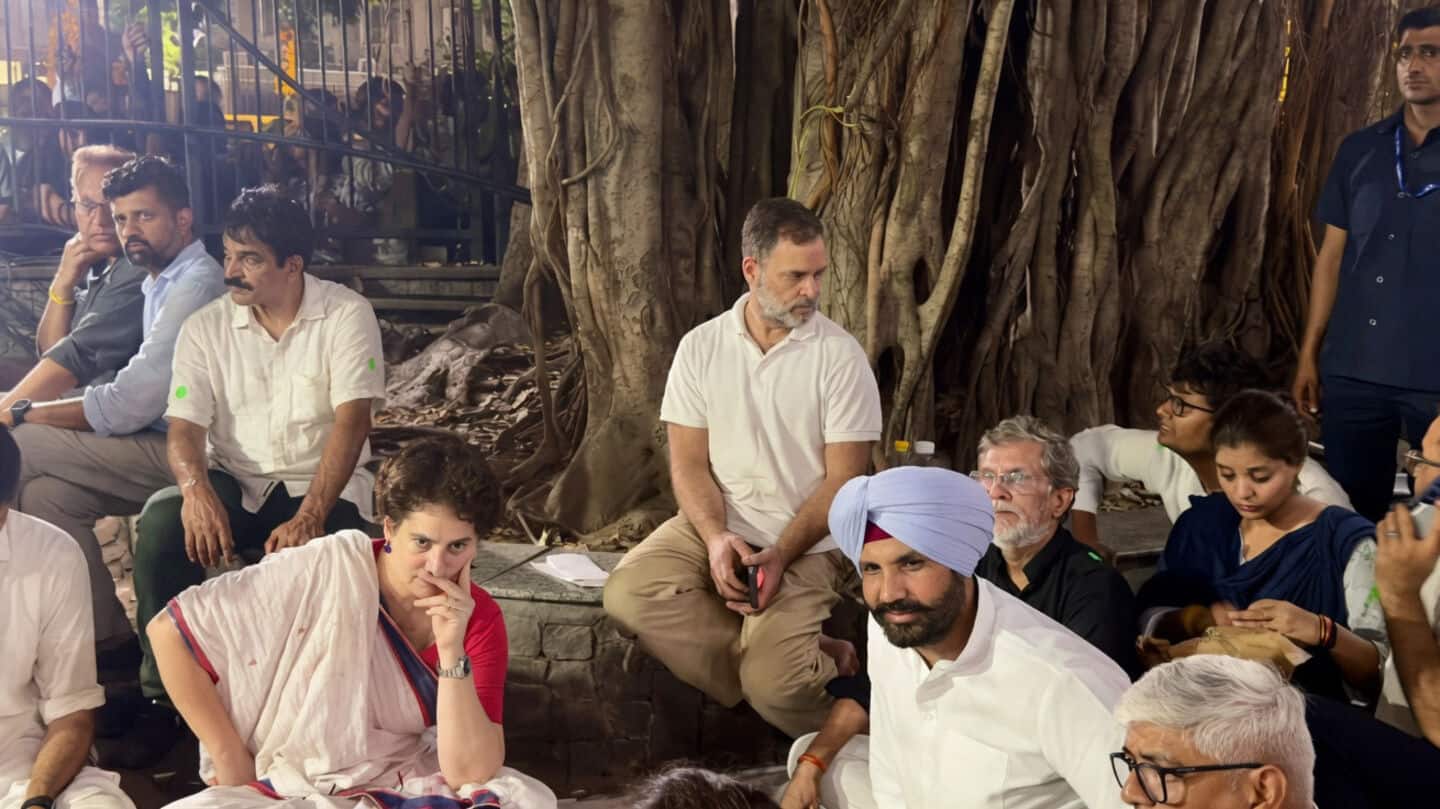
Rahul, Priyanka detained as cops remove MPs from Akashvani Bhawan
What's the story
Congress leader Rahul Gandhi and his sister Priyanka Gandhi Vadra were detained by Delhi Police after they began clearing the Akashwani Bhavan premises where opposition MPs have been camping. Visuals showed the siblings being dragged away by police personnel as Congress workers tried to stop them. They were taken to Kingsway Camp Police Station. The protest was part of the opposition's campaign against alleged irregularities in the electoral rolls. They are demanding the resignation of Chief Election Commissioner Gyanesh Kumar.
Protest continuation
No permission was granted for the march
Police also forcibly removed other leaders, including K C Venugopal, Pawan Khera, K Suresh, Amarinder Singh Raja, Warring, and Imran Pratapgarhi, as the All India Radio (AIR) premises were cleared of all protesting MPs.
They were all released after the brief detention.
The Delhi Police said no application seeking permission for the proposed march was submitted to the office of the Deputy Commissioner of Police, New Delhi District.
Consequently, no permission was granted for the march.
Twitter Post
Visuals show leaders at Kingsway camp
#WATCH | Delhi: Lok Sabha LoP Rahul Gandhi, Congress MP Priyanka Gandhi Vadra and other INDIA bloc MPs at New Police Line, Kingsway Camp.
— ANI (@ANI) October 6, 2026
Delhi Police have detained INDIA bloc MPs who were staging a protest at Akashvani Bhavan against Chief Election Commissioner Gyanesh Kumar. pic.twitter.com/KzBqmHUe0H
Cops
260 individuals were detained
The police said they repeatedly announced the restrictions imposed under Section 163 BNSS and appealed to them to disperse peacefully. Despite this, they remained at the site.
They said approximately 260 individuals, including 10 MPs, were detained and taken to various police stations after which most of the protesters left the area.
However, the Gandhi siblings, Venugopal, Khera, Manish Chhatrath, and about 50-60 supporters entered the Akashvani Bhawan premises without permission and staged a sit-in, police said.
Campaign escalation
Police said Gandhi refused to leave the Akashvani premises
The Delhi Police said Gandhi refused to leave the Akashvani premises, stating that he would not leave until a delegation of MPs was granted an appointment to meet with the ECI.
To maintain law and order and prevent the situation from escalating, the Delhi Police said they had to remove the protesters from the site.
"Adequate security and law-and-order arrangements have been put in place by the Delhi Police in the area. The situation is being continuously monitored."
Noon
They were detained earlier as well
Around noon, they were briefly detained but were seen stepping out of a police bus after some time.
"The Election Commission office is barely 50 meters away, but we were not allowed to go there. I do not understand what the problem is. The Election Commission's job is to conduct elections properly. At least 300 MPs want to meet Gyanesh Kumar. But he is scared. I don't know what's happening in the country," Gandhi told reporters at Akashwani Bhavan then.
ECI
No meeting sought before 4:00pm, claims ECI
However, the Election Commission of India said no political party formally sought an appointment before 4:00pm.
"When the Election Commission was considering the proposal...the DCP of Delhi Police informed....that the meeting being sought was with a group of 240 MPs and that the proposed venue was Parliament House Annexe. The Election Commission considered this request unusual and could not accept it because, as per protocol, such meetings are held only at the premises of the Election Commission," it said.
Panel
ECI offered to send its senior-most serving officer to venue
The commission said it offered to send its most senior serving officer to the Parliament Annex to receive the MPs' memorandum, which it described as an unprecedented step in itself but the MPs rejected it.
"Any political party can request a meeting with the Election Commission at any time, and the Commission can, depending on the availability of time, decide the date and time of the meeting. This is a normal process," the statement read.