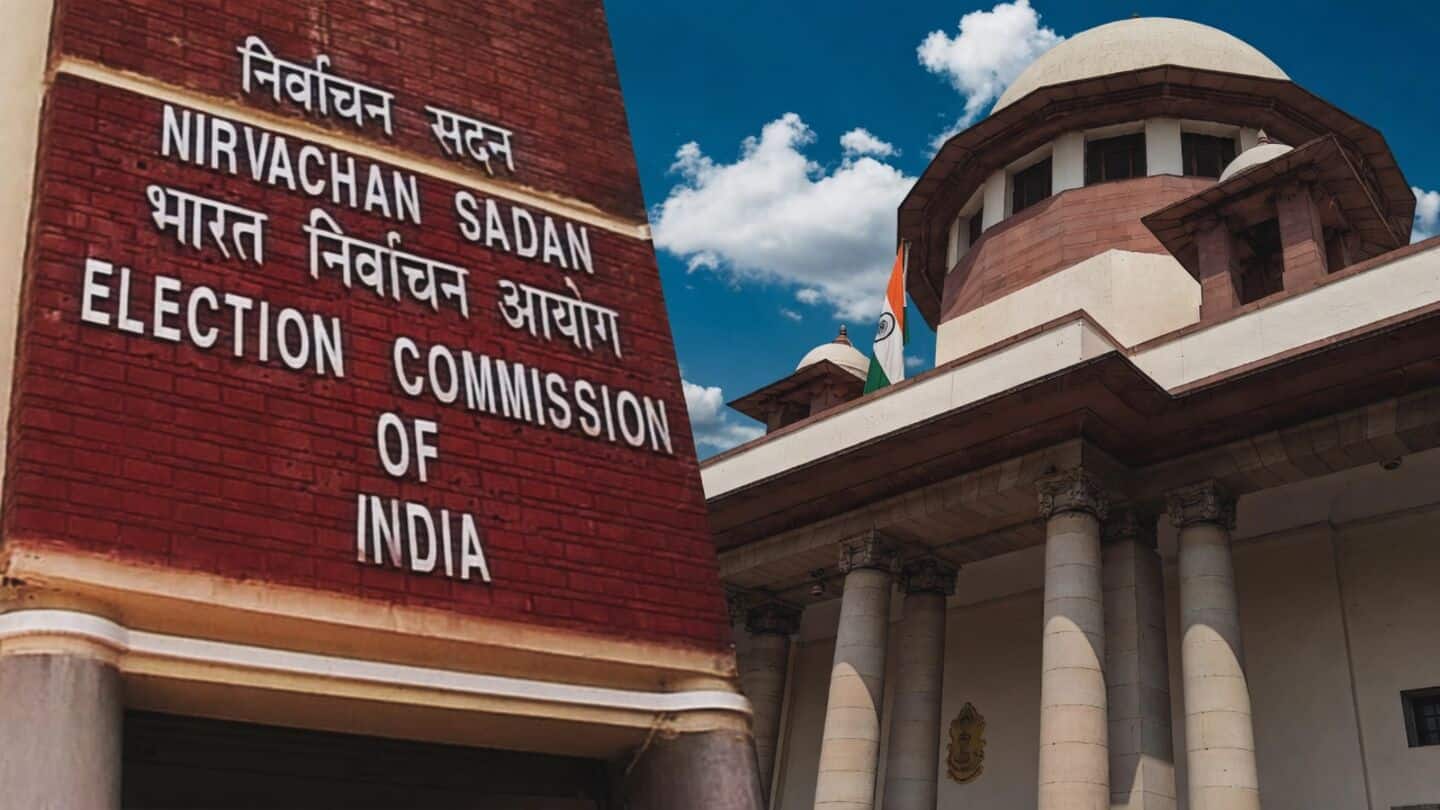
Election Commissioner appointment case: SC delivers split verdict
What's the story
The Supreme Court has delivered a split verdict on the central government's plea to refer petitions challenging the Chief Election Commissioner and Other Election Commissioners (Appointment, Conditions of Service and Term of Office) Act, 2023, to a larger bench. The Act controversially replaces the Chief Justice of India with a Cabinet Minister in the selection panel for appointing Election Commissioners. The central government had sought to refer this matter to a larger bench under Article 145(3) of the Constitution.
Dissent explained
Justice Datta's observations on institutional cohesion
Justice Dipankar Datta, who rejected the government's plea for reference, said speaking in one voice would have served institutional cohesion.
He emphasized that "it is a foundational principle of the constitutional scheme that rulers are bound by law and not above it."
However, he observed that it was not enough for the Election Commission to be independent; it must also appear to be independent.
Verdict
'Inclusion of cabinet ministers fails to provide 'independent counterweight'
He said that a minister on the selection panel nominated by the Prime Minister cannot be expected to defy his own nominator since the collective responsibility doctrine prevents him from defying the Prime Minister.
"It is far-fetched to expect that a minister who is part of Cabinet of Ministers would adopt a stand disagreeing with leader or government. Inclusion of cabinet ministers fails to provide an independent counterweight that a neutral selector would," Justice Datta said.
Independence debate
Disagreement between Justices Datta and Sharma
Justice Satish Chandra Sharma disagreed with Justice Datta's observations. He argued that a substantial question of law was involved and needed to be decided by a larger bench.
In light of the difference of opinion, the bench directed that the matter be put before the Chief Justice of India to consider whether a Constitution Bench must be formed to decide the issue.
Legislative impact
Law passed by Parliament in December 2023
The case stems from the Supreme Court's 2023 Constitution Bench order, which ordered that appointments to the Election Commission be made by a committee consisting of the PM, the Leader of the Opposition, and the Chief Justice of India, unless a law is enacted in this regard by Parliament.
The petitions challenging this law have been filed by several petitioners, including Congress leader Jaya Thakur and the Association for Democratic Reforms (ADR).
Petitioners
Pleas challenge Section 7 of the Act
The pleas challenge Section 7 of the Act, which establishes the Selection Committee as the Prime Minister, a Union Cabinet Minister nominated by the Prime Minister, and the Leader of the Opposition.
The petitioners argue that the arrangement grants the executive a two-to-one majority and compromises the independence of the Election Commission.