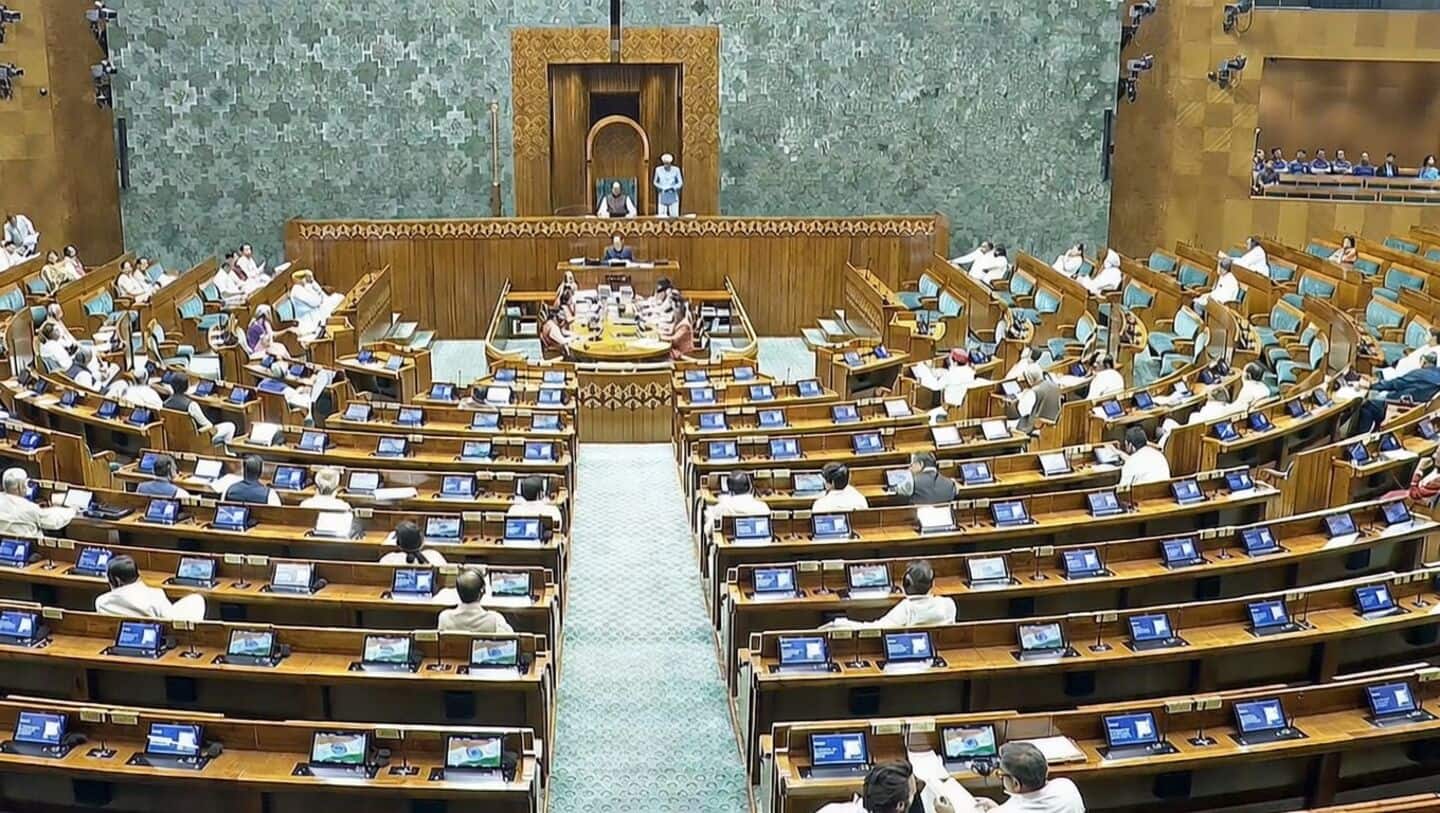
Special Parliament session from today: Delimitation, women's reservation on agenda
What's the story
A special three-day session of Parliament will begin on Thursday, during which the government plans to introduce three major bills. The bills are the Constitution (One Hundred and Thirty-First Amendment) Bill, 2026; the Delimitation Bill, 2026; and the Union Territories Laws (Amendment) Bill, 2026. These bills aim to enable new delimitation based on updated Census data, expand the Lok Sabha's strength, and operationalize the one-third reservation for women.
Bill details
Women's reservation at the forefront
At the heart of the session is the Constitution (131st Amendment) Bill, which proposes increasing Lok Sabha seats from 543 to 850 through delimitation to enable 33% reservation for women, based on the 2011 Census. The Women's Reservation Act was passed in 2023 but its implementation has been delayed due to the need for a new delimitation exercise based on updated Census data. The government hopes to amend provisions to allow for this before the 2029 Lok Sabha elections.
Electoral changes
Shifting from 1971 to 2011 census for delimitation
The Constitution (131st Amendment) Bill seeks to allow delimitation using the 2011 Census instead of the 1971 Census. This change would end a long-standing freeze on constituency allocation, which has preserved states' representation despite demographic shifts. The government argues that India's population patterns have changed due to migration and urbanization, creating disparities in constituency sizes.
Seat expansion
Expanding Lok Sabha and redrawing constituencies
The Delimitation Bill, 2026, proposes a new delimitation exercise based on updated population data. This exercise would expand the Lok Sabha from 543 to 850 seats to accommodate population changes and reservation requirements. The redrawing of constituencies would impact seat allocation across states, potentially altering the political balance in Parliament. Opposition leaders have argued that states like Uttar Pradesh could see a significant increase in their number of seats under the new proposal.
Legal alignment
Union Territories Laws (Amendment) Bill, 2026
The third legislation, the Union Territories Laws (Amendment) Bill, 2026, aims to align legal and administrative provisions with proposed changes. It is expected to address seat allocation for Union Territories and create mechanisms for reservation within the revised constituency framework. Combined, these three bills aim to synchronize delimitation, expansion of Parliament and implementation of women's reservation.
Political debate
Opposition concerns and government response
The proposals have drawn criticism from opposition parties, who argue that using updated Census data could benefit northern states at the expense of southern ones. Regional parties like DMK have expressed concerns over potential federal balance disruption. Tamil Nadu Chief Minister MK Stalin has launched a statewide protest against the central government's proposed delimitation exercise. Congress president Mallikarjun Kharge accused the government of pushing reforms for "political mileage."