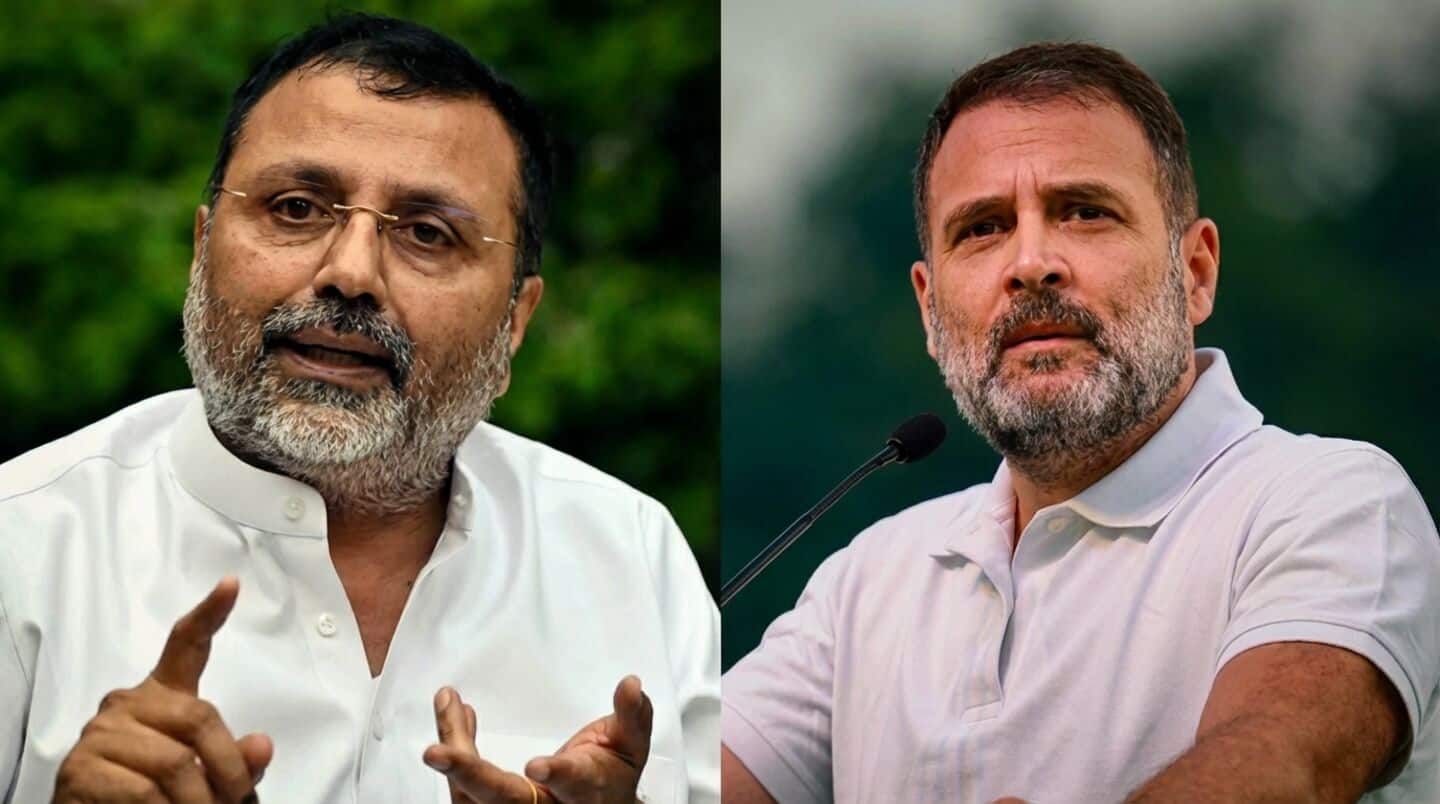
BJP MP Nishikant Dubey moves substantive motion against Rahul Gandhi
What's the story
Bharatiya Janata Party (BJP) MP Nishikant Dubey has moved a "substantive motion" against Congress leader Rahul Gandhi in the Lok Sabha. The motion seeks to cancel Gandhi's membership and impose a lifetime ban on him from contesting elections for life, India Today reported. Dubey's notice alleges that Gandhi has been visiting countries like Thailand, Cambodia, and Vietnam in collaboration with the Soros Foundation, USAID, and Ford Foundation while "colluding" with anti-India forces.
Motion dropped
Government withdraws privilege motion against Gandhi
In light of Dubey's motion, the central government has decided to withdraw a privilege motion against Gandhi for using unparliamentary language against Prime Minister Narendra Modi.
Union Minister Kiren Rijiju said the Lok Sabha Speaker will decide whether to refer Dubey's substantive motion to the House privilege panel, ethics committee, or place it directly before the Lower House.
Parliamentarians who have faced substantive motions include Trinamool Congress MP Mahua Moitra, expelled over a cash-for-query scam in 2023.
Motion explained
What is a substantive motion?
A substantive motion is a formal proposal in the House, seeking approval for a specific decision or opinion.
It can be used to call for an inquiry into allegations against a member.
If admitted and passed by the House, it may lead to the formation of a committee by the Lok Sabha Speaker to investigate allegations.
The committee would have a set time frame to submit its report for further consideration by the House.
Motion comparison
Parliamentary privileges and breaches
Parliamentary privileges are rights and immunities of MPs to effectively perform their functions.
Breaches of these privileges can lead to legal action under parliamentary law.
A notice is moved as a motion against those found guilty of breaching privilege.
Each House also has the authority to punish actions that, while not specific breaches of privilege, are offenses against its authority and dignity.
Historical precedents
Expulsion cases from Lok Sabha and Rajya Sabha
There have been several cases of substantive motions in the past.
In 2005, at least 10 Lok Sabha members were expelled over a cash-for-questions scandal.
In another instance, MP Babubhai K Katara was expelled for illegally taking people overseas in 2008.
Meanwhile, the removal motion against Justice Soumitra Sen was taken up by the Rajya Sabha on August 17, 2011, after an inquiry committee found him guilty of misappropriation of money.