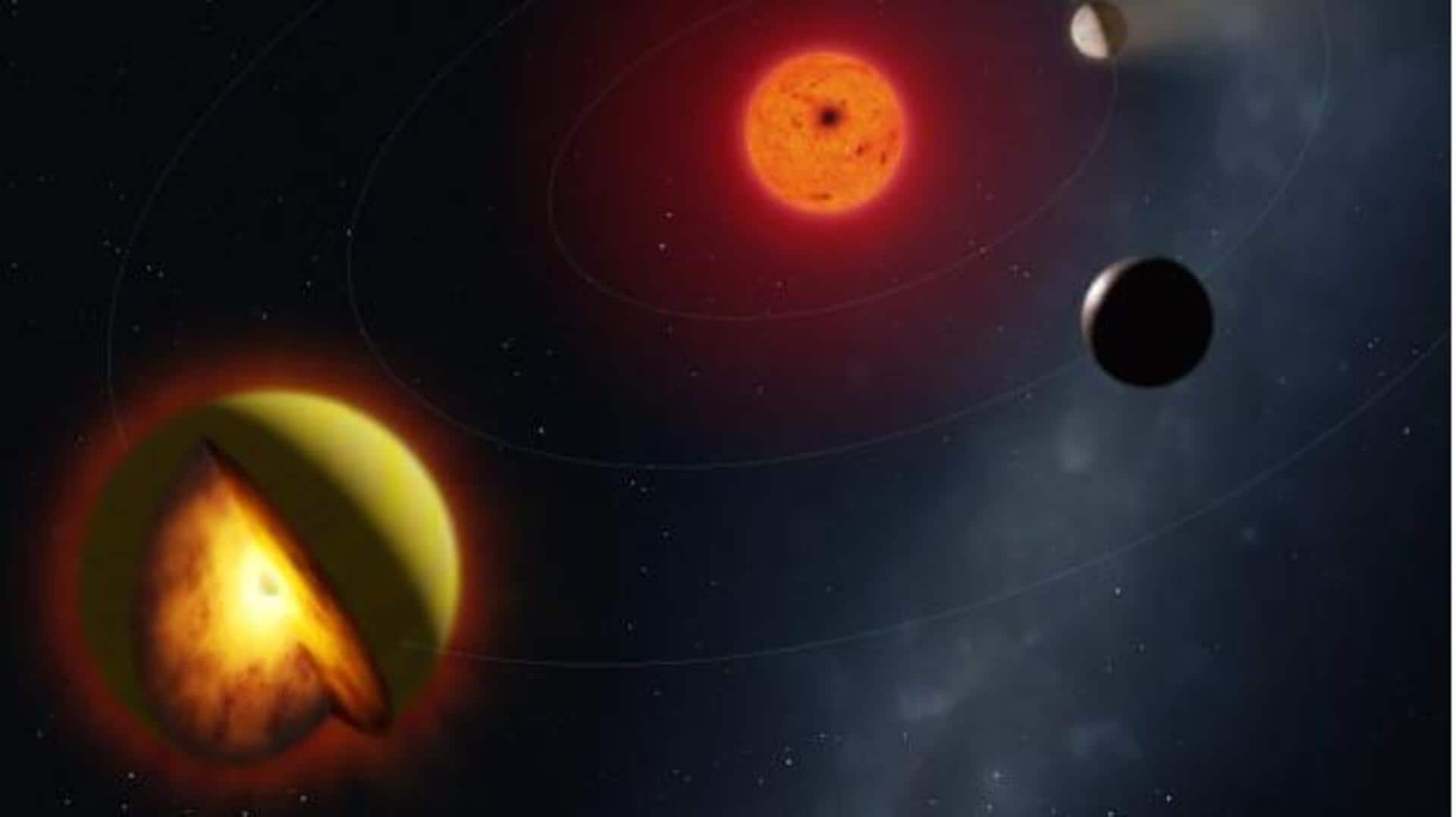
This planet, 35 light-years away, is made of molten lava
What's the story
Astronomers have discovered a planet composed of molten lava, suggesting the existence of a new type of liquid planet. The distant world, dubbed L98-59d, is located some 35 light-years away from Earth and is about 1.6 times bigger than our home planet. It orbits a small red star and was previously thought to be hiding a vast ocean of liquid water beneath its surface. However, recent observations show that it could be very different from anything we've seen before.
Planetary conditions
A mushy, molten world
Dr. Harrison Nicholls, an astrophysicist at the University of Oxford, described L98-59d as being in a "mushy, molten state."
He compared its surface to "molasses" and suggested that the planet's core is likely also molten.
The temperatures on this planet would be extremely high at around 1,900 degree Celsius, making it inhospitable for life as we know it.
Atmospheric composition
It has a rotten egg smell
The atmosphere of L98-59d is rich in hydrogen sulfide, giving it a distinct rotten egg smell. This further adds to the inhospitable conditions for life on this planet.
Dr. Nicholls said, "If there are aliens out there that could live in lava that would be amazing, but I don't think it's likely that it's habitable."
He added, "It's nice to revel in the alienness of the planet itself."
Planetary evolution
A global magma ocean is available
L98-59d's sulfur-rich atmosphere was previously thought to be incompatible with it being a rocky or water world.
These two conventional categories would not have been able to sustain a sulfur atmosphere for the nearly five billion years the planet has existed.
Advanced computer simulations of the planet's history indicate that L98-59d has a global magma ocean thousands of kilometers beneath its surface.
Exoplanet diversity
Reclassifying exoplanets
The discovery of L98-59d suggests that molten planets could be more common than previously thought, prompting astronomers to reconsider how they classify exoplanets.
Dr. Nicholls said, "Some planets in the so-called habitable zone might not be very habitable at all; they might be these molten planets."
He added that while this molten planet is unlikely to support life, it represents the wide variety of worlds beyond our solar system.