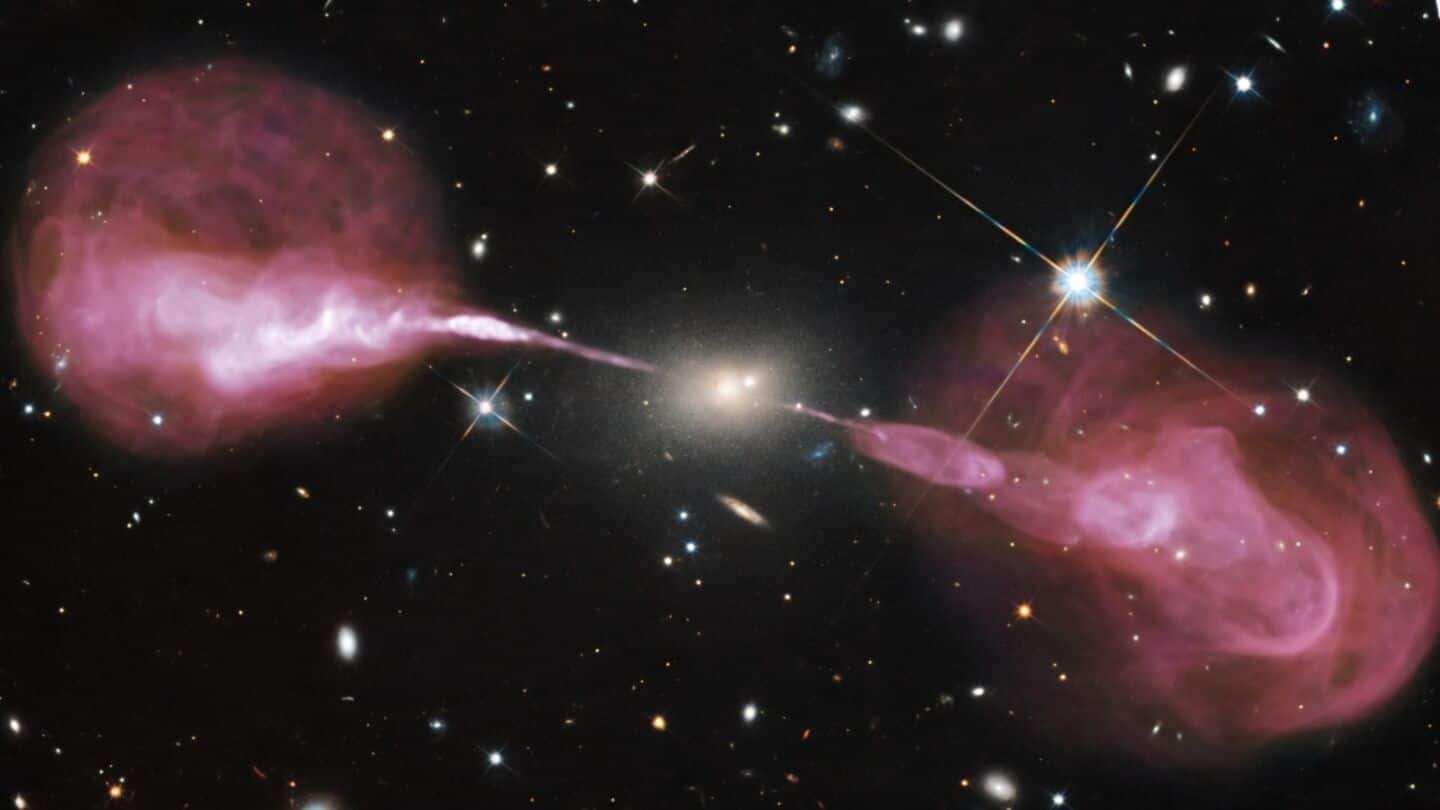
This is what happens when supermassive black holes turn off
What's the story
Astronomers have discovered a hitherto unseen population of "radio galaxies" with fading "radio lobes." The finding sheds light on the behavior of supermassive black holes that power these massive outflows of plasma. The research team examined 14 candidates for faded or remnant radio galaxies in the XMM-Newton Large-Scale Structure (XMM-LSS) field, an area extensively studied by the XMM-Newton X-ray spacecraft.
Cosmic phenomena
Understanding radio and remnant radio galaxies
Radio galaxies are known for their intense radio wave emissions and massive gas lobes extending millions of light-years.
Remnant radio galaxies mark the final phase in this cycle, when jets from active galactic nuclei (AGNs) powered by supermassive black holes cease.
As a result, these jets can no longer replenish the huge radio lobes, leading to their gradual fading over time.
Research methods
Observational tools used in the study
The research team employed the MeerKAT radio telescope, a 64-antenna array in the desert-like region of the Northern Cape, South Africa, along with the Jansky Very Large Array and the Low-Frequency Array (LOFAR) network.
This combination of advanced observational tools helped them study how radio emissions from these cosmic structures change as their constituent particles "age" and lose energy over time.
Research outcomes
Average fade age of about 12 million years
The study found that 12 of the 14 candidates were indeed remnant radio galaxies, while two were still active.
The ages of these remnants ranged from eight million to 42 million years, with an average "fade age" of about 12 million years.
This suggests astronomers may have overlooked a population of short-lived remnants in their observations.
Cosmic evolution
Findings enhance understanding of life cycles of radio galaxies
The study also revealed that the radio galaxy remnants studied exist in a wide range of evolutionary stages.
Some have just recently switched off their jets, while others are more evolved and have "powered down" long ago.
These findings significantly enhance our understanding of the life cycles of radio galaxies and how supermassive black holes act as engines powering jets that drive these vast cosmic structures.