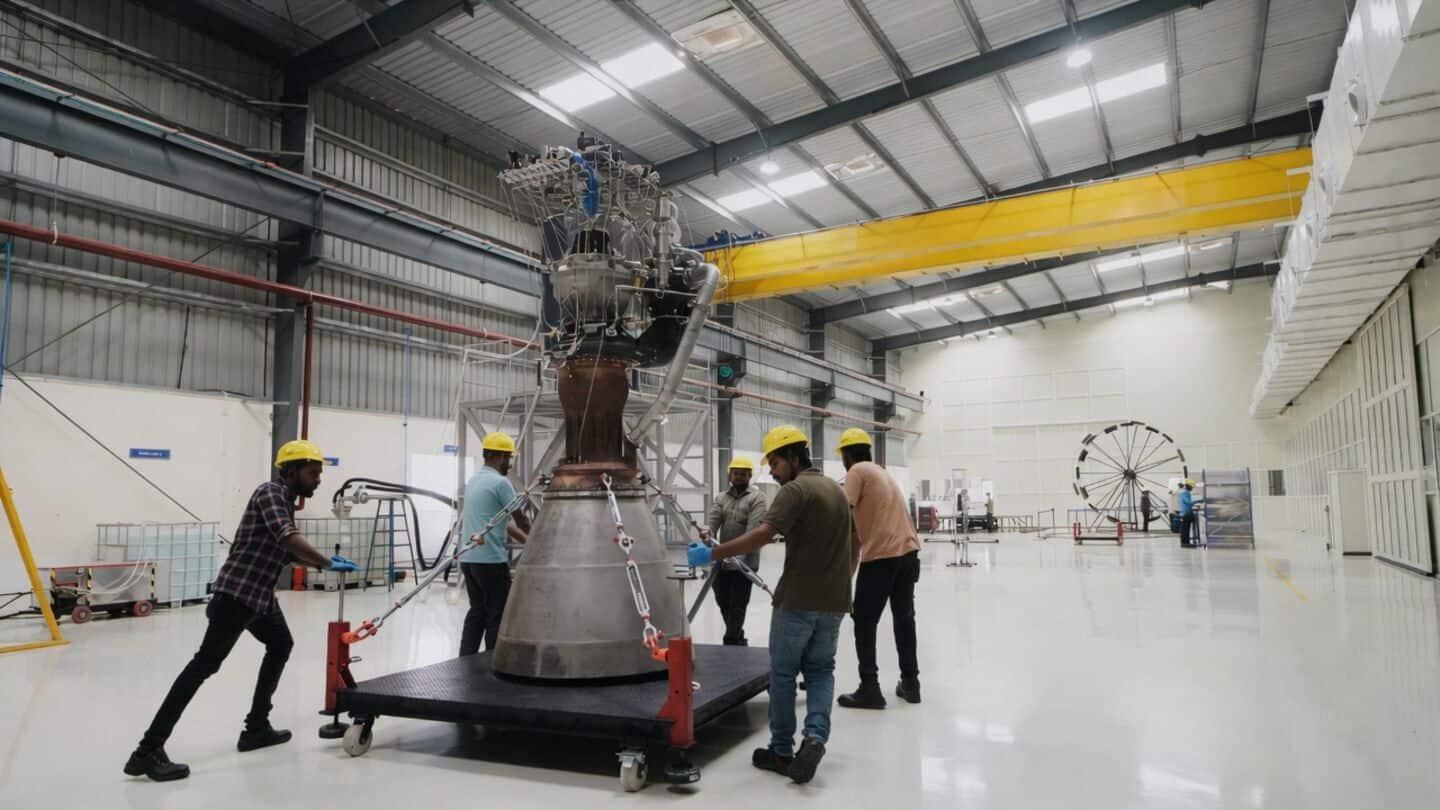
Bengaluru start-up unveils SpaceX-like rocket engine 'Everest'
What's the story
Bengaluru-based start-up Astrobase Space Technologies has unveiled Everest, India's first fully integrated and ready-to-test full-flow staged combustion (FFSC) rocket engine. The 80-ton-class engine uses liquid oxygen and liquid methane, also known as methalox. It is designed to generate around 800 kilonewtons of thrust in the vacuum of space, which is roughly equivalent to lifting 80 tons.
Engine features
How does full-flow staged combustion work?
Everest's full-flow staged combustion design is a highly advanced technique, similar to those used in SpaceX's Starship engines.
In this system, both fuel and oxygen are partially burned in separate pre-burners before entering the main combustion chamber.
This feature allows the engine to run efficiently at high pressure while minimizing stress on certain components.
Testing timeline
Astrobase has already tested smaller versions of the technology
Astrobase has already tested smaller versions of the FFSC technology. A scaled-down engine was successfully fired in September 2025, while high-speed propellant pumps were tested earlier this year.
The company plans to conduct its first full-scale hot-fire test in the coming months at its private facility in Andhra Pradesh.
If successful, Everest could be a major leap toward integrating advanced, reusable rocket tech into India's growing private space sector.
Future plans
Everest is designed to throttle its thrust
Founded in 2024 by Neeraj Khandelwal and Devakumar Thammisetty, Astrobase has set up its design and assembly facilities in Bengaluru.
The company also has a 21.5-acre test site near Anantapur for high-thrust cryogenic engines.
Everest is designed to throttle its thrust, an important capability for controlled rocket landings.
Astrobase plans to use multiple Everest engines on a medium-lift rocket to launch satellites into low Earth orbit and recover its first stage for reuse.