Biggest solar storm in decades hits Mars
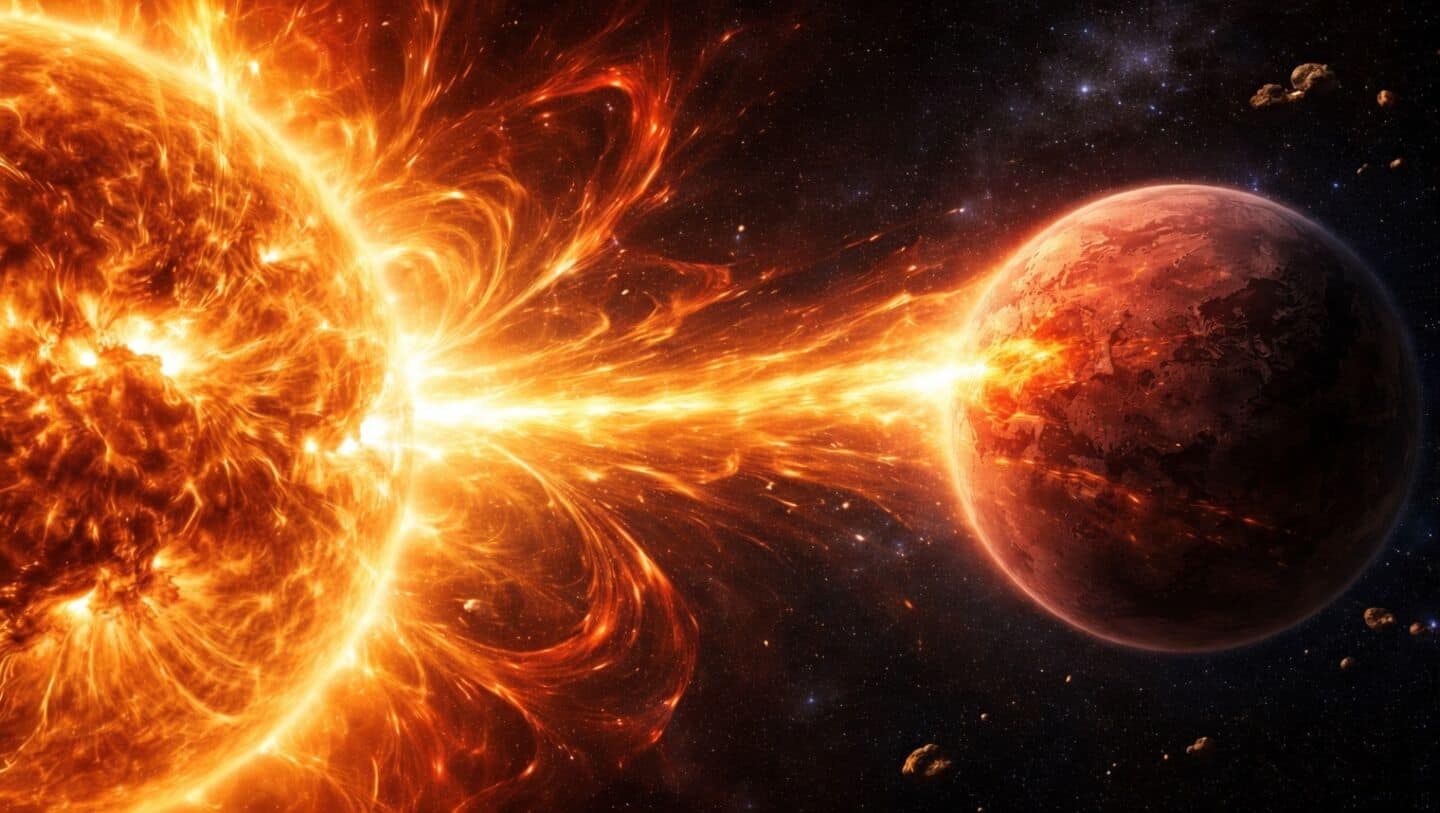
In May 2024, a powerful solar storm that was the biggest recorded on Earth in over 20 years also struck Mars, producing an unusually large response in the Martian atmosphere.
The blast caused computer glitches on ESA's Mars Express and ExoMars Trace Gas Orbiter (TGO), as radiation levels spiked to what they'd normally get in 200 days, just in under 3 days.
Scientists also saw record surges of electrons high up in the Martian atmosphere.
How did scientists map changes?
Luckily, both orbiters recovered quickly thanks to their tough electronics and smart error-fixing systems.
Scientists used a cool trick called radio occultation, basically sending signals between the orbiters as one ducked behind Mars, to map changes in the atmosphere just minutes after the storm hit.
NASA's MAVEN probe backed up these findings.
Impact on future Mars missions
Unlike Earth, Mars doesn't have a big magnetic shield to block space weather, so storms like this can mess with spacecraft and future astronaut plans.
It's a reminder that exploring Mars means planning for some wild space weather!