Boston Dynamics' robot gets AI reasoning skills for factory inspections
What's the story
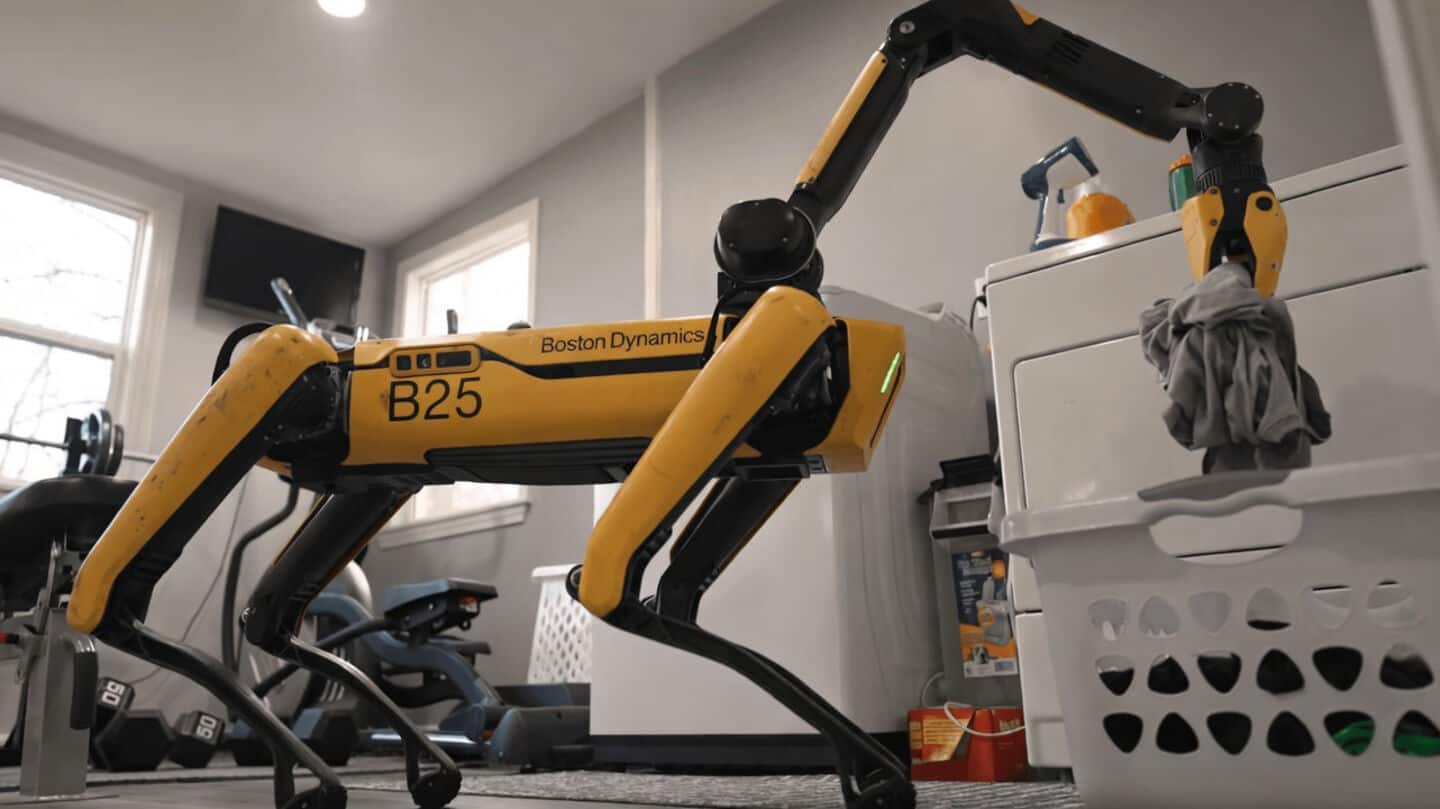
Boston Dynamics has announced an upgrade to its quadruped robot, Spot. The company has integrated Google DeepMind's Gemini Robotics-ER 1.6 into the bot. This high-level embodied reasoning model improves Spot's usability and intelligence for complex tasks. The partnership mainly focuses on industrial inspection, a commercially viable application where legged robots have proven their worth.
Enhanced functionality
Spot can now autonomously look for hazardous debris or spills
With the integration of Gemini Robotics-ER 1.6, Spot can now autonomously look for hazardous debris or spills, read complex gages and sight glasses.
The bot can also call on tools like vision-language-action models when it needs help understanding its environment.
The upgrade marks a significant step toward robots that can better understand and operate in the physical world, according to Marco da Silva, VP and GM of Spot at Boston Dynamics.
AI interpretation
What does 'understanding' and 'reasoning' mean in robotics?
The terms "reasoning" and "understanding" are often used in the context of AI and robotics. However, their practical implications for robots aren't always clear.
Carolina Parada, head of robotics at Google DeepMind, explained that the benchmark for understanding is if a system answers like a human would.
This connection between human-like understanding and task execution is vital to ensure reliable and safe performance from robots.
Safety measures
Gemini Robotics-ER 1.6 approaches situations from a safety perspective
Parada said Gemini Robotics-ER 1.6 approaches situations from a safety perspective, ensuring robots don't perform risky actions.
The current version of Spot doesn't use these semantic safety models for manipulation but future versions will be designed to reason about holding objects safely.
This is a major step toward making robots more reliable and safe in their interactions with the physical world.
Training hurdles
Training models with physical data is a challenge
One major issue in robotics is how to train models when physical data is needed.
Parada explained that the current models are strictly vision-based due to lack of touch information on the internet.
Customers using these new capabilities for Spot's inspection will have to share their data with Boston Dynamics, which could help address this problem by providing more diverse training datasets.