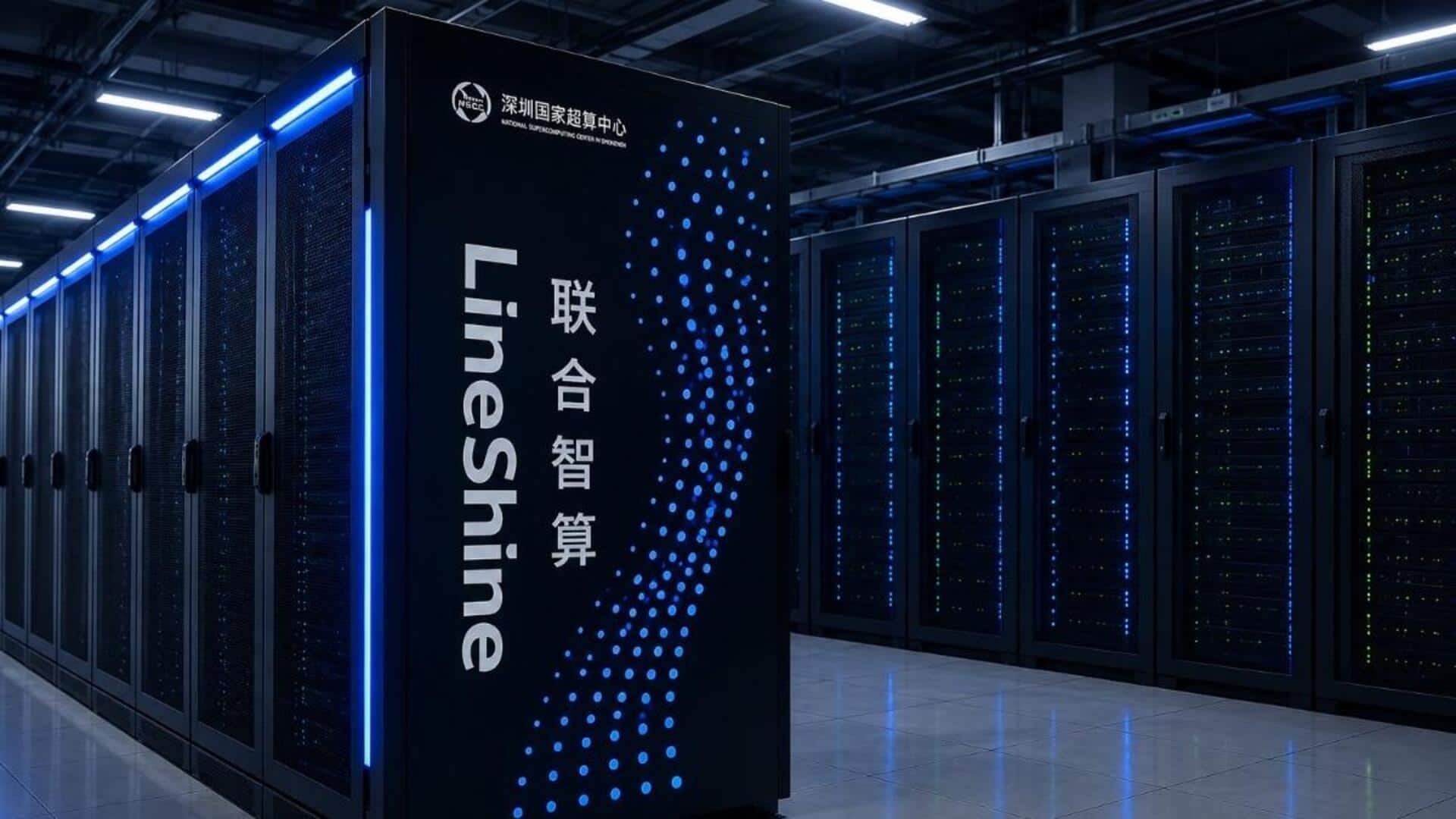
China's LineShine becomes world's fastest supercomputer
What's the story
China's LineShine supercomputer has been officially recognized as the world's fastest machine, surpassing its US counterpart, El Capitan. The ranking was released by Top500, a project that ranks the 500 most powerful supercomputers in the world. This is China's first time at the top since 2017 and marks a major shift in global tech dominance.
Technological edge
LineShine's unique design and performance
Unlike most high-performance computers that use a combination of CPUs and GPUs, China's LineShine uses only standard microprocessors.
The system integrates GPU-like capabilities directly into its processors through dedicated circuitry designed to speed up complex matrix and vector computations.
This unique design allowed LineShine to achieve an impressive performance of 2.198 exaflops, or more than two quintillion calculations per second.
Chip innovation
LineShine is powered by custom chips
LineShine is powered by custom chips that house nearly 14 million processing cores, tiny computational units often referred to as the "brains" of a computer.
These chips are spread across 90 hardware cabinets, making it one of the most powerful computing systems ever built.
The processors are based on an in-house design that uses an instruction set licensed from Arm Holdings, a British semiconductor company owned by Japan's SoftBank Group.
Global acclaim
Details about the project are scarce
Despite the high-profile nature of the project, many details remain unknown. The team behind LineShine has not disclosed which company manufactured the chips or what semiconductor process technology was used to make them.
However, they have sought international recognition through the Gordon Bell Prize, a prestigious award in high-performance computing.
The researchers associated with LineShine have submitted 14 entries for this prize, with three making it as finalists.
Tech race
Implications for US-China tech rivalry
The emergence of LineShine as the world's fastest supercomputer is likely to intensify the competition between China and the US for technological supremacy.
While US tech giants have developed leading AI models, China's apparent reliance on standard CPUs instead of GPUs to build a high-performance supercomputer could be a workaround to those constraints.
The export restrictions imposed by the US on advanced GPUs and semiconductor manufacturing technology seem to have accelerated China's pursuit of home-grown innovations.