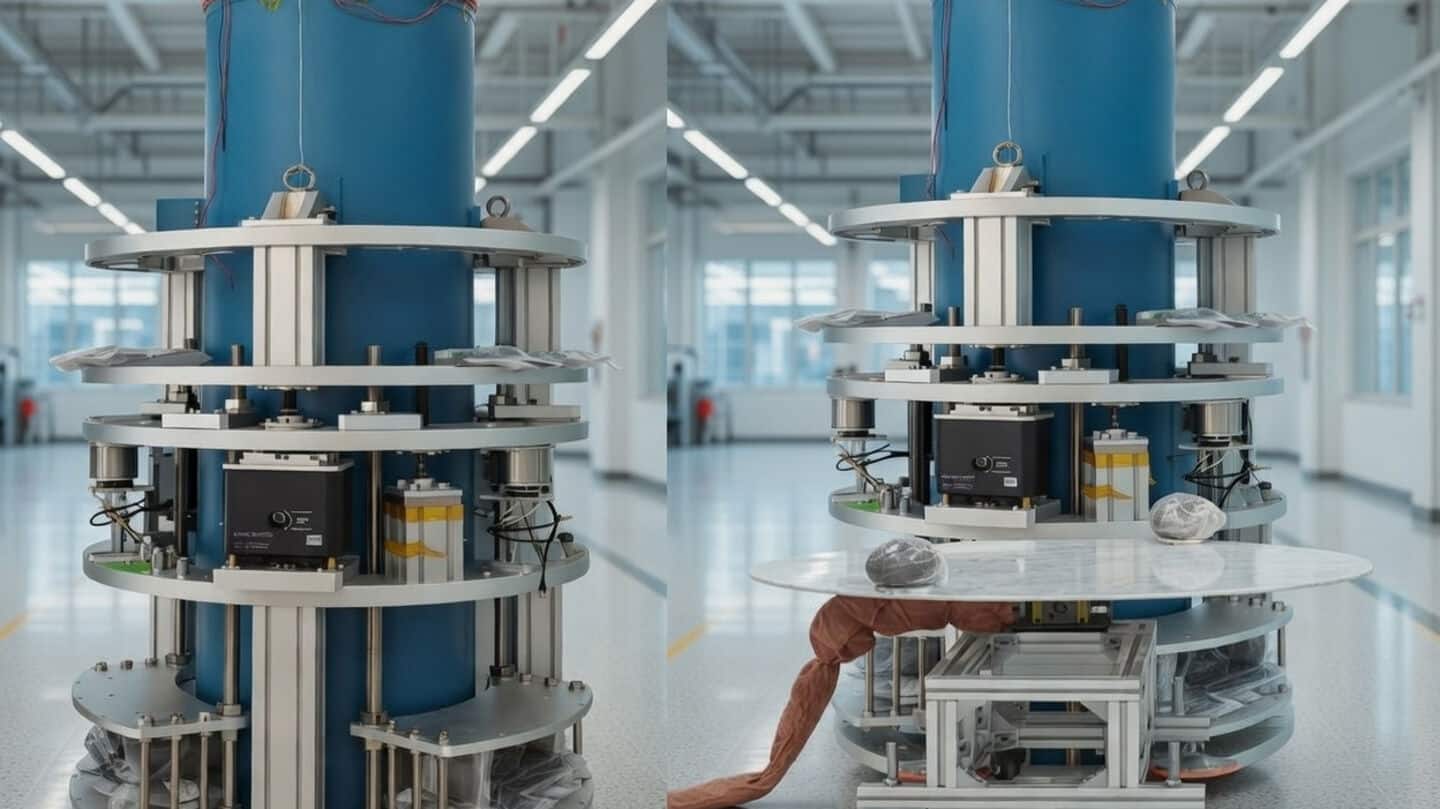
China's new gravity detector could help locate enemy nuclear submarines
What's the story
Chinese researchers have developed a highly advanced gravity detector, which uses a superconducting quantum interference device (SQUID) to detect objects by measuring minute changes in gravitational forces. The team behind the instrument claims it can be used for scientific research and locating underground resources. However, its most significant application could be in tracking patrolling nuclear submarines, bringing China closer to this military capability.
Technological advancement
The new instrument minimizes measurement noise
The new gravity detector minimizes measurement noise, which are external factors that can interfere with a gravity detector's precision, like seismic activity vibrations.
The instrument's performance is only second to kilometer-scale gravitational wave detectors.
This makes it more accurate than existing submarine detection methods such as sonar, magnetic anomaly detection, and radar.
Size comparison
Size difference between China's detector and US's model
The new instrument is about the size of an office cubicle, making it much smaller than US gravitational wave detectors like the Laser Interferometer Gravitational-Wave Observatory.
The latter uses mirrors spaced 4km apart to study cosmic phenomena.
This size difference further highlights the advanced technology behind China's new gravity detector and its potential military applications.