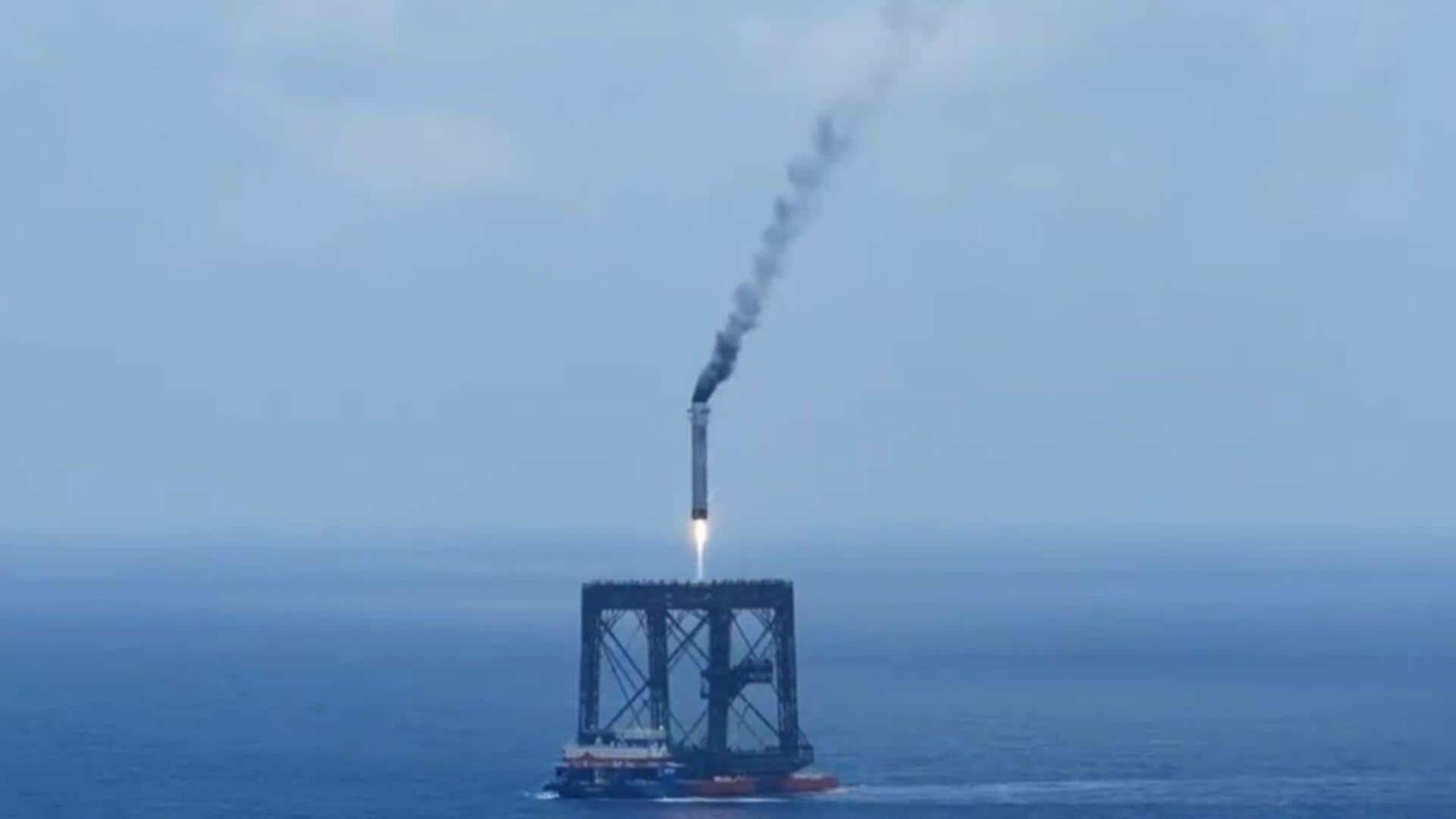
China successfully lands reusable rocket for first time
What's the story
China has successfully tested an experimental rocket retrieval system, using a net attached to a sea platform. The test was conducted with the Long March 10B rocket, which lifted off from Hainan commercial space launch site in southern China. About six minutes after the separation of its booster and upper stage, the booster returned vertically and was recovered on an offshore platform.
Rocket comparison
Long March 10B compared to SpaceX's Falcon 9
The Long March 10B, which can carry a payload of at least 16 metric tons to low-Earth orbit, has been compared to SpaceX's Falcon 9.
However, unlike the Falcon 9 that lands on deployable legs on a ground pad or drone ship, the Long March 10B uses "landing hooks" to catch the net attached to a sea platform.
Technological advancement
Significant step toward developing reusable rockets
China has been working on reusable rocket technologies for nearly a decade, from low-altitude hover tests to orbital-class booster recovery attempts.
The successful test of the Long March 10B brings the country one step closer to developing reusable rockets.
This system could significantly reduce launch costs for China's rapidly expanding commercial satellite constellations.
Market response
Private Chinese companies ramping up efforts
Private Chinese companies are also ramping up efforts to test their reusable rockets amid fierce global competition for the technology.
In a bid to support these companies, China has relaxed IPO rules for those developing reusable rockets, allowing them to raise funds more easily.
Following the news of China's successful test, shares in Chinese aerospace firms soared with China Spacesat and China Satellite Communications hitting their daily limits.
Lunar mission
Broader implications for China's lunar program
The Long March 10B is also part of the Long March 10 family, which is being developed for China's crewed lunar missions before 2030.
The successful retrieval system test could provide data and validate technologies relevant to this broader lunar program.
China plans to reuse the booster stage of the Long March 10 for another launch by the end of this year, state media reported.