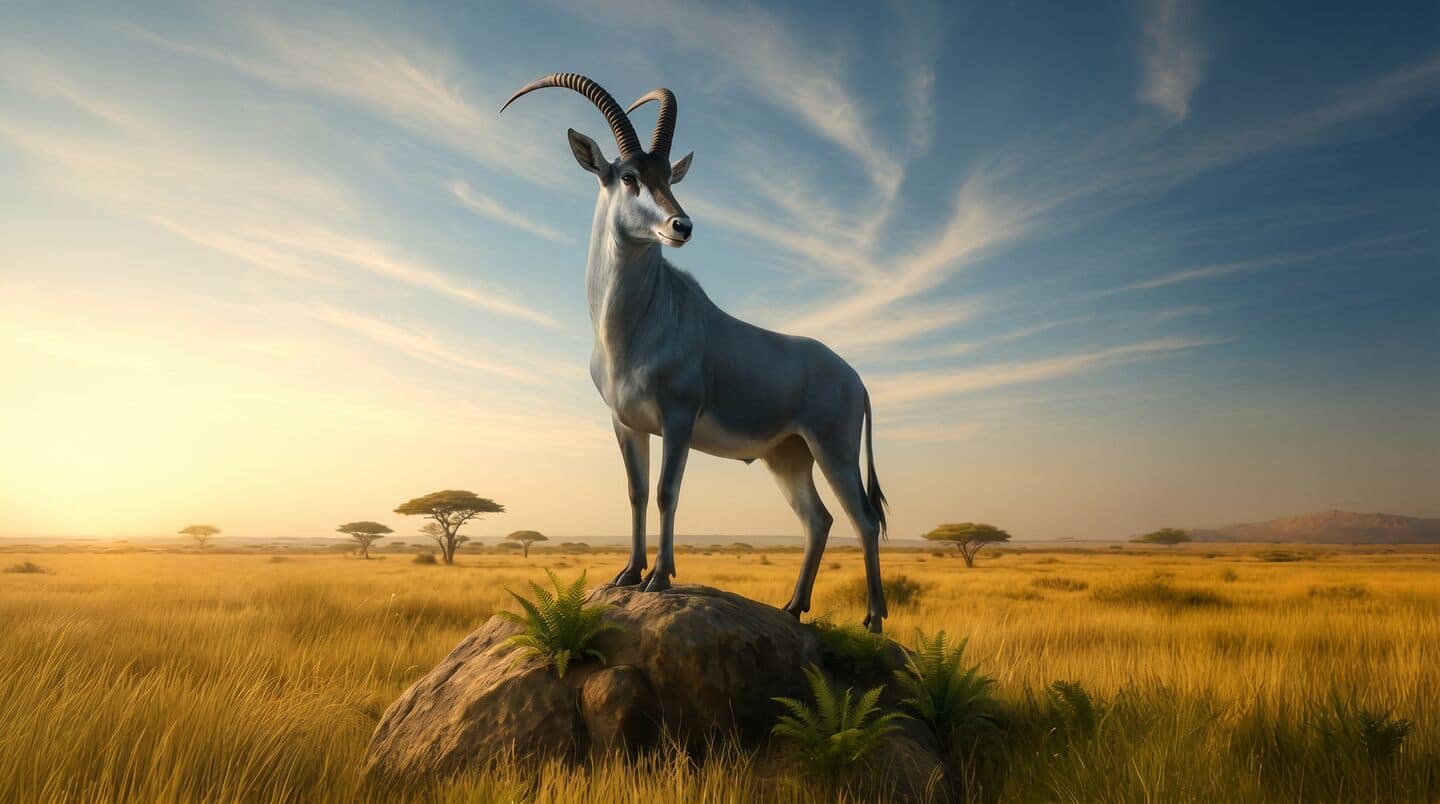
This company wants to revive animal extinct for 200 years
What's the story
Colossal Biosciences, the company that brought us a genetically engineered dire wolf, is now looking to revive Africa's extinct species. The Dallas-based firm has announced its plan to bring back the bluebuck, a stunning antelope that went extinct nearly 200 years ago. "This is a clear example of an extinction that is our fault, and that we have the technology now, and can develop the technology within the next several years, to reverse," said Beth Shapiro, Colossal's chief science officer.
Extinction details
The bluebuck went extinct in the early 19th century
The bluebuck, or blue antelope, was native to Southern Africa and is the only large African mammal species to have gone extinct in recorded history.
Its extinction was swift, often blamed on colonial-era hunting, habitat loss, and competition with livestock for grazing land.
Colossal Biosciences started working on this project in 2024 by analyzing DNA from a bluebuck specimen at the Swedish Museum of Natural History.
Genetic manipulation
Colossal has identified genetic variants that determine key physical traits
Colossal Biosciences has identified the genetic variants that determine key physical traits of the bluebuck, such as its blue-gray coat, white facial markings, and long curved horns.
The company found that sable and roan antelopes are the closest genetic relatives of the bluebuck.
It is now using roan antelope DNA as a cellular surrogate to make it more like the bluebuck—a process that is currently underway.
Reproductive strategy
A roan will be used as a surrogate mother
Colossal Biosciences plans to use a roan antelope as a surrogate mother for the lab-grown embryo.
The company has already secured a roan for this purpose, with a gestation period of nine months.
Although the bluebuck will require more gene editing than the dire wolf, it is expected to be born in "the coming years," not decades, according to CEO Ben Lamm.
Conservation advancements
Colossal has made significant strides in antelope conservation
Colossal Biosciences has made significant strides in antelope conservation, including the successful ovum pickup of roan antelope and the creation of induced pluripotent stem cells (iPSCs) from roan.
These are world firsts for roan antelopes, according to the company.
"We've made enough progress in technologies that can be now immediately applied," Lamm said, adding they would gladly share protocols used to create these iPSCs with interested parties.
Project criticism
Critics question conservation priority of such projects
Despite the scientific interest, some critics question the conservation priority of such projects.
Dr. David Mallon, a visiting professor at Manchester Metropolitan University, said "I think there's a question of how much of this would be seen as a conservation priority, and I think the answer is 'not a lot.'"
He added that while it's an interesting scientific experiment, there are far higher conservation priorities to be solved with limited resources.